

Turning the Page: Tools change. The mission remains
>> Writes: Bilal Mpembamoto
There are moments in an institution’s history that feel bigger than the event itself. The room may be modest. The ceremony may be brief. There may be no grand stage or elaborate procession. Yet, sometimes, a simple act—one person handing over the tools of leadership to another—carries the weight of an entire institution’s history.
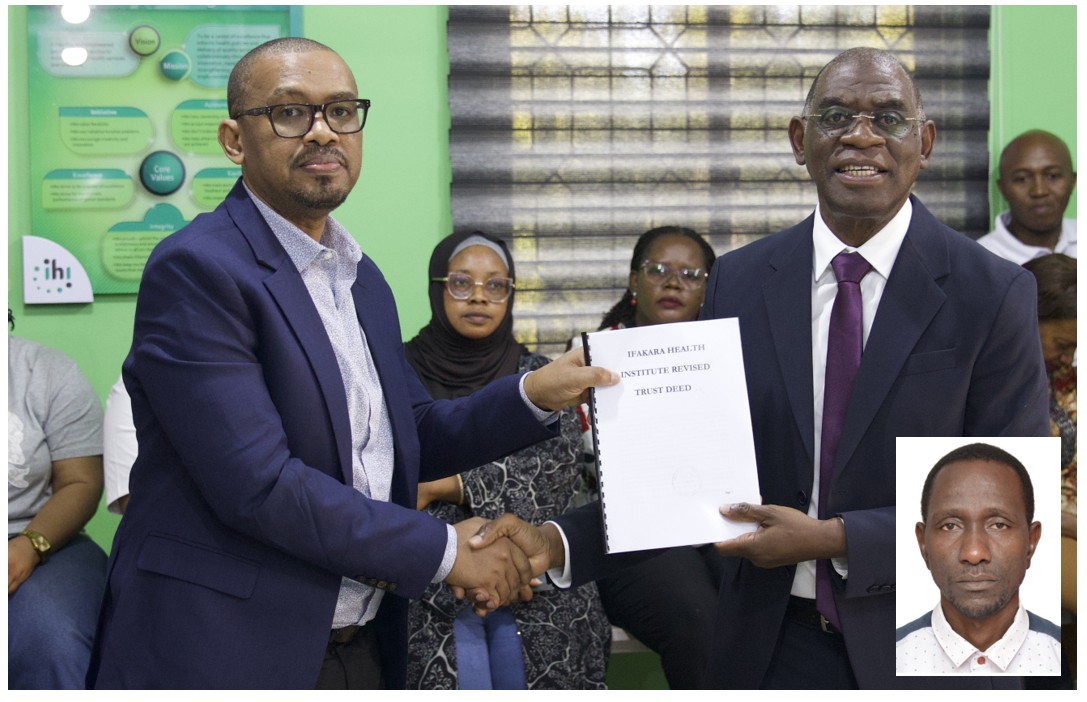
At Ifakara Health Institute, one such moment unfolded on August 28, 2026.
After a decade at the helm, Dr. Honorati Masanja handed over the leadership of Ifakara to Dr. Ally Olotu, bringing to a close a ten-year chapter and opening another one.
It was more than a change of office.
It was the turning of a page.
And fittingly, it happened in the same year that Ifakara is celebrating 70 years of scientific excellence and public health impact—a milestone that has invited the Institute to look back at where it came from, while asking an equally important question: Where do we go from here?
Naitwa Masanja
I still remember the first time I met Dr. Honorati Masanja.
It was during my interview for the position I hold today as Head of Communications at Ifakara.
I expected the usual formality that comes with an interview for a senior position. Instead, the man sitting before me simply introduced himself: “Naitwa Masanja,” leterally, “I’m Masanja.”
That was it.
No elaborate introduction. No list of achievements.
Just “Naitwa Masanja.”
Looking back now, that simple introduction feels symbolic of the person I would come to know over the years: accomplished, understated and often more interested in the work than in talking about himself.
When I eventually joined Ifakara, our work together quickly moved beyond the interview room.
One of the major tasks ahead was to build the Institute’s communications function and strategy from the ground up—to think about how a research institution with decades of scientific history could communicate its work more deliberately, consistently and effectively to staff, partners, policymakers, the media and the public.
That journey became part of a much larger transformation taking place at Ifakara.
A decade of building the bridge between science and the world
Dr. Masanja’s decade as Chief Executive Director began in 2016. But his relationship with Ifakara goes much further back.
He joined the Institute in 1992 and has spent more than three decades contributing to its scientific and institutional development. A statistician and epidemiologist by training, he holds a PhD in Epidemiology from the Swiss Tropical and Public Health Institute, University of Basel. His work has included data management, clinical trials, and the design and evaluation of major maternal and child health programmes.
Long before becoming CED, he was involved in the establishment of the Rufiji Health and Demographic Surveillance System and later served as Principal Investigator of the SAVVY project, contributing to Tanzania’s efforts to strengthen evidence-based health planning and evaluation. He also contributed to the development of the District Health Accounts tool, which became part of Tanzania’s health planning and reporting architecture.
But leadership is not measured only in scientific publications or projects.
Institutions also evolve through the systems people build around science.
And one of the transformations witnessed during Dr. Masanja’s leadership has been the Institute’s movement from largely paper-based processes towards increasingly digital ways of working—across financial systems, data management, scientific information and internal and external communication.
For those of us working in communications, the transformation was particularly visible.
The challenge was no longer simply to communicate what Ifakara was doing.
It was to make the organisation findable, visible, understandable and connected in an increasingly digital world.
Web platforms, digital publications, social media, multimedia storytelling and more structured internal communication became increasingly important parts of how Ifakara presented itself to the world.
The transformation was not completed by one person, nor did it happen overnight.
But it happened during a decade in which the Institute was being pushed to think differently about how a modern African research institution should work, communicate and position itself.
And that is part of Dr. Masanja’s legacy.
The scientist who became the institution’s storyteller
Over the years, I saw another side of Dr. Masanja.
A scientist who could step away from technical language and explain why research mattered.
A leader who understood that evidence sitting inside a scientific paper could not create its full impact if policymakers, communities, journalists and the wider public could not understand it.
His own scientific journey reflects that connection between evidence and public health action. He has published extensively and has contributed to national technical platforms, including Tanzania’s eHealth and monitoring and evaluation structures. He has also trained and supervised generations of postgraduate researchers.
His leadership therefore leaves behind more than projects and systems.
It leaves behind people.
It leaves behind partnerships.
It leaves behind institutional memory.
And, perhaps most importantly, it leaves behind a stronger platform upon which the next generation can build.
Three branches. One farewell
As Dr. Masanja prepared to leave office, Ifakara did not mark the moment with a single farewell.
Instead, the Institute took the farewell to its people.
Three events were held across its major locations: Ifakara on August 21, Bagamoyo on August 26, and Dar es Salaam on August 28.
They were not simply farewell gatherings.
They became moments of remembrance.
Staff reflected on ten years of leadership. Colleagues shared memories. There was laughter, appreciation and, inevitably, a sense that something significant was coming to an end.
At each occasion, Dr. Masanja briefly addressed staff.
These were, in many ways, his final words to the people with whom he had shared a remarkable chapter of Ifakara’s story.
Not a dramatic goodbye.
More a quiet sign-off.
A leader leaving the institution in the hands of another.
Olotu: a son of Ifakara returns to the helm
If Dr. Masanja’s story is one of institutional transformation, Dr. Ally Olotu’s story is one of institutional continuity.
I first encountered Dr. Olotu at a scientific meeting, shortly after he returned from his assignment in Kenya.
Since then, our paths have crossed repeatedly—in media calls, recorded interviews, live media discussions, scientific engagements and countless conversations around how to communicate research to the public.
What has always stood out is his ability to move comfortably between two worlds: science and communication.
He can discuss complex public health research with scientists and then engage a journalist in a way that makes the same subject accessible to a wider audience.
That quality will matter.
Because leading a modern research institution is not only about producing excellent science.
It is also about making that science count.
From malaria research to institutional leadership
Dr. Olotu brings substantial scientific credentials to the new role.
He is a medical doctor, having earned his MD from the University of Dar es Salaam, and holds a DPhil from the University of Oxford, where his research focused on malaria vaccines. His scientific career has centred on infectious disease epidemiology, malaria, immunology, vaccines and clinical trials.
His work has contributed to understanding malaria vaccine efficacy, immune correlates of protection and the safety and immunogenicity of vaccine candidates. He has led clinical research involving next-generation malaria vaccines and continues to contribute to research aimed at evaluating interventions in endemic populations.
His career has also taken him beyond Tanzania.
He worked as a research clinician with the KEMRI-Wellcome Trust Research Programme in Kenya and received a WHO/TDR Career Development Fellowship in malaria vaccine development, including training at GSK Biologicals in Belgium. His work has subsequently spanned clinical trials and vaccine research across Africa and international partnerships.
At Ifakara, he rose through the ranks.
He served for years as Head of the Interventions and Clinical Trials Department at the Bagamoyo Clinical Trials Facility before becoming Director of Science in 2023. His appointment as Director of Science followed a competitive selection process involving candidates from within and outside the organisation.
Now, he takes the biggest leadership role of his career.
The 13th director—and the fifth Tanzanian
There is something historically significant about Dr. Olotu’s appointment.
He becomes the 13th director in Ifakara’s 70-year history and the fifth Tanzanian to lead the institution.
The leadership journey began with Swiss scientist and founder Prof. Rudolf Geigy, who established the Swiss Tropical Institute Field Laboratory in Ifakara in 1956 following his earlier expeditions to the area.
He was followed through the years by leaders including Gerhard Eichenberger, Adrian Zumstein, Marcel Tanner, Don de Savigny, Christoph Hatz, Calum MacPherson and Thomas Teuscher.
Then came a defining chapter in the Institute’s Tanzanian leadership.
Dr. Andrew Kitua became the first Tanzanian scientific director in 1993, followed by Dr. Hassan Mshinda, Dr. Salim Abdulla, and then Dr. Honorati Masanja.
Now comes Dr. Ally Olotu.
Five Tanzanians.
One continuing institutional story.
And, in a remarkable twist, the next chapter is being entrusted to someone who has grown within the very institution he is now being asked to lead – effective September 1, 2026.
From learning in Ifakara’s corridors to leading them
Dr. Olotu joined Ifakara in 2011 as a young scientist.
Over the years, the Institute became more than a workplace.
It became a place where he conducted research, led teams, mentored colleagues, managed scientific programmes and learned the complexities of building and sustaining public health research in Tanzania.
In his own reflection on the appointment, he described Ifakara as having been his training ground, mentor and home—and recognised that taking the CED role is both an honour and a profound responsibility.
That history matters.
Because Olotu does not inherit an institution he needs to discover.
He inherits one he already knows.
He knows its science.
He knows its people.
He knows its partners.
He knows its laboratories and field sites.
He knows its opportunities—and its challenges.
And perhaps most importantly, he understands the culture of scientific excellence that has made Ifakara what it is.
From 70 years behind us to 70 years ahead
The timing could hardly be more symbolic.
In 2026, Ifakara is celebrating 70 years of impact—seven decades of research, innovation, capacity strengthening and contributions to public health in Tanzania, Africa and beyond.
Dr. Masanja leaves office at the end of that historic seven-decade chapter.
Dr. Olotu arrives at the beginning of what could become another.
That does not mean starting again.
It means building forward.
The next 70 years will demand new ways of doing research, new technologies, stronger partnerships and greater ability to translate evidence into policy and action.
It will require Ifakara to remain scientifically ambitious while staying deeply connected to the communities whose lives its research ultimately seeks to improve.
And it will require leadership that can see beyond the next project, the next grant or the next publication.
Dr. Olotu’s appointment signals an opportunity to do exactly that.
The tools change. The mission remains
On August 28, as Dr. Masanja handed over the leadership tools to Dr. Olotu in a brief ceremony witnessed by staff, the symbolism was unmistakable.
One set of hands released.
Another received.
One chapter closed.
Another opened.
But the mission remained.
For 70 years, Ifakara has evolved—from a field laboratory established in the 1950s to one of Africa’s recognised public health research institutions.
Its names have changed.
Its buildings have changed.
Its technologies have changed.
Its scientific priorities have expanded.
Its leadership has changed.
But the fundamental purpose has remained remarkably consistent: to generate knowledge and solutions that improve health and save lives.
What comes next?
There is optimism.
Not because the future will be easy. But because the person stepping forward knows the road.
Dr. Olotu is not simply an external leader arriving at Ifakara.
He is, in many ways, a son of Ifakara returning to lead the institution that helped shape him.
And there is something powerful about that.
The founder’s vision began with a scientist travelling to Ifakara in search of answers to tropical diseases.
Seventy years later, another scientist—trained by the institution and shaped by its scientific culture—is taking responsibility for carrying that mission into a new era.
Dr. Masanja leaves behind a decade marked by institutional growth, stronger systems, scientific contribution and transformation.
Dr. Olotu now inherits that foundation.
The expectation is not that he will recreate the past.
It is that he will build upon it.
That he will take what worked, improve what can be improved, embrace what is new—and keep Ifakara relevant to the health challenges of the future.
The next 70 years will be different from the first.
They will bring different diseases, different technologies, different questions and perhaps problems we cannot yet imagine.
But if Ifakara’s first 70 years have taught us anything, it is that great institutions survive not because they remain unchanged, but because they change without losing sight of why they exist.
As Dr. Honorati Masanja turns the page after ten years, Dr. Ally Olotu picks up the pen.
The story continues.
And the next chapter is waiting to be written.
_______
Bilal Mpembamoto heads the Communications Office at the Ifakara Health Institute. He’s an experienced science writer and media editor, having worked for reputable and top-notch media outlets in Tanzania, including The Guardian and Mwananchi Communications.