

BLOG: From a dusty field lab to a lasting partnership: Prof Marcel reflects on Ifakara’s 70-year journey
Writes: Bilal Mpembamoto
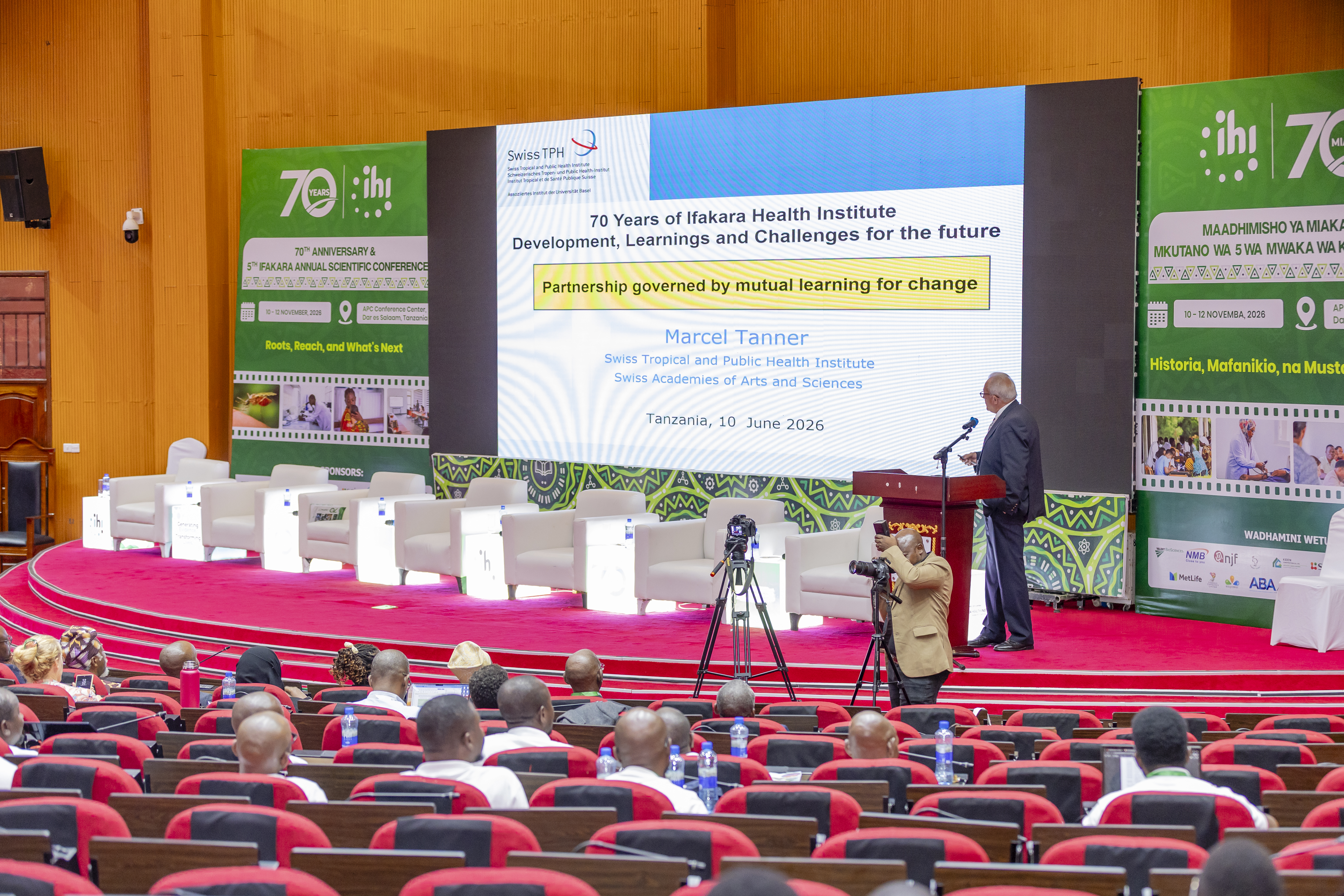
From muddy field roads and mosquito-filled villages in southern Tanzania to a globally recognised centre of health research, Professor Marcel Tanner’s keynote at Ifakara’s 70th anniversary celebration brought to life seven decades of scientific discovery, institutional transformation and a partnership built on mutual trust.
In a packed conference hall in Dar es Salaam on November 10, 2026, a man whose professional journey is deeply intertwined with Ifakara’s history took the audience back to where it all began.
Professor Marcel Tanner, Director Emeritus of the Swiss Tropical and Public Health Institute (Swiss TPH), delivered a keynote address that was much more than a reflection on the past. It was a personal account of a remarkable institutional journey, shaped by scientific curiosity, enduring relationships and a shared determination to make research matter to the communities it serves.
Speaking at the joint celebration of the Ifakara Health Institute’s 70th anniversary and the 5th Ifakara Annual Scientific Conference, Tanner revisited the transformation of a modest field laboratory in southern Tanzania into one of Africa’s respected health research institutions.
His central message was clear: Ifakara’s success has never been built on science alone. It has been built on people, partnerships, local ownership and the conviction that lasting progress comes from learning and working together.
Where the roots took hold
Tanner’s connection with Ifakara dates back to the early 1980s, when he arrived in Tanzania and, in 1981, took charge of the Swiss Tropical Institute Field Laboratory (STIFL).
The laboratory had a history rooted in decades of scientific and missionary engagement in the region, including the work of the Capuchin mission and the Baldegg sisters. Its formal establishment in the 1950s marked an important step towards organised scientific research in the area.
But the ambition was always bigger than conducting research in a rural setting.
Working alongside Tanzanian scientists, government institutions, the Ministry of Health, the National Institute for Medical Research (NIMR) and international partners, Tanner witnessed and contributed to a gradual but fundamental transformation.
The ambition was to build a research institution that was increasingly Tanzanian in its leadership, responsive to national health priorities and capable of generating evidence that could influence policy and improve people's lives.
That journey saw the field laboratory evolve into the Ifakara Centre in the mid-1990s and subsequently into an independent institution, laying the foundations for the Ifakara Health Institute as it is known today.
For Tanner, however, this transformation was never a story of one side giving and the other receiving. It was about reciprocity.
His long-standing philosophy, captured in the words, “We learn more than we could give,” challenged the conventional understanding of international research collaboration. It placed mutual respect, shared responsibility and learning at the centre of the relationship.
That philosophy would continue to define his career. As Director of Swiss TPH from 1997 to 2015, Tanner helped expand the institution's global influence while maintaining strong ties with Ifakara and other research centres across Africa.
His contributions to malaria research, vaccine development and neglected tropical disease initiatives further reinforced his belief that meaningful progress requires scientific excellence, local competence, contextual understanding and long-term investment in people and institutions.
Seven decades of partnership, science and transformation
In his keynote, Tanner took the audience through the milestones and ideas that shaped Ifakara's evolution. He revisited the historic 1960 encounter between Rudolf Geigy and Julius Nyerere, highlighting the importance of investing in education, scientific capacity and self-reliance as Tanzania charted its future.
From those early foundations, he traced the gradual evolution of international collaboration into a more balanced and enduring partnership, one in which Tanzanian scientists and institutions increasingly shaped research priorities, leadership and implementation.
He also reflected on how the nature of health research has changed over the decades. The focus has moved beyond studying individual diseases towards understanding broader health systems and the factors that determine whether scientific discoveries translate into meaningful improvements in people's lives.
Similarly, research has evolved from demonstrating whether an intervention works under controlled conditions to understanding whether it can work effectively, sustainably and equitably in real-world settings.
Throughout his address, Tanner emphasised several principles that he considers essential for the future of research institutions. These include thinking beyond individual projects towards integrated research portfolios; strengthening implementation science across the entire journey from innovation to application; investing in scientific and institutional capacity at every level; and building partnerships founded on mutual respect across different systems, cultures and disciplines.
Two messages particularly captured the spirit of his reflections: “No roots, no fruits” and “We never ever give up.” They were more than memorable expressions. They reflected the patience, commitment and collective effort required to build an institution that can endure, grow and remain relevant across generations.
From local roots to global influence
Seventy years after its establishment, Ifakara represents a very different institution from the modest field laboratory of its early years. Its scientific reach has expanded, its research platforms have grown, and its work increasingly informs health policies and programmes at national, regional and global levels. The institution has also strengthened its ability to attract competitive research funding, develop scientific talent and establish partnerships across geographical and disciplinary boundaries.
For Tanner, these achievements demonstrate what sustained investment in local scientific capacity and institutional ownership can accomplish. But he did not present the anniversary as a moment for simply celebrating past successes.
Instead, he challenged the institution to look ahead, recognising that the next generation of health challenges will demand fresh thinking, stronger collaboration and an even greater commitment to translating scientific knowledge into action.
Questions of health equity, climate change, resilient health systems and unfinished disease-control agendas will require research institutions to remain innovative, responsive and deeply connected to the communities they serve.
The next chapter, therefore, must build on the foundations already established while remaining open to new scientific frontiers and emerging opportunities.
A partnership that continues to shape the future
In a global health landscape often dominated by short-term projects, funding cycles and performance indicators, Tanner’s reflections offered an important reminder: lasting scientific progress is ultimately built through relationships that withstand time.
Behind Ifakara’s seven-decade journey are generations of scientists, technicians, field workers, institutional leaders, government partners and communities who have contributed to its growth. There are stories of researchers navigating muddy rural roads, working in challenging field conditions and building relationships with communities. There are also stories of Tanzanian scientists who grew into institutional leaders, partnerships that evolved with changing national priorities, and research findings that helped shape public health interventions.
Together, these experiences tell a much bigger story than the growth of a research institution. They tell the story of what is possible when science, local ownership and international partnership come together around a shared purpose.
As the three-day anniversary celebration and scientific conference continue, Tanner’s keynote has provided a powerful lens through which to reflect on Ifakara’s past and consider its future.
At 70, the institution has much to celebrate. But perhaps the most important lesson from Tanner’s reflections is that its greatest achievement is not simply how far it has come, but the foundations it has built to keep moving forward.
The roots are firmly established. The impact continues to grow. And the next chapter is still being written.
________
Bilal Mpembamoto heads the Communications Office at the Ifakara Health Institute. He’s an experienced science writer and media editor, having worked for reputable and top-notch media outlets in Tanzania, including The Guardian and Mwananchi Communications.