

NEWBORN CARE: Better data could help save neonatal lives in Ethiopia
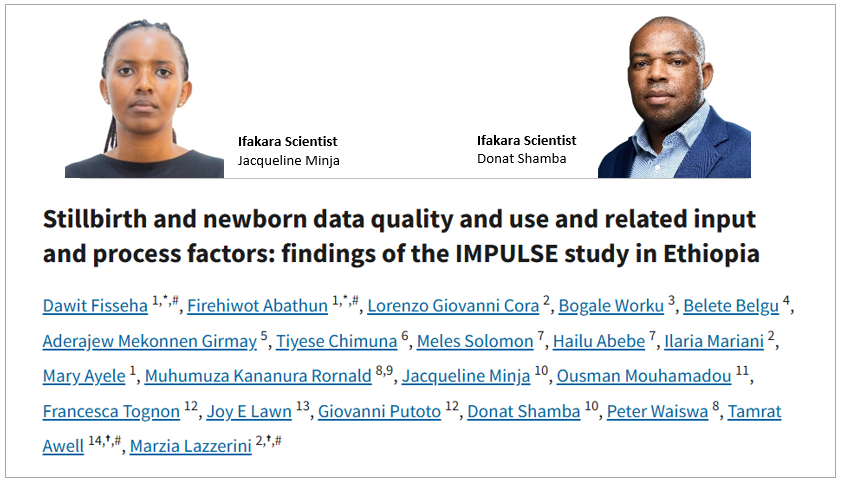
A study involving Ifakara Health Institute researchers has found major gaps in the accuracy and use of data on newborn deaths and stillbirths in Ethiopia, raising concerns about how health systems use information to improve care.
Ethiopia continues to face a significant burden of newborn deaths and stillbirths. The study found that although data on births and newborn health is widely available, it is not always accurate or consistently used to guide decisions.
Ifakara Health Institute researchers Jacqueline Minja and Dr. Donat Shamba were among the study authors, contributing to the research alongside partners from Ethiopia, Uganda, Italy, the United Kingdom and other institutions.
Why accurate data matters
Ethiopia has a neonatal mortality rate of about 27 deaths per 1,000 live births and a stillbirth rate of about 21 per 1,000 total births.
Accurate and timely information is critical for identifying where newborns are dying, understanding gaps in care, setting priorities, directing resources and tracking whether efforts to prevent deaths are working. When data is incomplete or inaccurate, important problems can remain hidden.
Data exists, but its quality remains a concern
Published recently in the Journal of Global Health, the study assessed the quality and use of newborn and stillbirth data across 35 sites in Ethiopia, including health facilities, subnational health offices and the Ministry of Health. Data was collected between November 2022 and September 2023.
Researchers found that basic information, such as total births and live births, was widely available, with completeness ranging from 91% to 98%.
However, when health facility records were compared with data reported through the national District Health Information Software 2 (DHIS2) system, accuracy across 10 newborn indicators was much lower, ranging from just 11% to 67%.
The findings suggest that having data available does not necessarily mean it accurately reflects what is happening at health facilities.
Data is not always used to improve services
The study also found gaps in how health workers and managers use data to review performance and guide decisions.
At health facilities, the proportion using data for performance reviews ranged from 12% to 66%, while at subnational data offices it ranged from 21% to 90%.
Researchers identified several factors contributing to these gaps, including limited staff skills, inadequate supplies for recording and reporting, weaknesses in supervision and insufficient financial planning to support routine health information systems.
Only 16–40% of facility staff assessed had the skills needed to perform routine health information system tasks, while just 15–68% of sites had adequate supplies of recording and reporting tools.
Strengthening the systems behind the numbers
The study was conducted as part of the IMProving qUaLity and uSE of newborn measures (IMPULSE) project, which aims to improve the quality and use of newborn and stillbirth data.
The researchers recommend strengthening data quality, building health workers' skills, improving supportive supervision and investing in health information systems, particularly at facility level.
Better data will not, on its own, save a newborn's life. But without accurate information, health systems cannot reliably see where the problems are, direct resources where they are most needed or know whether efforts to improve newborn care are working.
Read the publication here.