

CHILD DEVELOPMENT: Emergency newborn care linked to later developmental risks in childhood
Children who received basic emergency care as newborns may be more likely to experience developmental difficulties and challenges with early learning by preschool age, a new multi-country study has found.
The study, conducted between 2023 and 2024 in Bangladesh, Nepal and Tanzania, assessed 1,445 children aged 4–6 years. It compared children who had received interventions such as newborn resuscitation, kangaroo mother care or infection treatment with children who had no identified newborn risk factors.
Differences emerge in early learning and school readiness
The researchers found that children who had received basic emergency newborn care were 4.8 times more likely to have functional difficulties than children in the comparison group.
Among children without functional difficulties, those who had received newborn care also had lower average scores for IQ and school readiness. Differences in school readiness were mainly linked to early literacy, early maths and executive function — skills that help children with attention, memory and self-control.
Findings could support earlier developmental follow-up
The findings, published in Global Pediatrics recently, suggest that a history of needing emergency newborn care could help identify children who may benefit from closer developmental monitoring and early support as they grow.
This could be particularly useful in low- and middle-income countries, where routinely screening every child for developmental difficulties can be challenging.
Ifakara researchers contribute to the multi-country study
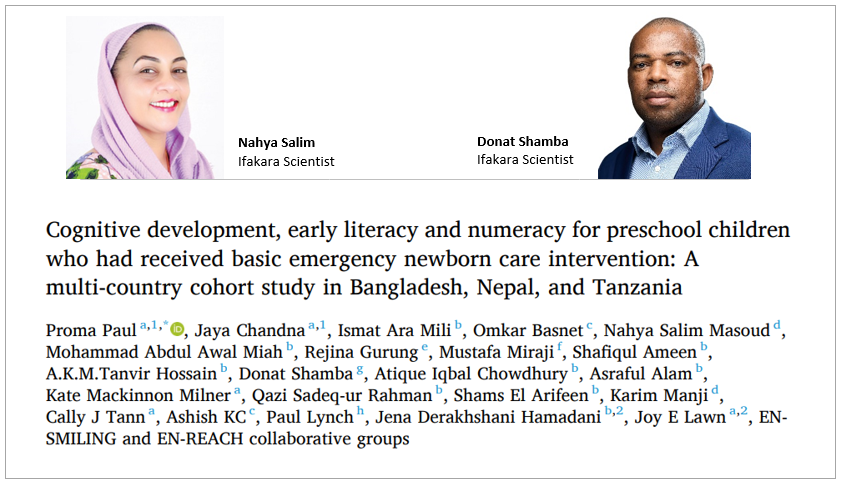
Prof. Nahya Salim and Dr. Donat Shamba of the Ifakara Health Institute contributed to the study as co-authors, supporting the multi-country research into the longer-term outcomes of newborn care interventions.
Read the full publication here.