

HEALTHY HOMES: Dar es Salaam house owners prioritize window style over ventilation
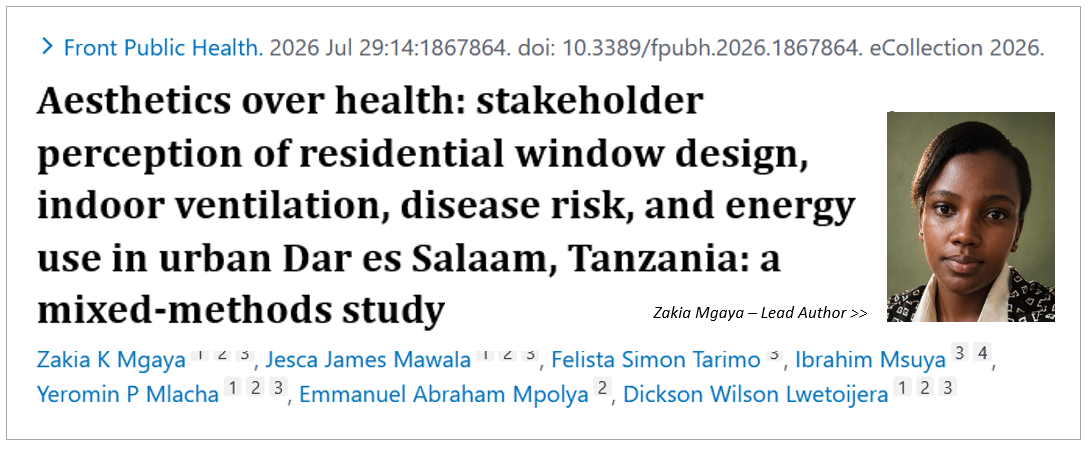
Homeowners in Dar es Salaam tend to care more about how windows look—their design, appearance or style—than how effectively they allow fresh air to circulate inside the house.
Fresh findings from a study held recently in the city, which is Tanzania's largest port and commercial center, raise concerns about ventilation and indoor comfort regarded by urban planning experts among the key elements of healthy homes.
Conducted between July and October 2025 across Dar es Salaam’s five municipalities - Ilala, Temeke, Kinondoni, Ubungo and Kigamboni, the study surveyed 496 households and 115 hardware-store vendors and held discussions with housing and health stakeholders to understand how window choices may affect indoor ventilation, disease risk and energy use.
The study, published in Frontiers in Public Health recently, was led by researchers from the Ifakara Health Institute and the Nelson Mandela African Institution of Science and Technology.
46% of households prioritized appearance
Sliding aluminium windows were the most common design, accounting for 57% of window sales and 47% of household installations.
But ventilation appeared to be a low priority when people chose their windows. Nearly half of households, 46%, said appearance was a major consideration, while affordability and security were also important. Only 7% identified ventilation as a key factor.
Why this matters
The researchers say the findings are particularly relevant to Dar es Salaam's hot and humid climate, where natural airflow can help keep homes cooler and reduce the need for mechanical cooling.
The study found that households reporting limited airflow were more likely to use fans. This suggests that window design may have implications not only for indoor comfort but also for household energy use.
Limited awareness of ventilation and health
The study also found gaps in understanding about the health implications of indoor airflow.
While 56% of households knew that poor indoor ventilation can contribute to disease transmission, only 25% recognized that the amount of airflow through a window could affect disease risk. Awareness of building guidelines related to window design and ventilation was also low, with only 18% of stakeholders reporting that they were aware of such guidance.
Researchers found that larger households were more likely to report malaria and respiratory infections. However, they caution that the study does not establish that window design causes these diseases. Instead, they highlight the wider role that housing conditions can play in health.
A gap in building rules
According to the researchers' review, Tanzania’s building regulations lack enforceable standards linking residential window design to ventilation, disease prevention and energy efficiency.
The authors argue that this gap becomes increasingly important as Dar es Salaam grows and more homes are built.
They call for housing standards that better balance health with appearance, cost and security, alongside ventilation guidance suited to local conditions; and urge greater public awareness of how window choices can affect indoor environments.
“Bringing public health ideas into housing rules” could help improve indoor air quality and reduce reliance on energy-intensive solutions, they note, particularly as rapidly growing cities face increasing pressure on housing and energy systems.
For homeowners, the message is not that attractive windows are unhealthy. Rather, the study suggests that the window is more than a design feature—it can also influence how well a home breathes, how comfortable it feels and how much energy is needed to cool it.
Ifakara young scientist led the study
The study was led by Zakia Mgaya, with contributions from Jesca James Mawala, Felista Simon Tarimo, Yeromin Mlacha, Emmanuel Abraham Mpolya and Dickson Wilson Lwetoijera, all from the Ifakara Health Institute (IHI), with additional contributions from researchers at the Nelson Mandela African Institution of Science and Technology (NM-AIST).
Read the publication here.