

MOSQUITO BEHAVIOUR: Study reveals how a key vector chooses where to lay eggs
This is interesting! A new study in Tanzania has uncovered an important behaviour of Anopheles arabiensis mosquitoes that could help scientists design better ways to fight malaria.
The study, published in Parasites & Vectors international journal recently, found that female mosquitoes carrying eggs prefer to lay them in smaller pools of water rather than larger ones. It also found that many females spread their eggs across several different water bodies instead of putting all their eggs in one place.
The study was conducted by a team of researchers from Uganda, Tanzania and the United Kingdom. Ifakara seasoned researcher Dr. Emmanuel Kaindoa contributed to this study, working alongside the lead author, Hudson Onen, from Uganda and Perpetra Akite, Jonathan Kayondo, Martha Kaddumukasa, Anne Akol (also from Uganda), and Frederic Tripet (from Keele University, UK).
Understanding these behaviours could help researchers improve malaria-control approaches that target mosquitoes before they become adults and start biting people.
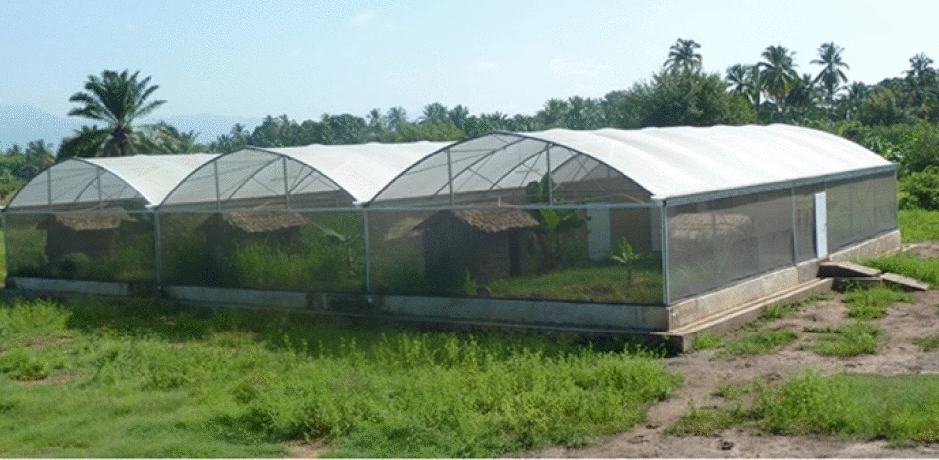
Dr. Kaindoa and colleagues conducted this study under semi-field conditions in south-central Tanzania, using wild Anopheles arabiensis mosquitoes.
Stopping mosquitoes before they can bite
For many years, malaria control has focused on protecting people from adult mosquitoes. Insecticide-treated bed nets and indoor spraying have played a major role in reducing malaria transmission. But mosquitoes are increasingly developing resistance to insecticides, making these tools less effective in some settings.
Scientists are therefore looking for additional ways to attack malaria mosquitoes at different stages of their lives. One promising approach is larval source management—targeting mosquitoes while they are still young and living in water.
Mosquito larvae develop in water before eventually emerging as flying adult mosquitoes. If researchers can identify the types of water bodies mosquitoes prefer for laying eggs, they may be able to target these locations more effectively.
Small pools were the favourite
To understand the mosquitoes' behaviour, researchers created artificial water habitats of two different sizes. Some were relatively small, measuring about 30 centimetres across and holding around 20 litres of water. Others were twice as wide and held about 40 litres.
They then released female Anopheles arabiensis mosquitoes carrying eggs into the experimental areas and allowed them to choose where to lay their eggs. The mosquitoes did not simply distribute their eggs according to the size of the available water bodies.
This finding could be useful because it gives malaria-control researchers more information about where female mosquitoes are likely to establish their next generation.
Some mosquitoes spread their eggs around
But the researchers discovered another interesting behaviour. Almost half of the female mosquitoes—49.2%—spread their eggs across two to four different water habitats rather than laying all their eggs in a single location.
This behaviour is known as skip-oviposition. Instead of putting all their eggs in one basket, so to speak, these mosquitoes spread them across several potential breeding sites.
The females that used this strategy generally laid more eggs overall, but placed fewer eggs in each individual habitat. They were also more likely to move between small and large water habitats rather than repeatedly choosing habitats of the same size.
Why would a mosquito spread its eggs?
The behaviour may be a way of reducing risk. For a mosquito, putting all its eggs in one place could be risky if that water body dries up, becomes unsuitable or is disturbed.
By spreading eggs across several locations, a female may increase the chances that at least some of her offspring survive. Scientists describe this type of behaviour as a possible “bet-hedging” strategy. For malaria researchers, however, the behaviour presents both a challenge and an opportunity.
If mosquitoes routinely move between different breeding sites, simply treating one water body may not be enough to stop them. At the same time, understanding how and where they move could help scientists design interventions that take advantage of these natural behaviours.
Turning mosquito behaviour against malaria
The findings could be particularly useful for new approaches that use mosquitoes' own behaviour to spread mosquito-control agents. One example is autodissemination, where female mosquitoes pick up a mosquito-control substance and carry it to other breeding sites when they lay eggs. Another approach is attract-and-kill, which aims to lure mosquitoes to a specific location where they can be exposed to a control measure.
Knowing that Anopheles arabiensis prefers smaller water habitats—and that many females move between multiple habitats—could help researchers decide where to place these interventions and how widely they need to be deployed.
A small detail with big implications
The study highlights an important lesson in malaria control: sometimes, understanding the mosquito itself can be just as important as developing a new insecticide.
A female mosquito choosing between two pools of water may seem like a small detail. But when millions of mosquitoes make similar choices, those behaviours can influence where malaria mosquitoes reproduce and how effectively control programmes can reach them.
By understanding these choices, scientists may be able to design smarter interventions that target mosquitoes before they grow wings, start biting and spread malaria.
>> Read the full publication, here.