
PAMCA KENYA 2026: Reimagining mosquito control from communities to better science
At the PAMCA Kenya Chapter Annual Meeting 2026 in Nairobi, Day 2 is bringing an important message to the forefront: the future of mosquito control will depend not only on the tools we develop, but on how effectively we connect science, communities, policy and action.
Remembering a Special Scientist and Champion of PAMCA
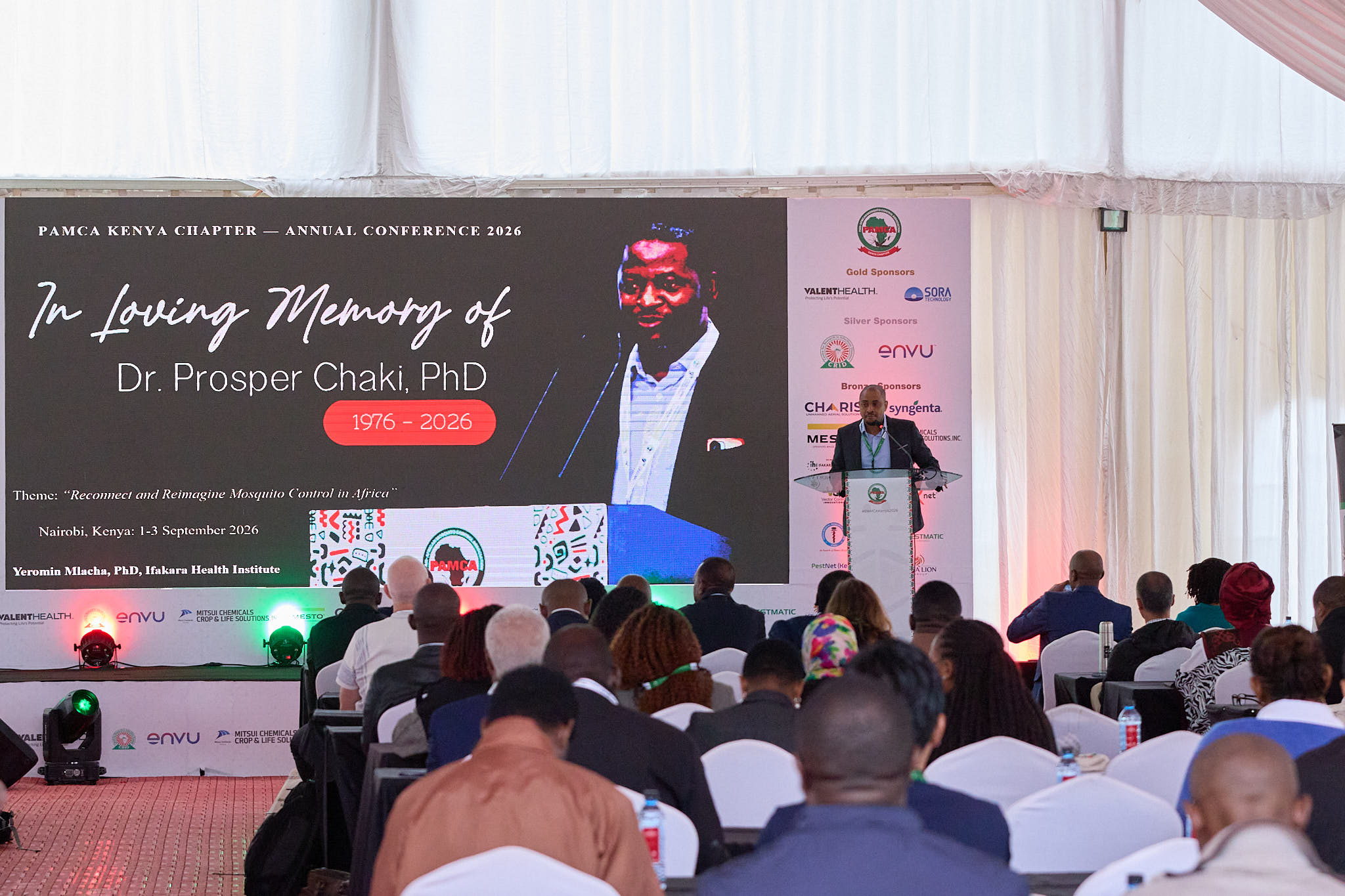
The day began with a moving tribute to the late Dr. Prosper Chaki, former Director of PAMCA and former Director of Resource Mobilization and Stakeholder Engagement at Ifakara Health Institute, whose contributions to malaria research and mosquito control continue to influence the field.
Dr. Chaki was a strong advocate for approaches that recognise communities as essential partners in malaria control. His work championed the importance of listening to communities, understanding local realities and ensuring that scientific knowledge translates into solutions that work for the people most affected by malaria and other mosquito-borne diseases.
The Inaugural Memorial Lecture in his honour, delivered by Dr. Yeromin Mlacha and moderated by Dr. Samson Kiware, provided an opportunity to reflect on this legacy while opening the wider conversation about the future of mosquito control.
The lecture was attended by Dr. Chaki’s wife, Dr. Doreen Ndossi, and his brother, Exavery Chaki, who expressed their gratitude for the outpouring of support and for honoring his legacy through a heartfelt session.
Bringing mosquito, human behaviour together
IHI researcher Praise Michael presented a new surveillance approach designed to capture mosquito behaviour and human behaviour at the same time.
The approach aims to provide a clearer picture of where and when people face the greatest risk of malaria transmission—for example, when people are outdoors during periods of mosquito activity or when they are not protected by bednets.
Early findings point to the potential value of seasonal, cost-effective surveillance combined with targeted, year-round prevention, particularly for populations and settings where bednet use may be lower.
By looking at both sides of the human–mosquito interaction, the approach seeks to strengthen understanding of malaria risk and support interventions that are better matched to how people actually live and interact with their environment.
Putting end users at the centre of prevention
The human dimension of malaria prevention was also highlighted by Fadhila Kihwele, a social scientist at IHI, who presented insights into bednet perceptions and use.
Her work underscores an important lesson for malaria intervention design: scientific effectiveness alone is not enough. Understanding how people perceive, use and experience interventions is essential to improving their uptake, acceptability and sustainability.
Together, the presentations reinforced the importance of designing malaria interventions around the realities of the communities they are intended to protect.
Building the data science capacity behind better decisions
IHI also shared its work to build a critical mass of data scientists and mathematical modellers in low- and middle-income countries.
The presentation highlighted efforts to establish sustainable capacity in malaria surveillance, mathematical modelling, data science, artificial intelligence and machine learning.
This includes the development and application of tools for integrated surveillance, malaria stratification, vector-control optimization, cost analysis and AI-based prediction. The work is complemented by training, mentorship, scholarships and collaboration with National Malaria Programmes and research institutions.
The goal goes beyond developing analytical tools. It is to build a strong pipeline of scientists who can generate, analyse and translate data into evidence for malaria control programmes.