

REVIEW: Monoclonal antibodies offer new hope for malaria prevention
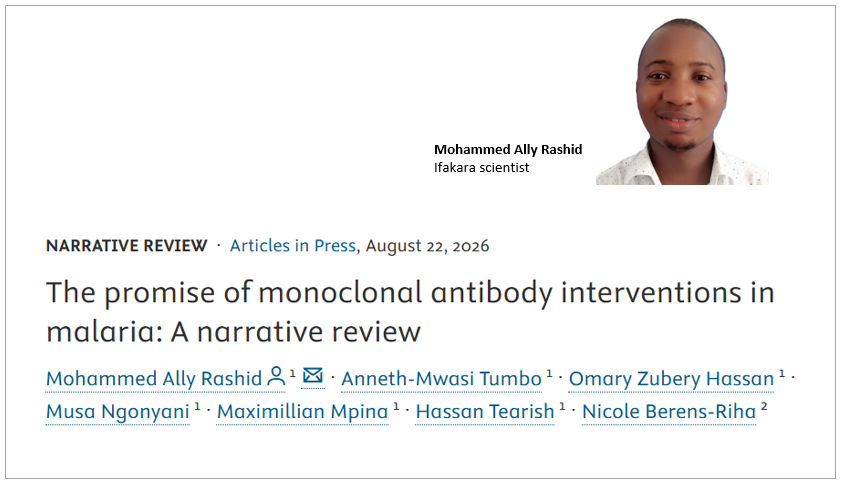
Researchers from Ifakara Health Institute have contributed to a new review looking at how long-lasting laboratory-made antibodies could become an important new way to prevent malaria. These antibodies could provide quick, strong and long-lasting protection, especially for people who are most at risk.
The review was recently published in Clinical Microbiology and Infection. Led by Mohammed Ally Rashid, it brings together findings from different malaria studies to examine the growing potential of laboratory-made antibodies to prevent infection by Plasmodium falciparum, the parasite that causes the most severe forms of malaria.
Additional Ifakara authors include Hassan Tearish, Omary Zubery Hassan, Musa Ngonyani, Anneth-Mwasi Tumbo and Maximillian Mpina. Nicole Berens-Riha, also an author, is affiliated with the Institute of Tropical Medicine in Antwerp.
Monoclonal antibodies could provide immediate protection
Unlike vaccines, which train the body to make its own protection against malaria, monoclonal antibodies provide ready-made protection that can start working soon after they are given.
The authors reviewed promising antibodies including CIS43LS, L9LS, MAM01 and TB31F. Several of these have been found to be safe, remain in the body for a long time and provide strong protection against malaria infection in clinical and field studies.
The greatest promise may be for those facing the greatest risk
The review suggests that long-lasting monoclonal antibodies could help fill important gaps in malaria prevention, particularly among young children, pregnant women and people living in areas where malaria increases during certain seasons.
If successfully developed for wider use, one treatment could potentially protect people during periods when the risk of malaria is highest, such as during seasonal increases in malaria transmission.
Understanding the body’s protection could guide future interventions
The review also highlights the importance of understanding how the body protects itself against malaria. By studying how the body responds to the malaria parasite—including protective antibodies, immune cells and the body's ability to remember past infections—the authors identify useful information that could help researchers develop and test future antibody-based prevention methods.
The pathway from scientific promise to public health impact will not be easy
The researchers caution, however, that important challenges remain. More work is needed to make these antibodies work better and last longer, find practical and affordable ways to give them to people, and produce them in large enough quantities for use in countries where malaria is common.
Not a replacement, but another layer of protection
The authors conclude that monoclonal antibodies are not expected to replace existing malaria prevention tools. Instead, they could work alongside vaccines, mosquito control and other prevention methods.
Their greatest promise may be in providing an additional layer of protection against malaria, a disease that continues to claim hundreds of thousands of lives each year, particularly in sub-Saharan Africa.
Read the publication here.