

SCIENTISTS: Standard test may be underestimating power of key insecticide
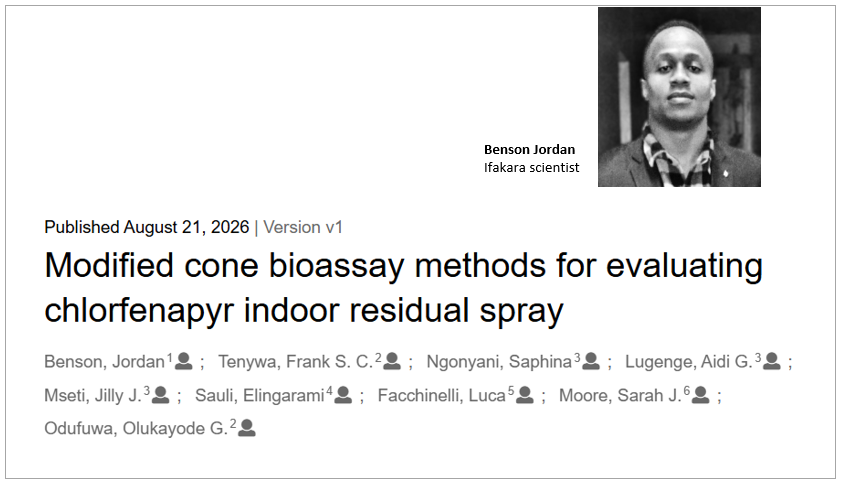
Researchers at Ifakara Health Institute have found that standard laboratory tests may underestimate the effectiveness of chlorfenapyr, an insecticide used in indoor malaria control, highlighting the need for better ways to evaluate mosquito-control tools.
Chlorfenapyr-based indoor residual spraying (IRS) has been prequalified for malaria control and offers a different way of tackling mosquitoes, particularly as resistance to some widely used insecticides continues to grow.
But there is a challenge. The standard test used to assess whether chlorfenapyr remains effective may not accurately reflect how it performs under more natural conditions.
The study, led by the Vector Control Product Testing Unit at Ifakara Health Institute and partner institutions, examined whether modifications to the commonly used “cone bioassay” could provide a more realistic way of evaluating the insecticide.
Published recently in MalariaWorld Journal, the study was led by Jordan Benson, with co-authors Frank Tenywa, Saphina Ngonyani, Aidi Lugenge, Jilly Mseti, Sarah Moore and Olukayode Odufuwa, all from Ifakara, alongside Elingarami Sauli of the Nelson Mandela African Institution of Science and Technology (NM-AIST) and Luca Facchinelli of the Liverpool School of Tropical Medicine.
The problem with the standard test
In a standard cone test, mosquitoes are placed inside a small cone attached to an insecticide-treated wall or surface. They are exposed for a set period, after which researchers monitor how many die.
The method works well for many conventional insecticides. Chlorfenapyr, however, presents a particular challenge.
Unlike many other insecticides, chlorfenapyr works best when mosquitoes are active and using energy. Yet mosquitoes confined inside a small cone cannot fly and behave very differently from mosquitoes moving freely inside a house.
This raises an important question: could the test itself be underestimating the insecticide’s effectiveness?
Putting the test to the test
The Ifakara-led team tested different ways of modifying the standard method. They exposed two malaria mosquito species to mud surfaces treated with a chlorfenapyr-based indoor spray and changed the conditions to encourage greater mosquito activity.
In one set of experiments, they increased the amount of time mosquitoes spent in contact with the treated surface and allowed them more time to move after exposure.
In another, they extended exposure to 12 hours and tested whether the presence of a host—a rabbit—would encourage mosquitoes to become more active.
The results showed that longer exposure and the presence of a host did increase mosquito deaths. However, the increase was modest.
Even under the modified conditions, mosquito mortality remained considerably lower than levels observed in studies where mosquitoes were allowed to fly freely when exposed to chlorfenapyr-treated surfaces.
Why it matters
The findings suggest that simply modifying the standard cone test may not be enough to reliably measure how well chlorfenapyr-based indoor spraying performs.
Importantly, the study does not suggest that chlorfenapyr itself is ineffective. Instead, it highlights the difficulty of testing an insecticide that works differently from many older products for which standard testing methods were developed.
If a test consistently underestimates an insecticide’s performance, malaria control programmes could struggle to determine how long a product remains effective after spraying or to compare it fairly with other interventions.
Looking for more realistic solutions
The researchers say further work is needed to identify practical and reliable methods for monitoring how long chlorfenapyr remains effective after being sprayed inside homes.
One possibility is conducting overnight cone tests inside people’s homes to determine whether they can provide a more realistic measure of the insecticide’s residual effectiveness.
For malaria control programmes, getting these measurements right matters. An inaccurate test could make a promising intervention appear less effective than it really is—or make it difficult to determine when a sprayed insecticide has genuinely stopped providing protection.
As malaria control increasingly relies on newer tools to address insecticide resistance, the study highlights an important lesson: developing new mosquito-control products is only part of the challenge. Scientists also need reliable ways to measure how well those products work in the real world.
Read the publication here.