

CLIMATE CHANGE: Growing health risks expose gaps in Tanzania’s preparedness
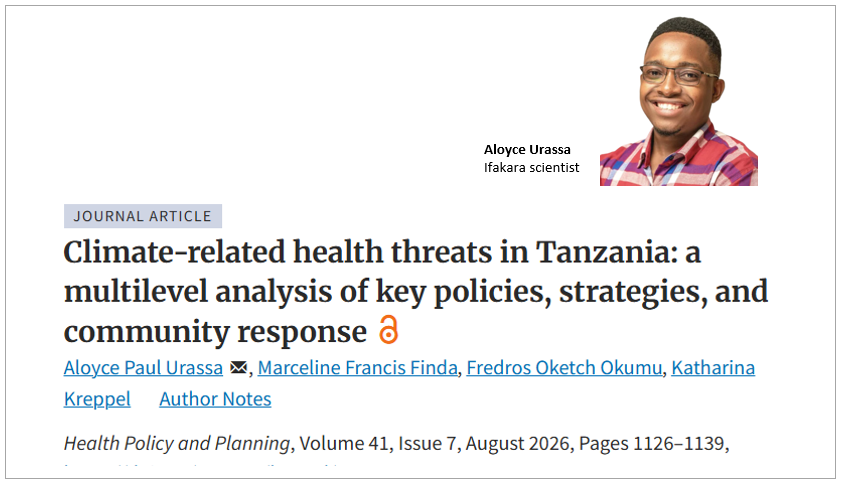
Tanzania has policies to tackle the health effects of climate change, but gaps in funding, coordination and implementation are leaving communities exposed to growing risks, a new study has found.
Conducted between January 2024 and May 2025, the study found that climate-related hazards are already affecting people's health and livelihoods, with communities reporting health problems ranging from malaria and diarrhoeal diseases to food shortages and crop losses.
The study, published recently in Health Policy and Planning, was led by Aloyce Urassa, from the Ifakara Health Institute and co-authored by Marceline Finda, Fredros Okumu and Katharina Kreppel.
The researchers note that, although Tanzania has developed a substantial policy and strategic framework to address climate-related health threats, translating these commitments into action at the community level remains a challenge.
Communities already feeling the impact
Researchers surveyed 388 adults and conducted eight focus group discussions across four councils in the Kilombero Valley in Morogoro Region, where many people depend on agriculture and face climate-sensitive health risks.
Almost all respondents – 97% – reported experiencing at least one climate-related hazard during the previous three years.
Drought was the most commonly reported, affecting 65.2% of respondents, followed by delayed rainfall at 54.4% and extreme heat at 47.7%. Flooding was reported by 31.2%, while 30.9% reported unpredictable rainfall.
Participants linked these climate-related changes to increases in malaria, diarrhoeal diseases, food shortages and crop losses, and other pressures on household livelihoods.
The researchers say these findings show how climate change can affect health both directly and indirectly through its effects on food, water and livelihoods.
Policies exist, but implementation remains a challenge
At national level, the researchers reviewed relevant climate and health policies and strategies, mapped 30 key stakeholders and interviewed 15 policymakers, researchers, development partners and civil society representatives.
The analysis found that Tanzania has developed several policies and strategies addressing climate change and health. However, stakeholders identified significant challenges in putting these policies into practice.
Among the main barriers were fragmented financing, weak coordination between sectors and poor integration of climate and health data.
These challenges, the researchers say, make it harder to translate national commitments into practical measures that protect communities.
Climate information needs to reach communities
The study also found a gap between the availability of climate information and its use by communities.
Although 77% of respondents recognized climate change, many relied on personal observations or informal networks to assess climate-related risks.
The researchers say communities need timely, clear and locally relevant information on risks such as drought, flooding, extreme heat and changing rainfall, alongside guidance on how to protect their health and livelihoods.
What needs to change?
The researchers say Tanzania could strengthen its preparedness by focusing on four areas.
- Improve climate-health communication so communities receive timely and practical information.
- Promote climate-smart agriculture to strengthen food and livelihood security.
- Build climate-resilient health facilities capable of maintaining services during climate-related emergencies.
- Strengthen inclusive early-warning systems that connect climate information with health planning and community action.
They also call for stronger coordination across sectors, more predictable financing, better integration of climate and health data, and greater involvement of communities in designing responses, rather than relying solely on national-level planning.
Turning policy into action
The findings suggest that Tanzania has an important foundation for responding to climate-related health threats, but more needs to be done to translate national commitments into action at community level.
As climate-related hazards increasingly affect health, agriculture and livelihoods, the researchers argue that climate resilience must also be treated as a public health priority.
Strengthening community preparedness, health systems and early-warning mechanisms, they underline, will be critical to protecting health gains and reducing the impact of future climate-related shocks.
Read the publication here.