

MOSQUITO NET EVALUATION: Study finds the testing environment can influence the results
When researchers test insecticide-treated nets (ITNs), they need reliable evidence on how well the nets prevent mosquito bites and kill them. But new research suggests that the environment in which the nets are tested can also influence the results.
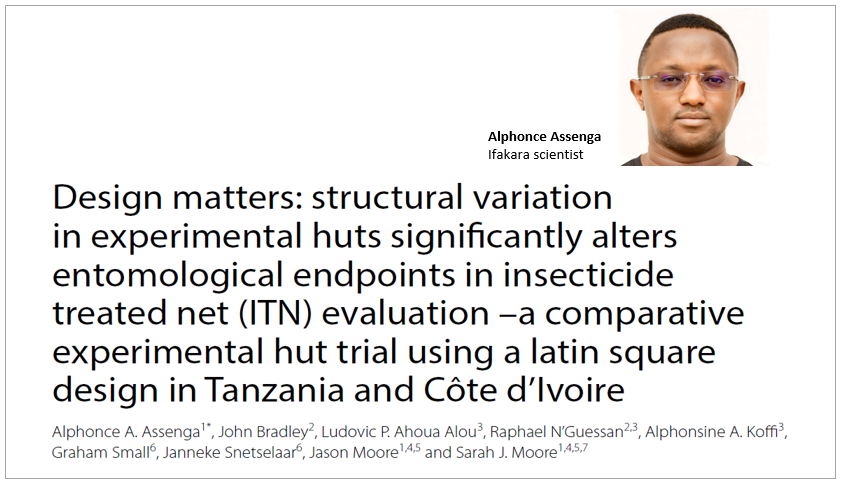
A study published recently in Malaria Journal found that different experimental hut designs can substantially affect key measurements of mosquito behaviour during ITN evaluations. The findings highlight the importance of standardizing testing environments to make results more comparable across studies.
The study was led by researchers from the Ifakara Health Institute, in collaboration with international partners including the London School of Hygiene & Tropical Medicine, Liverpool School of Tropical Medicine, Innovative Vector Control Consortium, Swiss Tropical and Public Health Institute, University of Basel, and research partners in Côte d’Ivoire and Tanzania.
Why experimental huts matter
Experimental huts are specially designed structures used to evaluate mosquito-control tools under controlled, semi-field conditions. They mimic some aspects of a real-world sleeping environment while allowing researchers to observe how mosquitoes interact with ITNs and measure outcomes such as mortality, blood-feeding and movement.
However, experimental huts used around the world vary in design and construction. These differences could influence how mosquitoes enter, move through and leave the structures—and how they interact with an ITN.
The researchers wanted to determine whether hut design could affect the outcomes of ITN evaluations.
Putting four hut designs to the test
Led by Alphonce Assenga of the Ifakara Health Institute’s Vector Control Product Testing Unit, the research team compared four experimental hut designs: East African, West African, Ifakara and Rapley huts.
126-night trials were conducted in Tanzania and Côte d’Ivoire using 18 huts. Researchers tested several ITNs alongside untreated nets and collected 22,611 Anopheles gambiae mosquitoes, of which 99.9% were identified as Anopheles arabiensis.
They then compared mosquito density, 72-hour mortality, blood-feeding and exiting across the different hut designs.
Striking differences between huts
The results showed major differences in mosquito behaviour depending on the hut design.
Rapley and Ifakara huts captured more than six times as many mosquitoes as East African huts. In contrast, West African huts captured 88% fewer mosquitoes than East African huts.
The differences were also evident in mosquito mortality and blood-feeding.
West African huts recorded the highest mosquito mortality, at 70%, compared with 40–46% in the other hut designs. They also recorded higher blood-feeding, at 15%, compared with around 3–8% in the other designs.
Together, these findings show that the physical environment used to test an ITN can strongly influence the entomological outcomes researchers measure.
Does hut design change how we judge the nets?
Importantly, the study found that although absolute results varied significantly between hut designs, the relative performance of the tested nets remained largely consistent.
This means that different hut designs did not necessarily change which product performed better. However, they could affect the size and variability of measured effects, factors that are important when designing and interpreting trials.
Why the findings matter
ITN evaluations generate evidence that can inform the development, further testing and potential deployment of malaria-control products.
When studies testing similar products produce very different results because they use substantially different experimental environments, it becomes difficult to compare findings across countries, research centres and trials.
The researchers, therefore, highlight the need for greater standardization of experimental hut design and reporting. More consistent testing environments could improve the comparability and reliability of ITN evaluations, helping researchers better distinguish the effects of a mosquito-control product from those of the testing environment.
Read the publication here.