NEGLECTED TROPICAL DISEASES: Community engagement key to delivering schistosomiasis treatment in schools
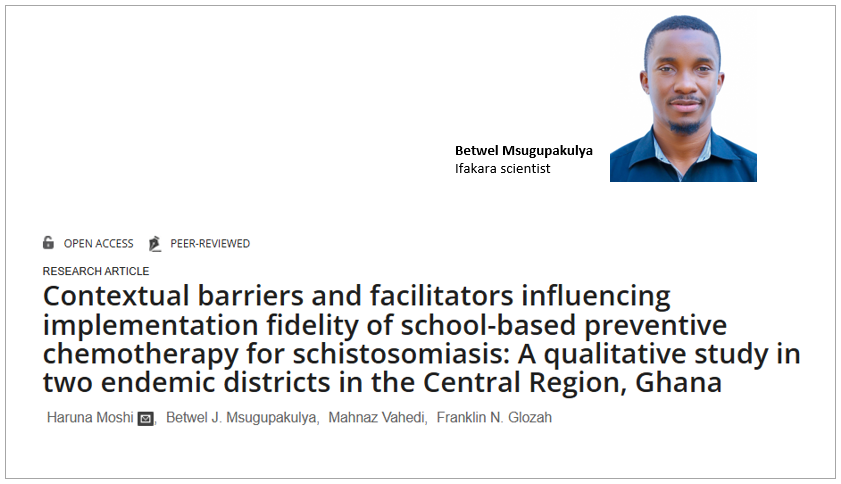
Getting preventive treatment to children is an important part of controlling schistosomiasis, a parasitic disease linked to contact with contaminated freshwater. But the success of school-based treatment programmes depends on more than having medicines available. A study in Ghana has identified community, health-system and school-level factors that can influence whether preventive treatment is delivered as intended.
Ifakara Health Institute’s research scientist Betwel Msugupakulya contributed to the study as a co-author. Published recently in PLOS ONE, the research examined the implementation of school-based schistosomiasis treatment in two endemic districts in Ghana’s Central Region – Gomoa East and Awutu Senya East. Data were collected in 2025.
About schistosomiasis
Schistosomiasis is a neglected tropical disease caused by parasitic worms that live in freshwater. People can become infected when they come into contact with contaminated water, for example while swimming, fishing, farming or washing. Children are particularly vulnerable in endemic areas because of their frequent contact with freshwater. Repeated infection can lead to long-term health problems, making regular prevention and treatment important in affected communities.
What the researchers found
Researchers interviewed 21 participants including health and education officials, head teachers and teachers involved in delivering the programme to understand the challenges they face and what helps them implement treatment effectively.
The study found that concerns about treatment side effects, limited community awareness, logistical constraints, inadequate resources, and gaps in training and support for teachers could hinder implementation.
What can improve treatment delivery
At the same time, community engagement and sensitization, motivated teachers, supportive supervision, adequate preparation, and strong collaboration between health and education authorities were identified as important factors supporting effective delivery.
Putting communities at the centre
The findings highlight that improving schistosomiasis control requires more than distributing medicines. The authors call for a “shift toward a community-centred delivery approach”, supported by better community sensitization and engagement, reliable logistics, and stronger training and motivation for frontline implementers.
In practical terms, this means ensuring that communities understand and support treatment programmes, while giving teachers and health workers the resources and support they need to deliver them effectively.
Read the publication here.