

MATERNAL HEALTH: Gaps in death surveillance and response
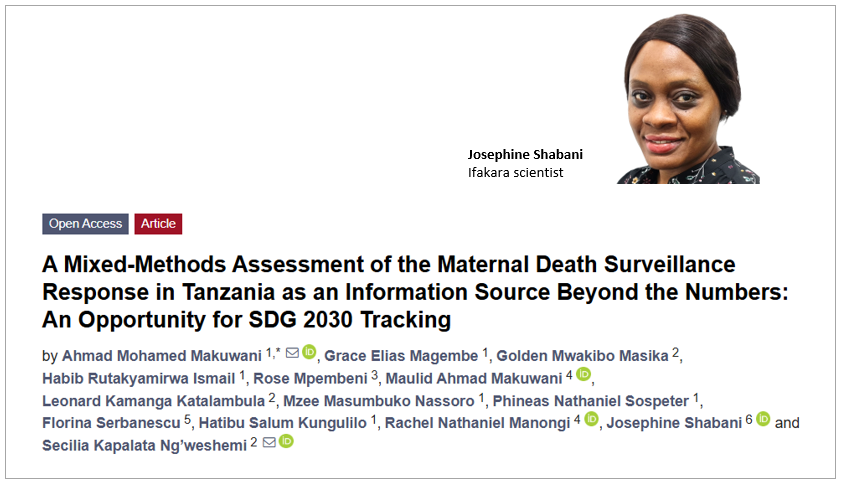
Tanzania’s system for tracking maternal deaths is generating valuable information about where and how women die, but gaps in reporting, follow-up and action are limiting its potential to help prevent future deaths, a new study finds.
The study, assessing Tanzania’s Maternal Death Surveillance and Response (MDSR) system, found that the system performs well in identifying, reporting and reviewing maternal deaths, but is less effective at ensuring recommendations from those reviews are acted upon.
Published recently in Trends in Public Health, the study assessed MDSR implementation and data quality using 2022–2023 data from regions across Tanzania, alongside interviews with health managers and healthcare providers.
Ifakara researcher, Josephine Shabani, contributed to the study and publication, whose lead author is Ahmad Makuwani from the Ministry of Health, Tanzania. Other contributors were drawn from Tanzania's Ministry of Health and academic and research institutions in Tanzania and the United States.
Strong reporting, weaker response
MDSR implementation was rated satisfactory at 80% at regional level, compared with 74% at district level and 73% at health-facility level.
The system performed particularly well in notifying, reporting and reviewing maternal deaths, with all 12 health facilities assessed scoring above 95% for these processes.
However, translating findings into action proved more difficult. Only one of three action plans examined at health-facility level had been implemented. The researchers also identified gaps in supervision, documentation, follow-up of recommendations and feedback to communities about maternal deaths.
Weekly reporting strengthens the data
The study also examined the timeliness and completeness of maternal death information as it enters the surveillance system.
Daily notification rates were relatively low, averaging 56.4% in 2022 and 43.8% in 2023 across the regions assessed.
Weekly reporting, however, produced more complete information, reaching 99% completeness, compared with 84% for initial notifications.
The researchers found that 349 maternal deaths were recorded through weekly reporting, compared with 200 in the initial notifications, highlighting the importance of the additional verification and review process.
From counting deaths to preventing them
MDSR is designed to go beyond counting deaths by helping health authorities understand what happened, identify avoidable factors and guide measures to prevent similar deaths.
However, the researchers identified several barriers to making full use of the system. These included limited training, heavy workloads, inadequate supervision and weaknesses in implementing corrective actions. Healthcare providers also raised concerns about fear and blame during maternal death reviews, which can make it harder to openly examine what happened and learn from it.
The researchers suggest that creating a more supportive environment for reviews could help health workers discuss challenges openly and strengthen learning from maternal deaths.
Digital integration could strengthen tracking
The researchers also suggest integrating maternal death reporting into electronic patient management systems. Reporting currently relies partly on paper-based processes, WhatsApp and email.
Greater digital integration could improve the timeliness of reporting, strengthen data analysis and make it easier to track whether recommendations from maternal death reviews are implemented.
The findings are relevant to Tanzania’s efforts to monitor progress towards Sustainable Development Goal 3, which includes reducing maternal mortality by 2030.
The study concludes that MDSR can provide a reliable source of routine maternal death information—but its greatest value lies in using that information to understand what went wrong and turn those lessons into action.
Read the publication here.