

ACKNOWLEDGEMENT: Tanzania highlights Ifakara’s role in malaria fight at UN General Assembly
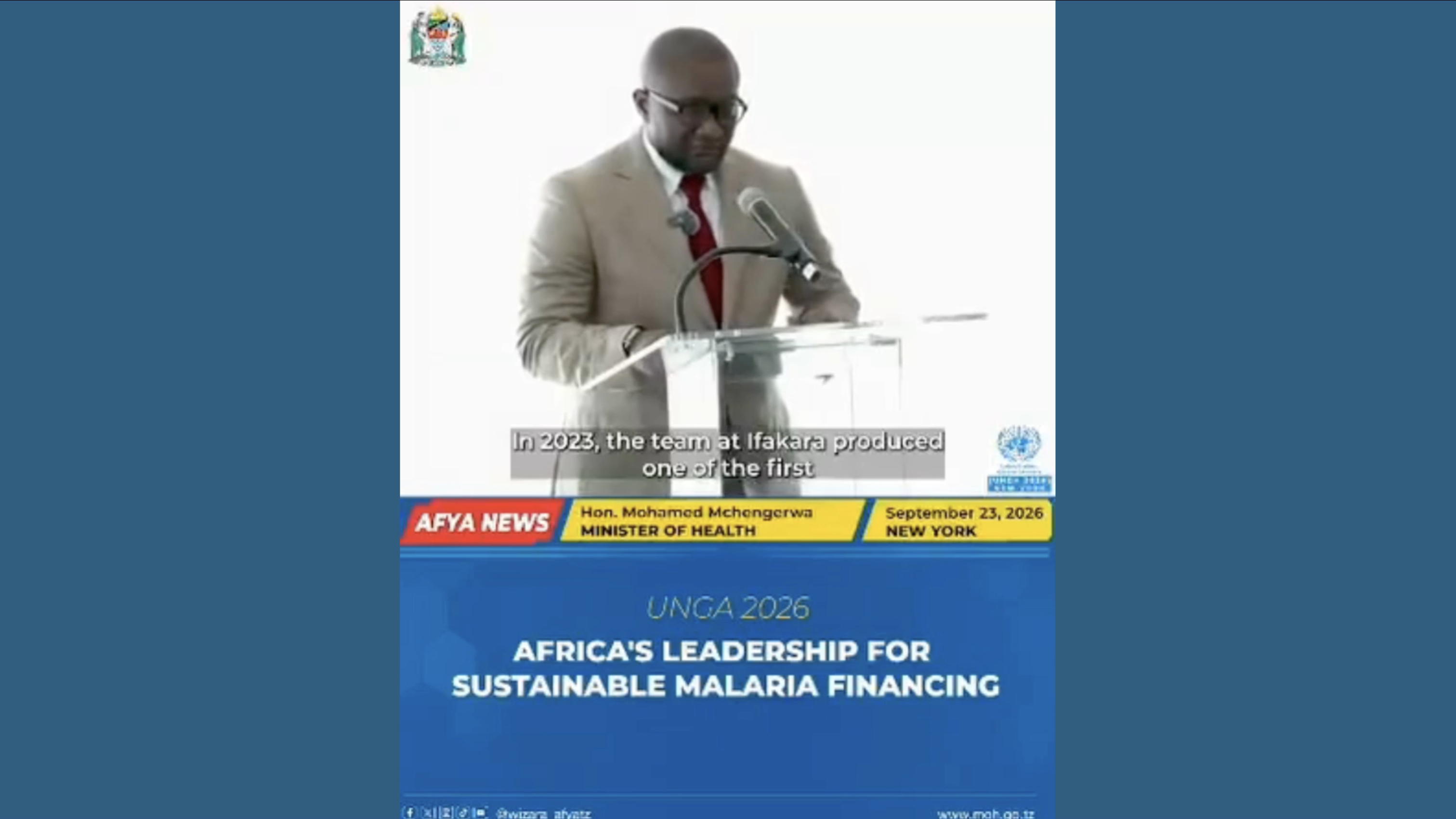
Tanzania has highlighted the contribution of the Ifakara Health Institute to the country’s long-running fight against malaria, placing African-led research and innovation at the centre of its message at the 81st United Nations General Assembly (UNGA81).
Speaking in New York on September 23, 2026, during discussions on malaria and sustainable financing for the fight against the disease, Tanzania’s Minister of Health Mohamed Mchengerwa underscored Tanzania’s investment in scientific research and the role of local institutions such as Ifakara in developing new solutions to one of the country’s most persistent public health challenges.
"At the Ifakara Health Institute, working with the National Institute for Medical Research, our scientists are working on gene drive. Tanzanian scientists in a Tanzanian laboratory "said Hon. Mchengerwa.
The recognition comes as Tanzania and other malaria-endemic countries face the challenge of sustaining progress against the disease while confronting emerging threats, including insecticide and drug resistance, changing transmission patterns and pressures on health financing.
The Minister’s remarks highlighted the importance of investing in home-grown scientific capacity and innovations that can contribute to the next generation of malaria control tools.
From research to new malaria solutions
For seven decades, Ifakara has been involved in research aimed at understanding, preventing and controlling malaria. Its work has evolved from early studies of mosquito behaviour to large-scale field research, surveillance, clinical trials and the development and testing of new vector-control and malaria prevention technologies.
More recently, Ifakara scientists have been involved in research into genetic technologies, including gene-drive approaches, through the Transmission Zero programme.
The work has attracted international attention following the development of genetically modified mosquitoes in Tanzania that are designed to block malaria transmission. The research was led by scientists from Ifakara and the National Institute for Medical Research, in partnership with Imperial College London through the Transmission Zero programme.
The development was described by Ifakara as an African-led innovation, with the research designed around malaria parasites and mosquito populations relevant to African communities.
Government and research partnership
The Ministry of Health's recognition at UNGA builds on a growing emphasis by the Tanzanian Government on research, innovation and stronger partnerships as part of the country's malaria response.
Earlier this year, President Samia Suluhu Hassan publicly highlighted Ifakara during a high-level discussion on sustainable malaria financing on the sidelines of the African Union Summit in Addis Ababa.
She said Tanzania's response to malaria spans the full spectrum of interventions and noted the country's investment in world-class research, specifically identifying Ifakara as a home of scientists working at the frontier of new technologies.
The President also referred to gene-drive research as an innovative approach being explored to prevent mosquitoes from transmitting malaria, describing it as “African science, conducted by African researchers, addressing an African challenge.”
That recognition reflects the increasingly important role of Tanzanian research institutions in generating evidence and technologies that can inform national and global malaria-control efforts.
A 70-year contribution
The UNGA recognition comes in a significant year for Ifakara, as the Institute marks 70 years of scientific contribution to health research in Tanzania and beyond.
Founded in Ifakara in 1956, the Institute's malaria work has contributed to evidence that has informed malaria-control strategies and the development and evaluation of interventions, including mosquito nets, vaccines, surveillance approaches and emerging vector-control technologies.
Its current portfolio ranges from molecular surveillance and monitoring of drug resistance to research on next-generation mosquito nets, malaria vaccines and advanced genetic technologies.
A recent national malaria molecular surveillance programme involving Ifakara, the Ministry of Health and NIMR is examining malaria parasites across Tanzania Mainland to generate evidence that can support targeted interventions and national decision-making.
From Ifakara to the world
The acknowledgement at UNGA provides another international platform for Tanzania to demonstrate how investments in local research institutions can contribute to global health challenges.
For Ifakara, it also reinforces a central principle that has defined its work for decades: that locally generated evidence and African scientific leadership can help develop solutions to challenges affecting African communities.
As Tanzania continues its push towards malaria elimination, the role of institutions capable of moving from discovery to evidence, and from evidence to policy and implementation, will remain central to the country's response.
For Ifakara, the recognition at the United Nations comes as the Institute enters its eighth decade with a continuing commitment to advance science, strengthen partnerships and develop the next generation of solutions for malaria and other major health challenges.
Seventy years on, the fight against malaria continues — and Tanzania's scientific institutions remain an important part of the effort to end it.