

WORLD ENVIRONMENTAL HEALTH DAY 2026: Standing with science to protect communities
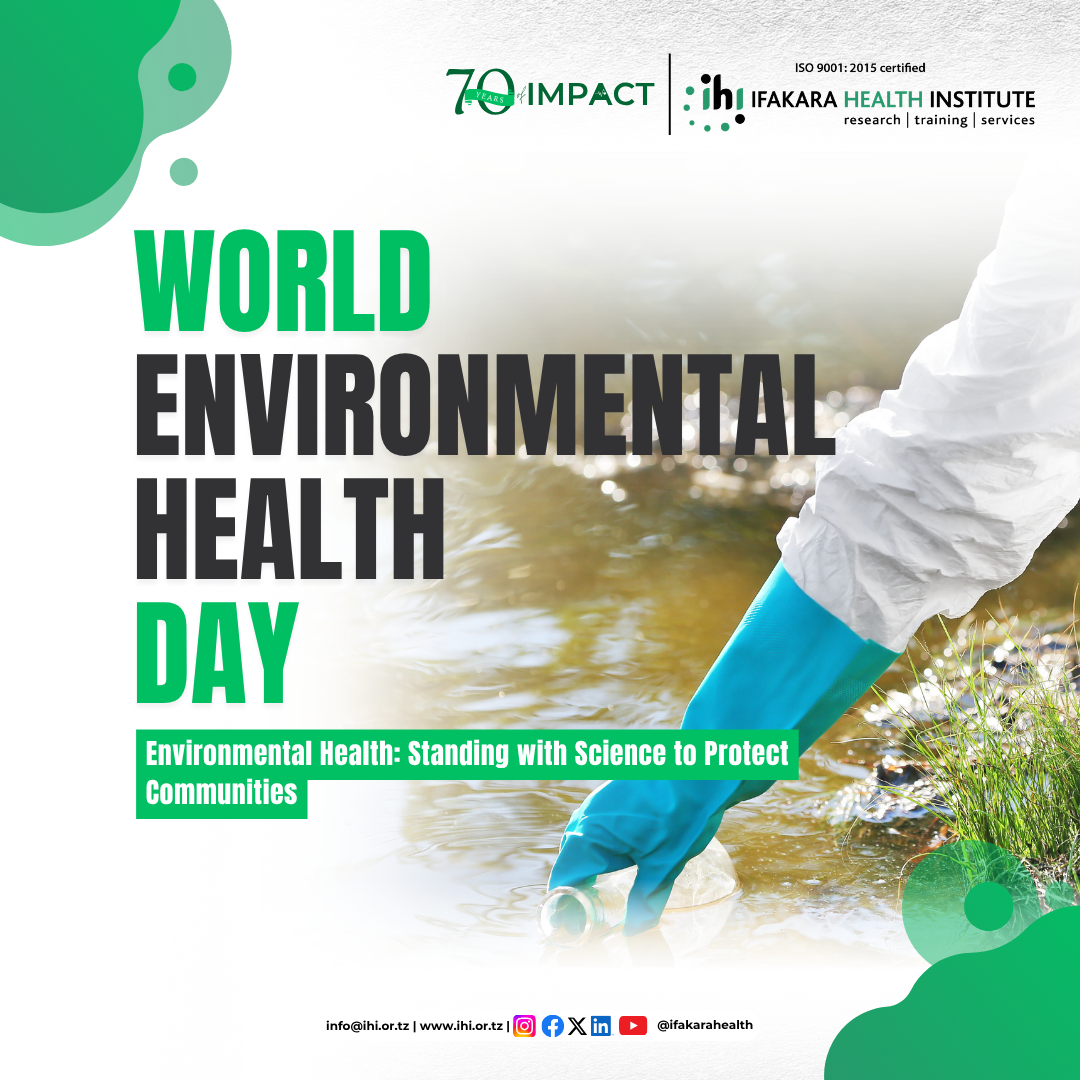
This is the theme for World Environmental Health Day 2026, observed on 26 September. For the Ifakara Health Institute (IHI), the theme reflects the importance of generating evidence to understand how environmental and ecological conditions influence health and how science can support healthier communities.
Through its Environmental Health & Ecological Sciences (EHES) research, Ifakara investigates the complex connections between people, their environments and the ecosystems in which they live.
Environmental health extends beyond the health of individuals. The quality of the air and water around us, environmental exposures, ecological changes, disease vectors and interactions between people and their surroundings can all influence health outcomes.
Research at the environment–health interface
EHES brings together research that helps us better understand these relationships. By studying environmental and ecological factors that shape health, Ifakara researchers generate evidence that can contribute to public health interventions, environmental management and policies that respond to the realities faced by communities.
This work draws on a range of disciplines, including environmental science, ecology, epidemiology, entomology and public health, recognising that many environmental health challenges cannot be addressed through a single discipline alone.
Standing with science
As environmental conditions continue to change, evidence is increasingly important for understanding emerging and existing health risks. Research can help identify these risks, explain how they affect communities and guide approaches to prevention and protection.
On World Environmental Health Day 2026, IHI joins the global community in recognising the importance of environmental health research and the role of science in protecting communities.
Through EHES and across our wider research portfolio, Ifakara remains committed to generating and translating evidence that contributes to healthier people, healthier environments and more resilient communities.
Taking the conversation beyond research
The connection between environment and health is also reflected in Ifakara’s work on malaria and vector-borne diseases. On World Environmental Health Day 2026, A24TV featured the work of Dr Dickson Lwetoijera, Programme Director for Transmission Zero at Ifakara, in an article exploring why understanding the environment is important in the fight against malaria.
The feature highlights how factors such as rainfall, temperature, humidity, seasonal variation and mosquito behaviour can influence malaria transmission, while also exploring how researchers are investigating new approaches to malaria control.
In the feature, Dr Lwetoijera emphasises the close relationship between human and environmental health, noting the importance of understanding mosquitoes, parasites and the environments in which transmission occurs as researchers develop and assess new interventions.
The feature provides another opportunity to bring research on the environment–health connection to wider audiences and highlight the role of science in addressing complex public health challenges.
Read the full A24TV feature: Understanding our environment matters in the fight against malaria
This World Environmental Health Day, we stand with science to protect communities.