

MATERNAL HEALTH: Lessons on implementing group antenatal care in Geita, Tanzania
For pregnant women, antenatal care (ANC)—commonly known as clinics—provides an important opportunity to receive health checks, information and support during pregnancy. But ensuring women consistently attend clinics and receive quality care can be challenging, particularly in health facilities facing limited staff, space and resources.
A study in Tanzania has identified practical factors that can determine whether Group Antenatal Care (G-ANC) can be successfully introduced and sustained in such settings.
G-ANC brings pregnant women at similar stages of pregnancy together for sessions that combine routine clinical care with health education, facilitated discussions and peer support. Unlike conventional ANC, where women are generally seen individually, the group model creates opportunities for women to learn from both healthcare providers and one another.
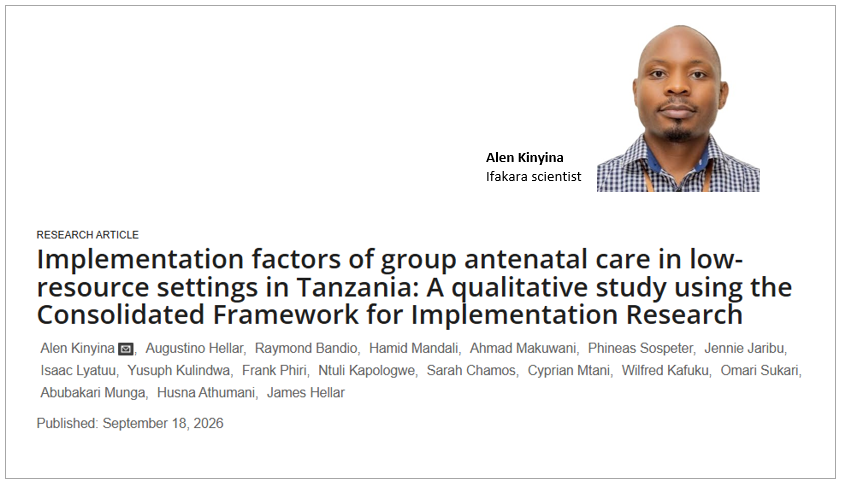
Published in PLOS Global Public Health, the study was led by Alen Kinyina, affiliated with the Ifakara Health Institute (IHI) and Prime Health Initiative Tanzania (PHIT). IHI researchers Jennie Jaribu and Isaac Lyatuu also contributed to the study, alongside collaborators from PHIT, Tanzania’s Ministry of Health, the East, Central and Southern Africa Health Community (ECSA-HC), the Ministry of Foreign Affairs and East African Cooperation, and the Geita Regional Health Management Team.
What helps group care succeed?
Conducted in Geita Region between June and November 2024, the study explored the experiences of pregnant and recently delivered women, healthcare providers, facility leaders and health managers.
Researchers found that women and health workers recognized several advantages of G-ANC, including opportunities for women to share experiences, learn together and support one another.
Supportive facility leadership, teamwork among health workers and the ability to adapt the model to local circumstances also helped implementation. Proper scheduling of group sessions also helped maintain continuity, while positive experiences among community health workers, providers and pregnant women encouraged continued use of the approach.
But implementation comes with challenges
The study also found that introducing G-ANC does not solve the constraints already facing health facilities.
Researchers identified inadequate space for group meetings, shortages of healthcare workers and competing clinical demands as major barriers. Socioeconomic challenges also affected women's participation, while some women and providers raised concerns about maintaining privacy in a group setting.
These challenges suggest that scaling up G-ANC requires more than introducing a new model of care. Health facilities need the capacity, leadership and working arrangements to support it, while the approach must remain responsive to the needs and circumstances of the communities they serve.
Why the findings matter
The findings are particularly relevant as Tanzania and other low-resource settings explore approaches to strengthen maternal and newborn health services.
The study suggests that successful G-ANC implementation depends on aligning the design of the intervention with health-system capacity and community realities.
Addressing constraints such as space and staffing, while strengthening leadership, teamwork, scheduling and peer support, could help facilities integrate G-ANC more effectively into routine maternal and newborn health services.
Importantly, the findings complement evidence from a related G-ANC study in six government facilities in Geita, to which Kinyina also contributed. Involving nearly 6,000 women, that study found that G-ANC could be integrated into routine government health services and was associated with high uptake of recommended ANC services.
Read the publication here.