

MALARIA SURVEILLANCE: Scientists validate method for estimating mosquito age
To understand malaria transmission, scientists need to know more than where mosquitoes are found. They also need to know how old they are.
This is because a mosquito must survive long enough for the malaria parasite to develop inside it before it can transmit the disease. Understanding the age of a mosquito can therefore help researchers assess malaria transmission and evaluate whether vector-control interventions are effective.
But determining a mosquito’s age is not as simple as looking at it.
One method researchers have used for decades is the Polovodova method, a technique used to determine the physiological age and parity level of female mosquitoes, specifically tracking how many times a mosquito has laid eggs and, in turn, estimate its age.
But how reliable is this method when different researchers use it?
Putting an old method under closer analysis
A new study published in the Journal of Medical Entomology, involving researchers from the Ifakara Health Institute (IHI) and the University of Glasgow, has put the method to the test.
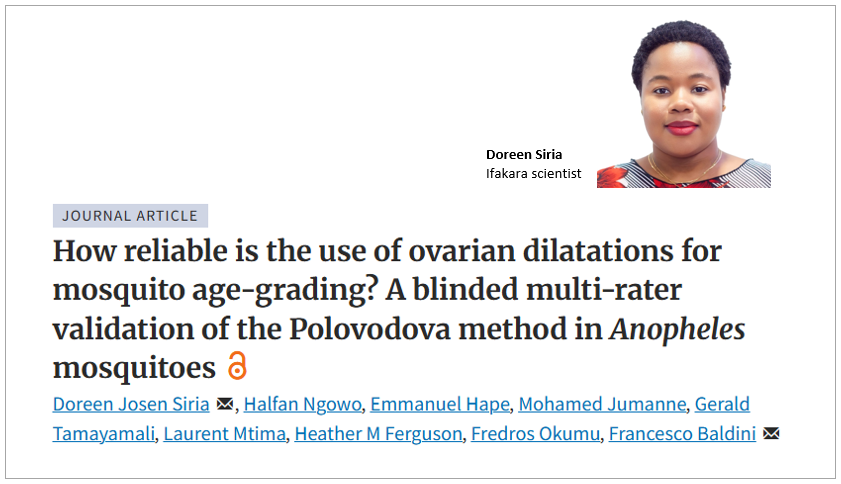
Led by IHI researcher Doreen Josen Siria, under the supervision of Heather Ferguson, Fredros Okumu and Francesco Baldini, the study assessed how accurately and consistently the Polovodova method could estimate the age of Anopheles mosquitoes.
Experiments were conducted at the IHI’s VectorSphere facility in Ifakara, Tanzania, where researchers examined more than 3,600 laboratory-reared mosquitoes from two important malaria-vector species, Anopheles arabiensis and Anopheles funestus, representing different reproductive stages. They also examined 600 mosquitoes collected in the field in Ulanga District, Tanzania.
Importantly, the researchers used a blinded, multi-rater approach. Three researchers independently dissected and assessed the mosquitoes without knowing their expected age classification. Their results were then compared to determine how consistently the method performed between readers.
The study involved several IHI researchers, including Halfan Ngowo, Emmanuel Hape, Mohamed Jumanne, Gerald Tamayamali, and Laurent Mtima.
Reliable—but not at every stage
The findings show that the Polovodova method remains a useful tool, particularly for distinguishing mosquitoes that have reproduced from those that have not.
The method correctly identified 98–100% of mosquitoes that had never reproduced and 94–96% of those that had reproduced. Agreement between researchers was also very high for this basic distinction.
However, the method became less reliable when estimating the age of older mosquitoes.
For the oldest mosquitoes, researchers were more likely to underestimate their age—an important finding because older mosquitoes are more likely to have survived long enough for the malaria parasite to develop and be transmitted.
What this means for malaria research
The findings do not mean that the Polovodova method should be abandoned.
Instead, they give researchers a clearer understanding of where the method performs well and where greater caution is needed, especially when assessing older mosquitoes.
The researchers suggest that additional quality-control measures may be needed, including having multiple trained readers assess specimens and reviewing cases where their assessments differ.
These findings provide an important benchmark for researchers using mosquito age-grading in malaria surveillance and in evaluating vector-control interventions.
Read more here.