

MEETING: Ifakara VectorGrid-Africa team, government partners advance mosquito surveillance and outbreak preparedness in Tanzania
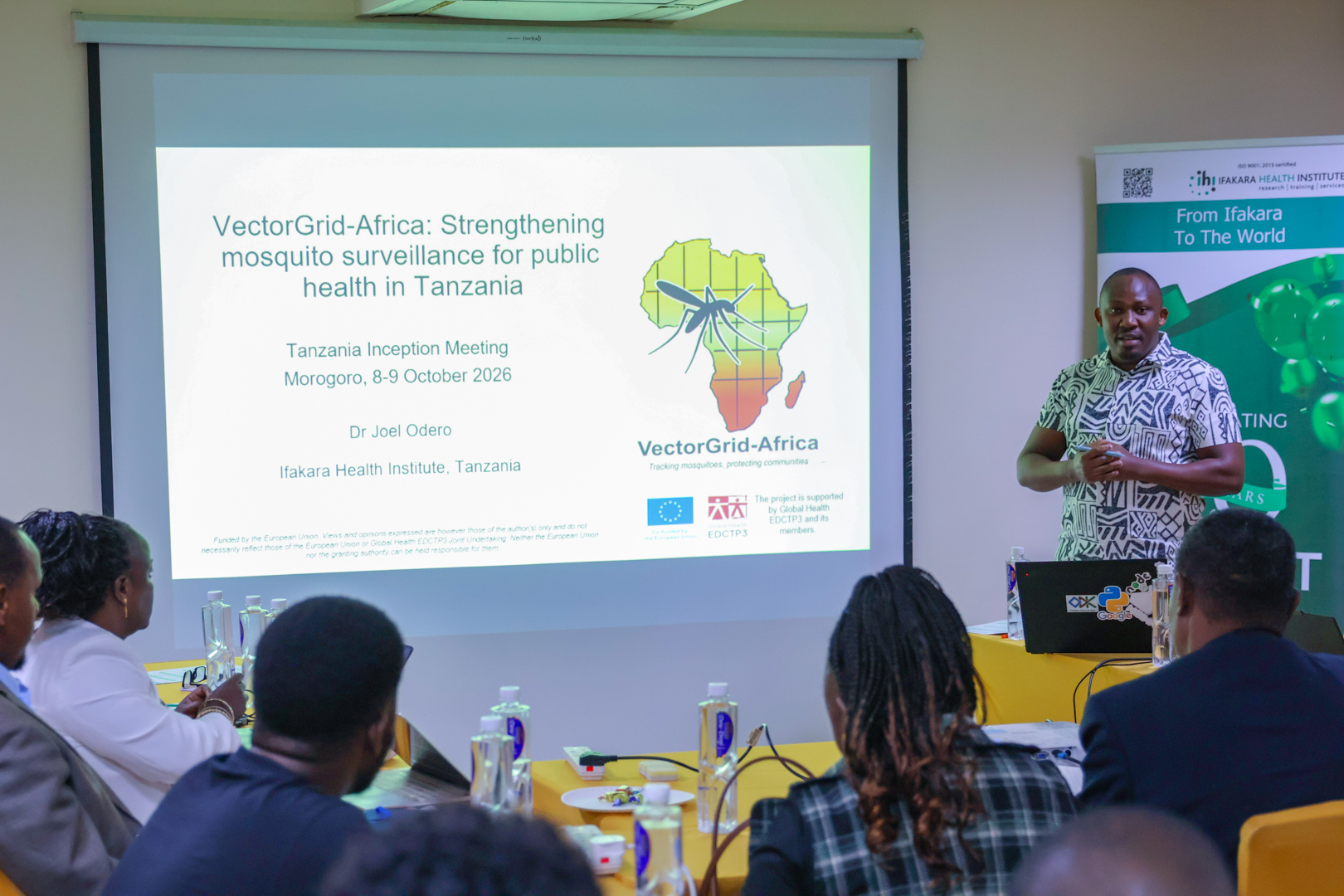
The VectorGrid-Africa team at Ifakara Health Institute (IHI) convened a two-day inception meeting in Morogoro, Tanzania, on 8–9 October 2026, bringing together government departments and research partners to discuss implementation plans and national priorities for mosquito surveillance and outbreak preparedness.
The meeting covered three complementary projects supported by the European Union through the Global Health EDCTP3 Joint Undertaking, Coefficient Giving and Amref Health Africa. Discussions addressed their respective contributions to long-term surveillance, country ownership and use of data, and workforce readiness to respond to climate-sensitive outbreaks.
The meeting brought together representatives from the Prime Minister’s Office – Regional Administration and Local Government (PMO–TAMISEMI); the Ministry of Health, through the Neglected Tropical Diseases Department and the National Malaria Control Programme (NMCP); the National Institute for Medical Research (NIMR); and the Kilimanjaro Clinical Research Institute (KCRI), Tanzania. Discussions focused on how the three projects can support existing national systems and generate evidence that informs public health decisions.
The EU-funded observatory project is coordinated by the University of Glasgow, with IHI serving as the scientific lead, and brings together partners in Tanzania, Kenya, Madagascar, Mozambique and South Africa.
Together, the projects aim to improve understanding of changing mosquito-borne disease risks and strengthen countries’ capacity to act on surveillance evidence.
Giving an overview of the work, Dr Joel Odero, Principal Investigator at IHI and Technical Director of VectorGrid-Africa, emphasized the importance of listening to stakeholders, engaging communities, learning from local experiences and adapting approaches to the needs of participating countries.
Building a stronger foundation for mosquito surveillance
Mosquito-borne diseases remain a major public health challenge, but gaps in long-term surveillance data can make it difficult to track changes in mosquito populations, understand transmission patterns and assess how environmental changes and vector control interventions affect disease risk.
The EU-funded VectorGrid-Africa project is establishing observatory sites across the five participating countries to collect standardized, long-term data on mosquitoes, the pathogens they carry and environmental conditions. This work will help assess how climate, land use and vector control influence disease risks.
Support from Coefficient Giving strengthens country ownership, engagement with communities and government institutions, and the management and use of surveillance data. It will help link mosquito surveillance with routine health data and support national teams to use the evidence in public health decisions.
The VectorGrid-Africa Rapid Vector Response project, supported through Amref Health Africa, focuses on workforce readiness and the capacity to mobilize during climate-sensitive outbreaks in Tanzania, Kenya and Mozambique. Activities include practical training, response procedures and pre-positioned equipment for field teams, linking surveillance findings to preparedness and response.
Aligning research with national public health priorities
The Morogoro meeting focused on translating the three projects’ objectives into practical implementation plans that respond to Tanzania’s surveillance and preparedness needs.
Discussions covered the selection of observatory sites, collection of environmental and climate data, community engagement and data management, alongside workforce development and outbreak response readiness. Participants considered how these activities could link with existing national surveillance systems and priorities.
Participants also explored surveillance needs relating to malaria and neglected tropical diseases, alongside the use of a One Health approach, which recognizes the connections between human, animal and environmental health. Discussions included surveillance relevant to diseases such as Rift Valley fever.
Another focus was the relationship between urbanization and mosquito-borne diseases. Participants examined how Aedes mosquitoes, which can transmit dengue, may behave differently across urban, peri-urban and rural settings in Tanzania’s Mwanza region, with implications for human exposure to the disease.
The discussions also highlighted the importance of country ownership and sustained engagement with government agencies and communities across all three projects.
The meeting concluded with action planning to define activities, responsibilities and timelines for implementation in Tanzania.
Funding acknowledgement
The VectorGrid-Africa observatory is funded by the European Union through Global Health EDCTP3 and its members. The country ownership and data project is supported by Coefficient Giving. The Rapid Vector Response project is supported through Amref Health Africa’s Advancing Research for Climate and Health (ARCH) Eastern and Southern Africa Regional Hub, with funding from Canada’s International Development Research Centre (IDRC) and the UK Foreign, Commonwealth & Development Office (FCDO).