

NEWBORN HEALTH: Simple hospital practices could improve care for sick newborns across Africa
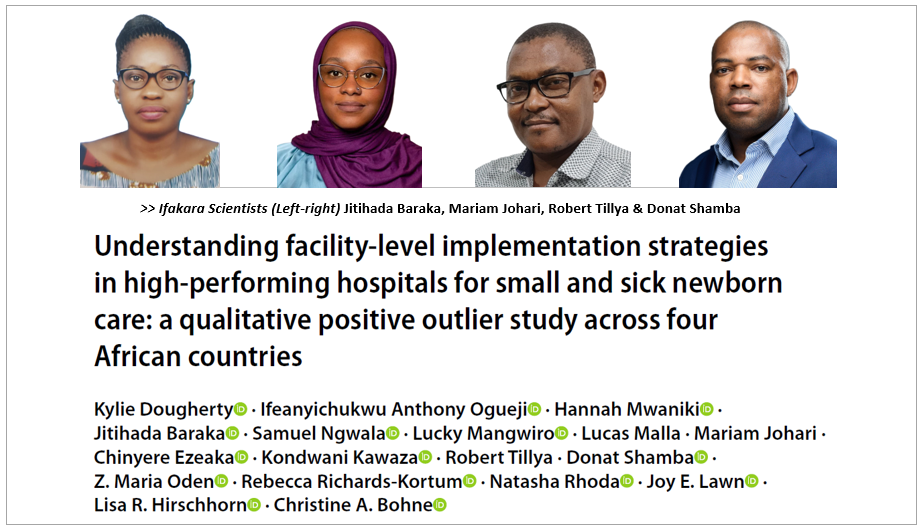
Better teamwork, regular staff mentoring and effective use of hospital data could help more premature and sick newborn babies receive lifesaving care, a new study has found.
Published recently in BMC Health Services Research, the study examined how 16 high-performing hospitals in Tanzania, Kenya, Malawi and Nigeria, supported by The Newborn Essential Solutions and Technologies (NEST360) alliance, delivered essential newborn care, identifying practical strategies that other hospitals could adopt.
Four Ifakara Health Institute researchers, Jitihada Baraka, Mariam Johari, Robert Tillya and Donat Shamba—contributed to the multi-country study, led by Kylie Dougherty of Northwestern University.
Learning from successful hospitals
Rather than focusing on hospitals struggling to provide quality care, researchers investigated those achieving strong results to understand what they were doing differently.
The study examined four essential newborn care interventions: kangaroo mother care, which involves prolonged skin-to-skin contact; continuous positive airway pressure (CPAP) to support babies with breathing difficulties; phototherapy to treat newborn jaundice; and measures to prevent dangerously low body temperatures.
Small changes, meaningful improvements
Through interviews and focus group discussions with healthcare workers, researchers identified 114 strategies used to improve newborn care. Common strategies included:
- Peer-to-peer mentorship: Experienced health workers helping colleagues strengthen their skills.
- Routine data reviews: Using patient care information to identify gaps and track improvements.
- Family education: Helping parents understand and participate in their babies' care.
Hospitals also adapted their approaches to local needs. In Tanzania, greater emphasis was placed on infection prevention and control, while hospitals in Malawi prioritized using data to guide decisions.
Many of the strategies were low-cost, focusing on staff motivation, accountability and teamwork rather than requiring substantial new investments.
Why does this matter?
The findings offer practical lessons for hospitals and health policymakers seeking to improve newborn care across Africa.
The researchers emphasized that providing medical equipment and training alone is not enough.
“Beyond program interventions, like trainings and providing medical devices, strategies fostering staff engagement, leadership support, and cultural alignment are critical,” the authors underlined.
The study highlights how relatively simple changes in everyday hospital practices could help more vulnerable newborns receive the care they need.
Read the publication here.