

INNOVATION: Digital imaging offers a faster, more accurate way to assess mosquito net damage
Blocking mosquitoes from reaching humans at night is one of the most effective strategies for preventing malaria. Insecticide-treated nets play a vital role in this protection, but over time they develop holes that weaken their barrier—reducing both effectiveness and the willingness of families to use them. Assessing the physical condition of these nets is essential for deciding when to replace them.
Traditionally, health workers use the World Health Organization (WHO) hole counting method—visually inspecting nets, classifying holes into size categories, and estimating total damaged area. While useful, this method can be labor-intensive, prone to underestimating damage, and slow to conduct in the field.
Researchers who contributed to this study - published in Malaria Journal in March 2025 – came from the Ifakara Health Institute, Swiss Tropical and Public Health Institute, University of Basel, Center for Medical Image Analysis & Navigation (University of Basel), Yale University, The Nelson Mandela African Institution of Science and Technology, and the Ministry of Health—National Malaria Control Programme (Tanzania).
An innovative solution: image-based damage assessment
To improve accuracy and efficiency, a research team from Tanzania, Switzerland, and the USA tested a digital image analysis approach for assessing net damage. Instead of relying solely on visual inspection, nets are photographed in a standardized setup, and holes are identified using a custom-built graphical user interface.
This method allows researchers to measure the exact surface area of holes and compare results with close-up calibrated images. By doing so, they can determine if image analysis is as accurate—or better—than the traditional WHO method.
Key findings from the study
The study found that:
- Image analysis closely matched ground truth measurements, confirming that photographs can reliably capture net damage.
- The WHO method consistently underestimated damage, especially for very small or very large holes.
- The image-based approach could be automated using machine learning, offering a faster, cheaper, and more objective tool for net monitoring.
Why it matters
Smarter net monitoring means better use of resources. By knowing exactly when nets need replacing, malaria control programmes can prioritize areas with the greatest need, improve household protection, and save money on unnecessary replacements.
The researchers explain, this method “provides a basis for automating hole detection using deep learning—offering a fast, objective, and low-cost way to monitor ITN durability.”
Designed for scale and sustainability
The image analysis method is:
- Low-cost – requires only a camera or tablet.
- Scalable – can be used in any malaria-endemic region.
- Adaptable – works with minimal training and could be integrated into existing malaria programme workflows.
With further development, the system could link directly to national malaria control dashboards, providing real-time durability data for decision-makers.
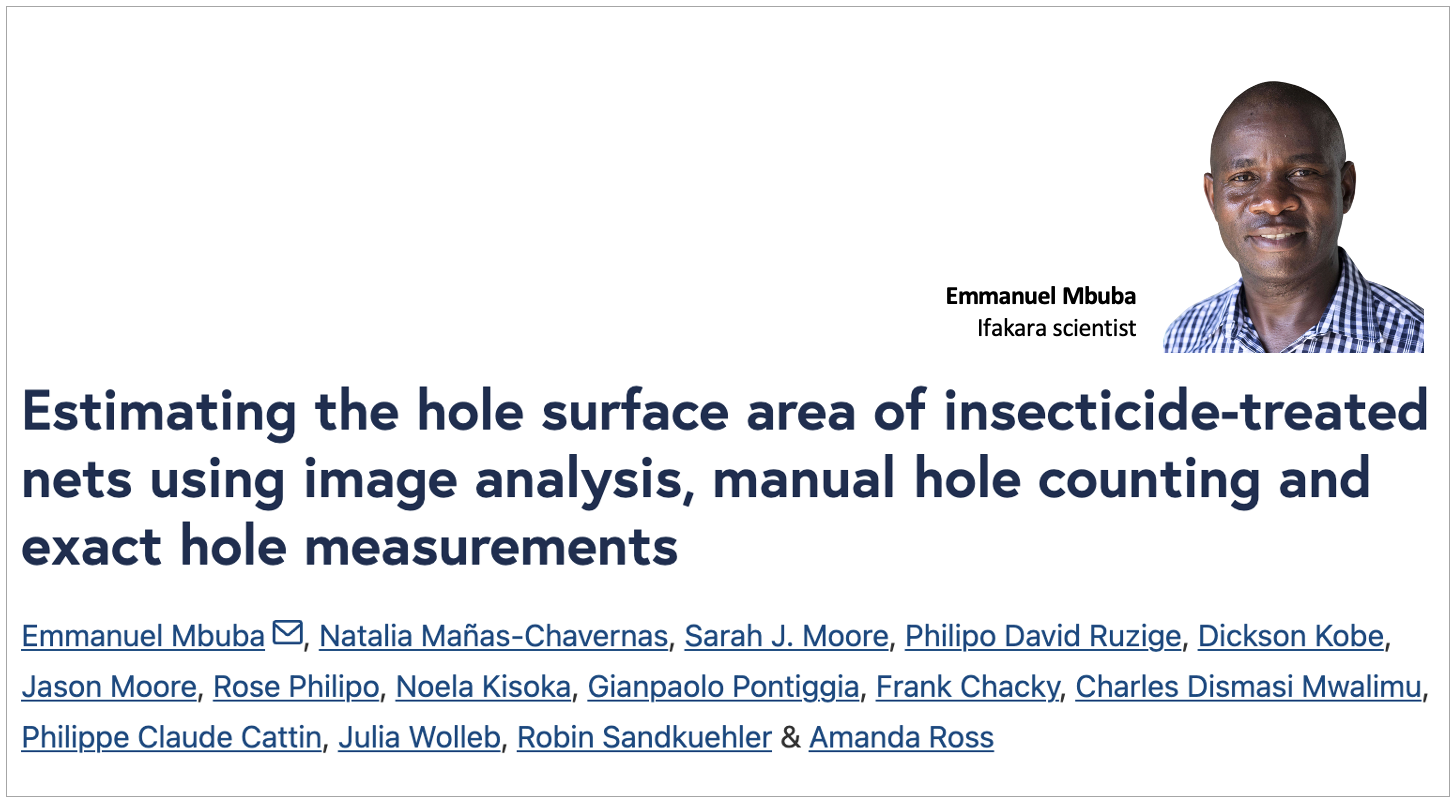
Ifakara’s Emmanuel Mbuba led the study
The study was led by Ifakara Health Institute’s Emmanuel Mbuba, with contributions from Natalia Mañas-Chavernas, Sarah J. Moore, Philipo David Ruzige, Dickson Kobe, Jason Moore, Rose Philipo, Noela Kisoka, Gianpaolo Pontiggia, Frank Chacky, Charles Dismasi Mwalimu, Philippe Claude Cattin, Julia Wolleb, Robin Sandkuehler, and Amanda Ross
Read the full publication here