

NEWBORN CARE: Staffing shortages threaten survival of small and sick babies
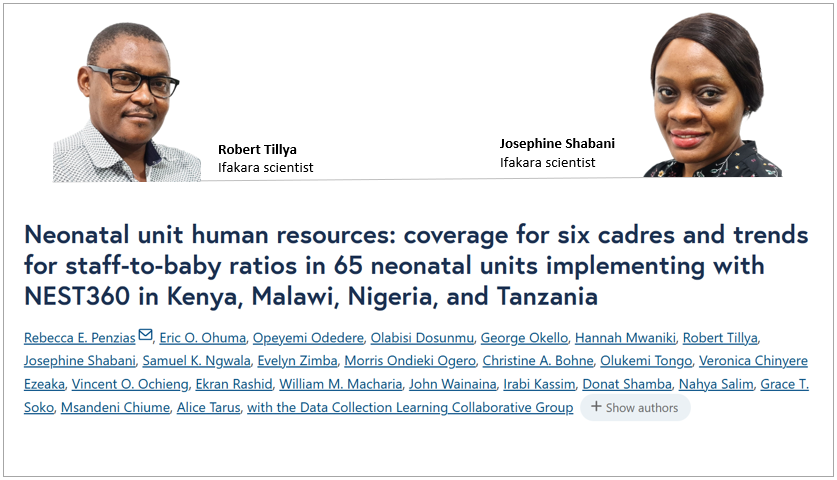
As the world marks World Prematurity Day this week, we are reminded of the urgent need to strengthen care systems to save newborns lives. In a recent study led by partners within the Newborn Essential Solutions and Technologies (NEST360) Alliance, scientists warn that staff shortages in newborn units across four African countries are putting vulnerable newborns at risk.
Published recently on Human Resources for Health, the study reveals understaffing gaps across 65 neonatal units in hospitals in Kenya, Malawi, Nigeria and Tanzania, which directly affects the quality of care for small and sick newborns.
Why this matters?
Sick neonates can die in minutes and having sufficient skilled staff and specialized technologies is essential. Yet in many low- and middle-income countries (LMICs), there is a severe shortage of health workers, with the deepest gaps in the poorest countries in Africa and Southern Asia.
In Tanzania, the Ifakara Health Institute is a key player in improving newborn care through research, innovation, and implementation. Through the NEST360 Alliance, Ifakara supports the government in strengthening small and sick newborn care (SSNC) and addressing staffing gaps by training nurses, biomedical technicians, and other frontline health workers who run neonatal units. This new multi-country study underscores the importance of these efforts.
Collaboration across continents to save newborn lives
The study — carried out through a collaboration between Ifakara and partners from the UK, Kenya, Nigeria, Malawi, and the US — examined staff-to-baby ratio across 65 neonatal units four African countries that are part of the NEST360 program. The findings make one thing clear: newborn survival depends on having enough trained and skilled staff in neonatal units.
“Neonatal survival in hospitals requires better staff-to-baby ratios and more skilled staff,” the scientists emphasized. “To meet the projected shortfall in the health workforce, governments must invest in training more health workers for neonatal care.”
Led by Rebecca Penzias with Joy Lawn and David Gathara as joint senior authors — all from the London School of Hygiene & Tropical Medicine — the study also included key contributions from Ifakara scientists Robert Tillya, Josephine Shabani, Christine Bohne, Irabi Kassim, Donat Shamba, and Nahya Salim.
Inside the newborn units: A look at the findings
Here’s what the study revealed across the 65 neonatal units:
- Unfavorable nurse-to-baby ratios
- The median nurse-to-baby ratio was 1:6 during the day.
- At night, the ratio worsened to 1:10, meaning one nurse may care for ten newborns.
- Staffing gaps were greatest at higher-level hospitals, reporting ratios as wide as 1:14.
- In overcrowded wards (occupancy >80%), the ratio again stretched to 1:14.
- Limited doctor presence
- Nearly four in ten (40%) of neonatal units had no doctor on-site during the day.
- Doctor-to-baby ratios dropped from 1:35 by day to 1:105 at night.
- Only about half of hospitals had a paediatrician or neonatologist assigned to the unit.
For small and sick newborns who need constant monitoring and specialized care, these numbers are alarming. They underscore a stark reality: nurses and doctors are working very hard, but there simply aren’t enough of them.
Progress behind the scenes
Despite these challenges, the study also found important progress. More neonatal units now have biomedical technicians to maintain life-saving equipment, data clerks for tracking admissions, treatment and outcomes, and improved systems for recording workloads and staffing. However, critical services such as 24-hour laboratory support remain limited in many hospitals, leaving gaps in newborn care.
What needs to happen next?
The researchers recommend several priority actions. This include;
- Routine, timely data on staffing to guide decisions,
- Increased investment in the quantity and skills of the neonatal workforce,
- Strengthening health systems to ensure reliable supplies, functioning equipment, and effective supervision and management
Why this matter on World Prematurity Day?
This evidence gives health managers and policymakers a clear picture of what’s working and where urgent action is needed.
While technology plays an important role, the study underscores that without enough trained people, even the best tools fall short. Equipment, tools, and guidelines are important — but none of them can replace trained, available nurses, doctors, and technicians
As we mark World Prematurity Day, the message is urgent yet hopeful: with increased investments in people, many more tiny lives can be saved.
Read the publication here.