

BREAKTHROUGH: Tanzania scientists develop mosquitoes that cannot transmit malaria
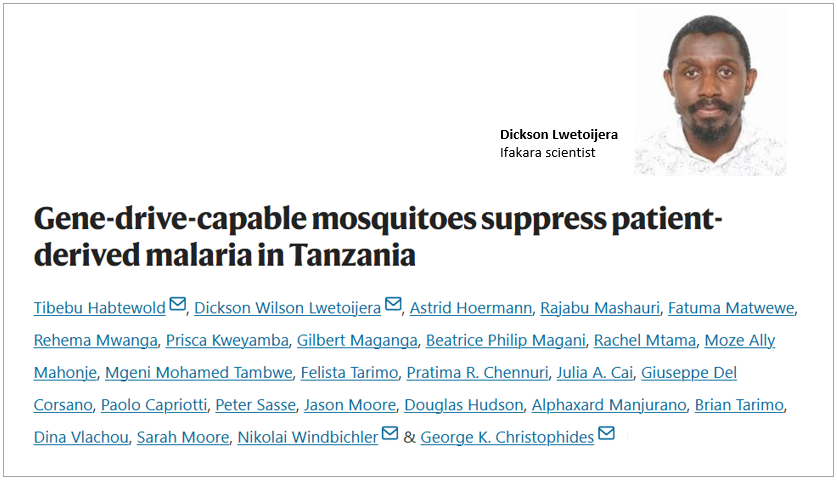
In Tanzania, a team of scientists has achieved a major breakthrough that could transform malaria control across Africa: the successful development of genetically modified mosquitoes that are can block the transmission of malaria.
Milestone achieved on African soil by African scientists
A study published today in Nature, confirms that researchers from the Ifakara Health Institute (IHI) and the National Institute for Medical Research (NIMR) in Tanzania, in partnership with Imperial College London in the UK through the Transmission Zero programme, have created the first gene-drive mosquito strain developed on African soil by African scientists.
“This is the first time a genetically modified, gene-drive compatible mosquito strain has been developed in Africa, by African scientists, targeting malaria parasites circulating in local communities,” said Dr Dickson Wilson Lwetoijera, Programme Director at IHI. “We are proud to be driving innovation locally, using cutting-edge tools to address one of our continent’s most pressing health challenges.”
Ifakara scientists among key contributors to the study
Dr. Dickson serves a co–lead author of the study alongside Tibebu Habtewold of Imperial College London. The paper’s senior authors are Nikolai Windbichler and George Christophides, also from Imperial College London.
From Ifakara, contributors to the study include Rajabu Mashauri, Fatuma Matwewe, Rehema Mwanga, Prisca Kweyamba, Gilbert Maganga, Beatrice Philip Magani, Rachel Mtama, Moze Ally Mahonje, Mgeni Mohamed Tambwe, Felista Tarimo, Peter Sasse, Jason Moore, Brian Tarimo and Sarah Moore.
The research team modified anopheles gambiae, the species responsible for malaria infections, by introducing naturally occurring molecules found in frogs and honeybees. These molecules prevent the malaria parasite from maturing inside the mosquito.
Simply put: if the parasite cannot grow, the mosquito cannot pass malaria to people.
Why this matter
For many Tanzanian communities, malaria remains a daily threat. Bed nets, indoor spraying, and other tools have saved countless lives, but their effectiveness is increasingly undermined by growing insecticide resistance.
Developed in 2023, the new mosquito strain offers an alternative approach. Instead of trying to kill mosquitoes, it blocks the malaria parasite inside them. If proven safe and effective on a larger scale, it could complement existing tools and support efforts to eliminate malaria.
Tested against real infections
To confirm the approach works in real life, scientists fed the genetically modified mosquitoes with blood from local children infected with malaria. The mosquitoes were largely unable to support parasite growth, reducing their ability to infect humans.
A milestone for African-led science
This historic achievement reflects years training and collaboration under the Transmission Zero programme, which has helped build local expertise in molecular biology, genetics, and vector control, placing local institutions at the forefront of emerging genetic technologies.
Prof. George K. Christophides from Imperial College London said the work demonstrated the importance of African leadership.
“This study is not about technology alone. It’s about leadership, responsibility, and partnership. It shows what is possible when African institutions lead, and international collaborators support.”
The research also represents a shift in where high-tech malaria research is conducted. Developing the modified mosquitoes in Tanzania, using local facilities and expertise, ensures the technology is better adapted to local conditions and public health needs.
A new tool in the malaria fight
Tanzania is among the four countries responsible for more than half of global malaria deaths. The genetically modified mosquitoes could provide an additional, promising new approach to complement existing efforts.
Dr. Lwetoijera noted that Tanzania’s regulatory environment is supportive and responsible:
“In line with global guidelines and policy by the WHO, CBD, and IUCN—and with a responsible Tanzanian regulatory landscape—we are setting our own agenda in the fight against malaria.”
He added that the findings pave the way for expanding the technology to other mosquito species:
“These findings on Anopheles gambiae are the pathfinder for the technology to be extended to other important malaria vectors such as Anopheles arabiensis and Anopheles funestus, as well as vectors of arboviral diseases like dengue and chikungunya.”
What are the next steps
Although the modified mosquitoes will not be released into the wild at this stage, the successful outcomes so far are promising. Further research, regulatory reviews, and community consultations are required before any field trials can move forward, emphasizes the scientists.
Dr. Nikolai Windbichler of Imperial College London underlines the need to move forward with both caution and urgency:
“Our goal is to offer a novel tool that can complement existing methods in order to achieve malaria elimination in Africa, and this is a huge step forward," he said.
"We want to move at the right speed, not too fast so that everyone is on board and supportive of this new technology, but also with urgency, so that we treat malaria as the emergency that it is.”
Read the publication here.