
GENDER: Study links discrimination to poor health outcomes for women in Africa
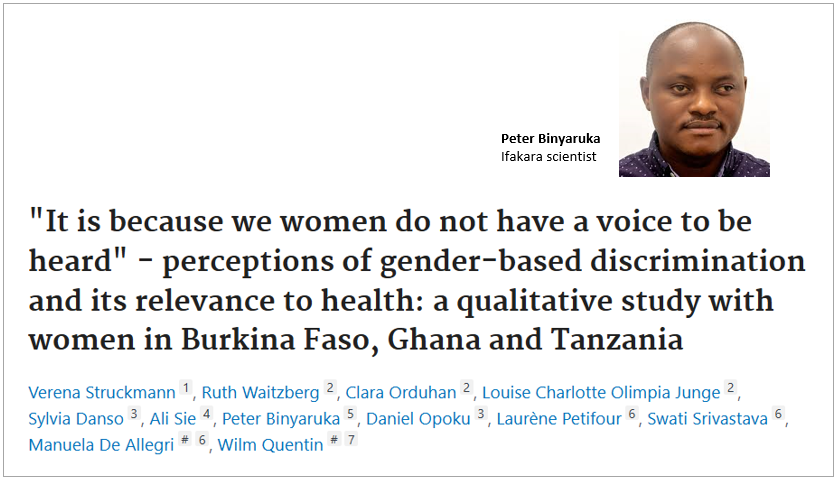
A new multi-country study has found that gender-based discrimination remains a major barrier to women’s health and wellbeing in parts of Africa, limiting their access to healthcare, education, income, and decision-making power.
The study, conducted in Burkina Faso, Ghana, and Tanzania, draws on women lived experiences to show how deeply rooted social and cultural norms continue to shape their daily lives and health outcomes.
Published recently in the International Journal for Equity in Health, the research was led by scientists from Germany and Ghana, with key contributions from Ifakara Health Institute scientist Peter Binyaruka.
What the study found
Based on focus group discussions and in-depth interviews with women from diverse communities, the study found that many women experience discrimination as part of everyday life. Men often control household decisions, including those related to healthcare, pregnancy, and family planning.
These inequalities are often so normalized that many women accept them as part of everyday life, even when they negatively affect their health.
Key findings include:
- Limited decision-making power: Many women reported needing permission or financial support from male partners or family members before seeking medical care, leading to delays in treatment, particularly for maternal and reproductive health services.
- Economic dependence: Restricted access to education and income-generating opportunities keeps many women financially dependent, leading to unequal power dynamics in households and communities.
- Silenced voices: Women described feeling excluded from decision-making processes, saying their views were often ignored, limiting their ability to advocate for their own health and wellbeing.
According to the researchers, gender-based discrimination is often internalised and accepted as “normal”. “Across all sites, participants conceptualised gender-based discrimination as a normalised, systemic structure embedded in both public and private spheres,” the study notes.
Women also described discrimination as “omnipresent”, upheld by cultural, religious, economic, and educational norms that reinforce power imbalances, particularly in household decision-making.
Why these findings matter
The study highlights that gender discrimination is not only a social issue, but also a public health concern.
When women lack autonomy over health-related decisions, the consequences include:
- Delayed treatment and poorer health outcomes
- Increased health risks, especially during pregnancy and childbirth
- Emotional stress and reduced overall wellbeing
The findings show that strengthening health systems alone is not enough to address health inequalities if the underlying social and power structures that disadvantage women remain unaddressed.
The study calls for stronger efforts to challenge harmful gender norms at both community and institutional levels, rather than focusing solely on improving health services.
Recommended actions include increasing women’s participation in household and community decision-making, engaging men and community leaders in discussions about gender equality, and strengthening gender-responsive health systems.
“Our findings underscore the need for multisectoral strategies to address women’s health inequities,” the researchers note adding that, efforts must focus on “dismantling entrenched gender norms, enhancing women’s decision-making power, and ensuring institutional accountability for gender equity within health systems, not only in Burkina Faso, Ghana, and Tanzania.”
As one participant told researchers, women’s health challenges persist “because we do not have a voice to be heard” — a statement underlines the urgent need to place women’s experiences at the centre of health and development strategies.
Read the publication, here.