

HEALTH FINANCING: Incentives can improve health services — but only if they fit local realities
Incentives offered through pay-for-performance (P4P) programmes—which reward health workers and facilities for meeting specific service targets—can improve health outcomes. However, a new study shows that their success depends largely on how well these programmes are adapted to local contexts.
P4P schemes aim to improve the quality of care by linking funding to measurable results. But health systems are complex. A programme that delivers results in one country may fail in another because of differences in staffing, funding, and the way health services are managed.
Published in the journal SSM – Health Systems, the study examined how P4P programmes operate in Zambia and compared the findings with earlier research from Tanzania.
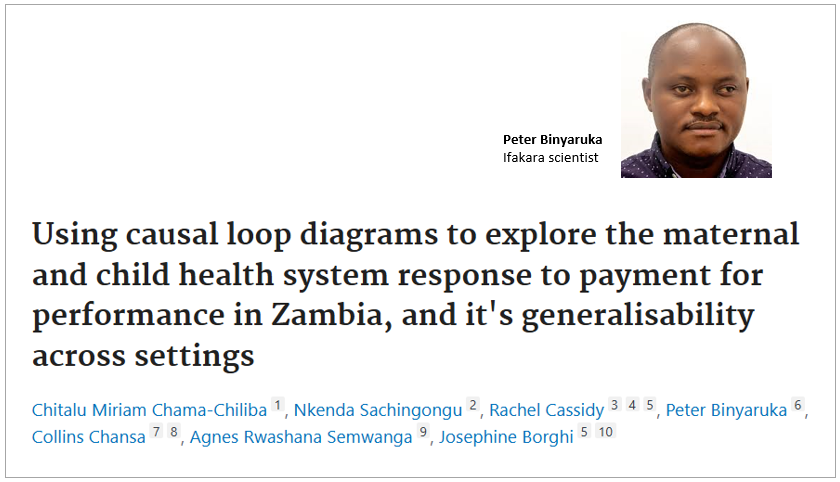
The study was led by scientists from Zambia, Switzerland, Tanzania, Liberia, Uganda and Austria. Contributing to the study is Ifakara Health Institute scientist Peter Binyaruka.
Why this study matters
Despite increased service utilization, many health systems in low-and-middle-income countries (LMICs) continue to struggle with poor outcomes.
P4P programmes have been promoted by governments and donors as a way to improve health services by making better use of existing resources. Yet evidence of their effectiveness has been mixed.
This study helps explain why. Financial incentives do not operate in isolation. They interact with social, institutional, and behavioural factors that vary from one setting to another. Ignoring these dynamics can limit their impact.
Understanding how P4P works
The researchers used causal loop diagrams (CLDs) — a systems-thinking tool that maps how different parts of a health system influence one another over time.
The diagrams mapped interactions between funding, health worker motivation, supervision, workload, service quality, and patient use of services. They also revealed feedback loops that can either improve or undermine performance.
Using Zambia as a case study, the researchers compared these dynamics with those previously identified in Tanzania to assess whether similar patterns emerged in a different context.
Incentives help — but context determines impact
The study found that financial incentives can motivate health workers, improve service delivery, and encourage accountability. However, the impact of these incentives varied widely depending on local conditions.
In Zambia, factors such as limited facility autonomy, delayed incentive payments, weak management systems, staff shortages, heavy workloads, and low levels of trust between health workers and authorities shaped how well P4P functioned.
In some cases, these challenges weakened the intended effects of the P4P — even where the scheme itself was well designed.
Recommendations to improve P4P
The researchers argue that policymakers should move beyond simply copying “successful” P4P models from other countries.
Instead, they recommend context-specific design and adaptation, warning that a one-size-fits-all approach is unlikely to produce desired results across different health systems.
The study also highlights the value of causal loop diagrams as a practical tool for understanding health system dynamics and comparing interventions across countries.
If P4P schemes are to deliver real results, the study urges policymakers and programme designers to pay close attention to local conditions and system readiness.
Read the publication, here.