

MALARIA CONTROL: Different insecticides between homes may tackle mosquito resistance
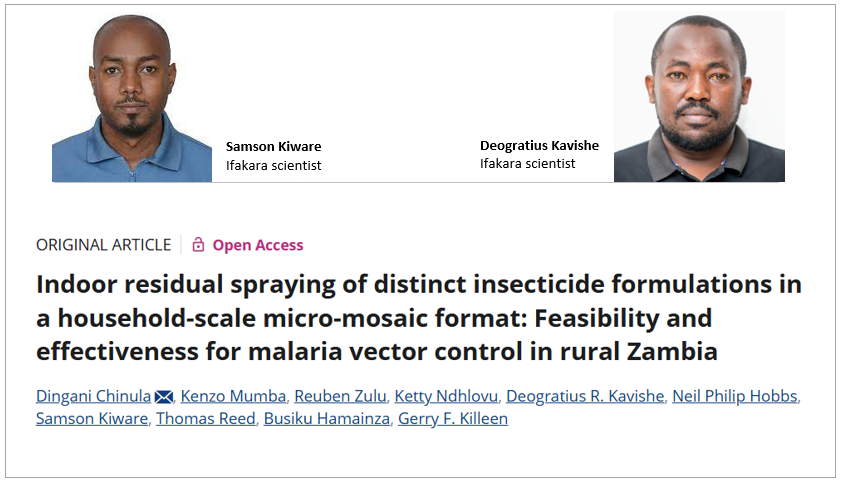
A new study in rural Zambia suggests that spraying different insecticides in neighboring households could help slow the spread of insecticide resistance while maintaining protection against malaria.
Published recently in the journal of Medical and Veterinary Entomology, the study tested a household-level spraying approach known as a "micro-mosaic". Instead of using the same insecticide across an entire community, different insecticides were applied in alternating neighboring homes.
A growing challenge for malaria control
The approach aims to address one of the biggest challenges facing malaria control today: insecticide resistance. As mosquitoes become less prone to commonly used insecticides, some malaria prevention tools risk becoming less effective over time.
Researchers from Zambia, Ireland, the United Kingdom and Tanzania, including scientists from Ifakara Health Institute, compared three indoor residual spraying (IRS) strategies: spraying all houses with DDT, spraying all houses with a mixture of clothianidin and deltamethrin, and alternating the two insecticides between neighboring households.
IRS is a widely used malaria prevention method that involves spraying insecticides on indoor walls, where mosquitoes often rest after feeding. The intervention has helped reduce malaria transmission in many countries, but its long-term effectiveness is threatened when mosquitoes develop resistance to the chemicals used.
Testing an alternative way to use existing insecticides
To address this challenge, malaria control programmes increasingly use different insecticides in different locations. However, these products are usually distributed between villages or larger geographical areas. This study explored whether the same principle could work at the level of individual households.
The research was conducted in Luangwa District, Zambia, where mosquito populations were monitored in 135 households for one year following a routine IRS campaign.
What the researchers found
The results showed that mosquito numbers remained low across all study areas. Researchers found no significant differences in the number or types of malaria-carrying mosquitoes under the three spraying strategies.
The findings suggest that household-level micro-mosaics can provide similar protection against malaria mosquitoes as conventional spraying methods while potentially offering an additional way to manage insecticide resistance.
Although further studies are needed to determine whether the strategy can slow resistance over the long term, the researchers found that micro-mosaic spraying was practical to implement under routine programme conditions.
Why the findings matter
Insecticide resistance is an increasing threat to malaria control across Africa. When mosquitoes are repeatedly exposed to the same insecticide, those with resistance traits are more likely to survive and pass those traits on to future generations.
By exposing mosquito populations to different insecticides within the same community, micro-mosaics may reduce the selection pressure that drives resistance, making it harder for mosquitoes to adapt to a single product.
If future studies confirm these benefits, the approach could help preserve the effectiveness of existing insecticides and provide malaria control programmes with another tool to protect communities from malaria.
Read the publication here.
We're a Registered Charity Organization in Tanzania
Ifakara Health Institute (IHI) is officially recognized as a charitable organization under the Income Tax Act. Certification issued on 20 March 2025 and valid until 31 December 2030.
Ifakara Health Institute (IHI) is officially recognized as a charitable organization under the Income Tax Act. Certification issued on 20 March 2025 and valid until 31 December 2030.