

MALARIA: Imported cases in Pemba puts elimination goals at risk
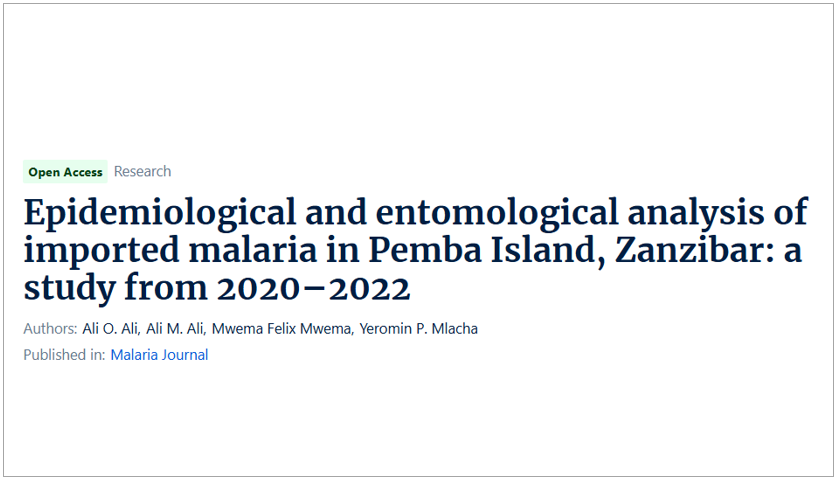
Imported malaria remains a major barrier to eliminating the disease on Pemba Island, new research by Ifakara health institute shows, threatening years of progress in reducing cases across the Zanzibar archipelago.
Between 2020 and 2022, more than 2,600 malaria cases were recorded in Pemba, with over half (53%) classified as “imported” — meaning the infection was acquired outside the island and brought back by travelers.
Published in Malaria Journal recently, the study found that most imported infections originated from high-transmission regions on Tanzania Mainland, particularly Tanga, Dar es Salaam and the Coastal Region. Men and adults over 18 were far more likely to carry infections home following travel.
The study was led by Ifakara Health Institute scientists Ali O. Ali, Ali M. Ali and Yeromin Mlacha, with contributions from Mwema Felix Mwema of the Nelson Mandela African Institution of Science and Technology (NM-AIST).
Why these findings matter
Zanzibar has made remarkable achievements in reducing malaria prevalence to around 1% in recent years, driven by sustained control efforts such as insecticide-treated bed nets, improved testing, and rapid treatment. However, the continued importation of malaria threatens to reverse this progress by re-introducing parasites into areas where transmission could re-establish.
Scientists warn that this risk is particularly high in districts such as Mkoani, where higher mosquito biting rates indicate greater receptivity to local transmission if imported cases are not detected and treated quickly.
“Imported cases a persistent barrier”
The researchers emphasize that imported malaria has become a persistent challenge to elimination efforts, especially as travel and economic activity between the islands and mainland Tanzania increase following the COVID-19 pandemic.
Although the study did not show a direct link between the total number of mosquitoes and imported case distribution, areas with higher human biting rates were associated with greater numbers of imported infections.
Call for stronger travel-linked controls
The scientists conclude that the findings underscore the need for stronger cross-border surveillance, particularly at ports of entry, including timely screening and treatment of travelers returning from high-risk areas.
They also call for closer coordination between Zanzibar and mainland health systems, alongside spatially targeted interventions in districts most vulnerable to transmission. Integrating entomological and epidemiological data, they say, will be critical to guiding effective strategies and sustaining malaria elimination progress on Pemba Island.
Without decisive action, the researchers warn, the hard-won gains toward malaria elimination in Zanzibar could be at risk of reversal, undermining broader regional efforts to eliminate the disease in East Africa.
Read the publication, here.