NEW HOPE: Shorter TB treatment on the horizon
Imagine battling a disease that requires you to take pills every day for six long months. For millions living with tuberculosis (TB), this is the reality.
But what if that timeline could be cut down to just four months without losing effectiveness? That's the exciting promise of a new clinical trial called OptiRiMoxTB, detailed in a study protocol published on January 30, 2026, in Trials.
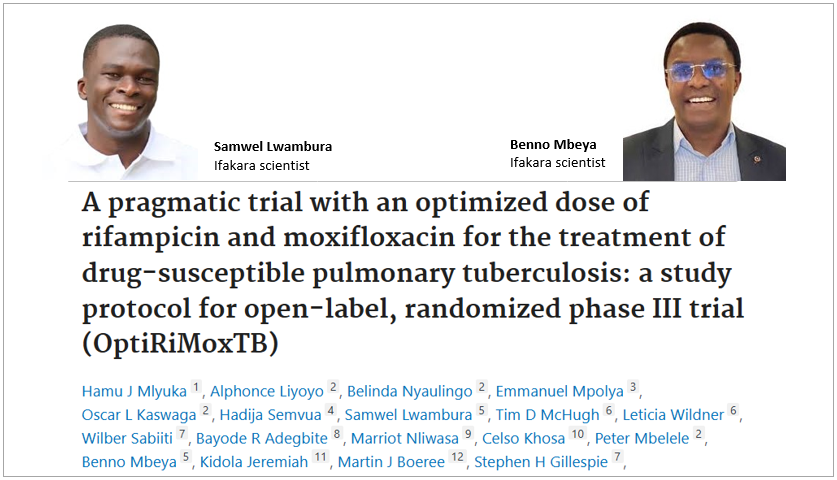
This research – to which Ifakara Health Institute researchers Benno Mbeya and Samwel Lwambura contributed to – aims to test a faster, more accessible treatment for drug-susceptible pulmonary TB, using higher doses of a common antibiotic combined with others to speed up recovery.
Why this trial could change lives
TB remains one of the world's deadliest infectious diseases, claiming over a million lives each year, especially in regions like Africa where access to healthcare can be challenging. The current standard treatment works, but its lengthy duration often leads to patients dropping out, which can worsen outcomes and spread the disease.
This trial matters because it seeks a shorter regimen that's easier to stick with, potentially saving lives and reducing the burden on health systems. By using readily available drugs like rifampicin at an optimized higher dose, it addresses real-world barriers—unlike some alternatives that rely on hard-to-get medications.
If successful, it could transform TB care, making it more patient-friendly and helping communities hit harder by poverty and limited resources.
Digging Deeper: The science and the approach
The background here is rooted in the ongoing quest for better TB therapies. Standard treatment involves a cocktail of antibiotics for six months, but recent studies have shown that shorter options, like one using rifapentine and moxifloxacin, can be just as effective.
However, rifapentine's global scarcity has slowed its rollout. Enter OptiRiMoxTB: this phase III trial swaps in rifampicin—a more common rifamycin—at a bumped-up dose of 35 mg/kg, testing it in a four-month plan.
The methods are straightforward yet rigorous. Conducted across four African countries—Gabon, Malawi, Mozambique, and Tanzania—the study will enroll 414 adults newly diagnosed with DS-TB. Participants are randomly assigned to one of three groups:
Everyone will be monitored for efficacy (like TB-free survival) and safety (tracking severe side effects). They'll also use a new tool, the Tuberculosis Molecular Bacterial Load Assay (TB-MBLA), to check how well the treatment clears the bacteria. This open-label design means no placebos—everyone knows what they're getting, mirroring real-life medical practice.
The global team driving the research
This isn't a solo effort; it's a shining example of international collaboration, bringing together 20 experts from Europe and Africa to tackle a shared global health challenge. Leading the charge as first author is Hamu Mlyuka from Muhimbili University of Health and Allied Sciences in Tanzania.
The last authors, often seen as supervisors, are Derek Sloan from the University of St Andrews in Scotland, UK, and Stellah G. Mpagama from Nelson Mandela African Institution of Science and Technology (Tanzania), providing oversight and expertise.
Other collaborators hail from institutions like University College London (UK), Radboud University Medical Center (The Netherlands), Kilimanjaro Clinical Research Institute (Tanzania), National Institute for Medical Research (Tanzania), Nelson Mandela African Institution of Science and Technology (Tanzania), and Victoria Hospital, NHS Fife (Scotland, UK).
This diverse partnership ensures the trial is grounded in both cutting-edge science and on-the-ground realities, fostering hope for more equitable TB solutions worldwide.
>> Access the publication in full, here.