

REVIEW: A novel malaria mosquito is evolving to survive insecticides
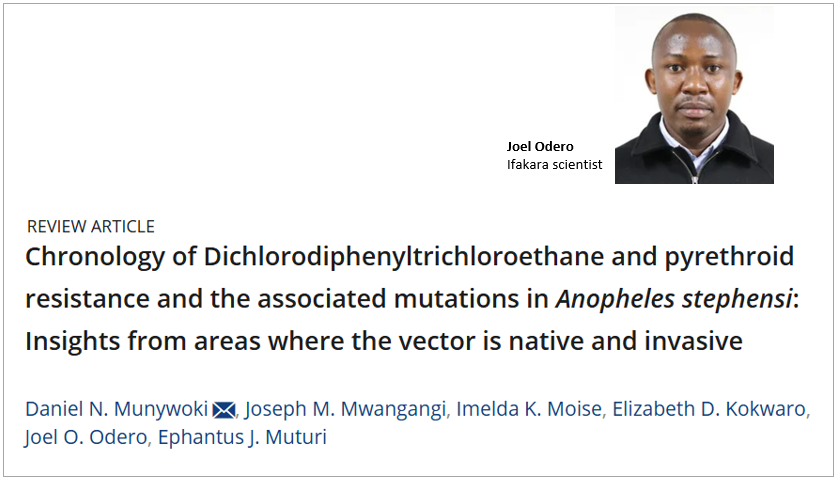
A major malaria-carrying mosquito, anopheles stephensi, spreading across Africa, is becoming increasingly resistant to insecticides, putting global malaria control efforts at risk, scientists warn.
In a review, published in Medical and Veterinary Entomology recently, scientists from Kenya, Tanzania and the USA, say urgent action is needed to prevent this resistance from reversing decades of progress against the disease.
One of the contributors to the review is Ifakara Health Institute scientist, Dr. Joel Odero, who worked alongside researchers from the Kenya Medical Research Institute (KEMRI), Kenyatta University, Nova Southeastern University in the United States, and the US Department of Agriculture.
Why these findings matter
For decades, malaria control has depended on insecticides — through indoor spraying or insecticide-treated bed nets. These tools have saved millions of lives and cut malaria deaths across Africa.
But when mosquitoes evolve resistance, those tools lose efficiency undermining control programs and potentially lead to resurgence in transmission if resistance becomes widespread.
Tracking resistance over two decades
The review, which examined 21 studies over the past two decades, confirmed stephensi’s growing resistance to pyrethroids, the main insecticides used in bed nets and indoor spraying, as well as to DDT, an older chemical once widely used in malaria control. It tracked how resistance has emerged and spread across Asia, the Middle East, and Africa.
A mosquito on the move
Originally from South Asia, stephensi has recently invaded parts of East Africa, including Ethiopia. Unlike many malaria mosquitoes, it thrives in urban areas, breeding in water tanks, containers, and construction sites. This adaptability makes the species particularly dangerous, as it brings malaria risk closer to densely populated areas.
How the mosquito is beating insecticides
Researchers found stephensi has developed multiple ways to survive insecticides. Some populations carry genetic mutations — known as knockdown resistance or kdr — that reduce the effectiveness of pyrethroids. Others rely on biological mechanisms that break down insecticides before they can cause harm, allowing the mosquito to survive and continue spreading malaria.
“There is an urgent need for expanded molecular surveillance for insecticide resistance in Anopheles stephensi in the Horn of Africa,” the authors note, “to understand the evolutionary origins and spread of resistance genes and guide effective vector control.”
What must be done to tackle resistance
Scientists recommend urgent action to tackle insecticide resistance including:
- Integrated resistance management (IRM) approaches rather than relying on single tools, including rotating insecticides and using products with multiple active ingredients
- Improved surveillance of mosquito behaviour and genetic changes driving resistance.
- Combine existing insecticides with synergists, which block the enzymes mosquitoes use to detoxify chemicals, making resistant mosquitoes, especially anopheles stephensi, vulnerable again.
- Introduce new insecticides with novel modes of action for areas with invasive species.
A narrow window to act
“These findings show the urgent need to expand molecular surveillance, strengthen regional laboratory capacity, and adopt resistance management strategies that reflect local mosquito ecology,” the authors emphasize.
They warn that as anopheles stephensi continues to spread with its resistance traits, the future of malaria control will depend on early detection, timely data sharing, and adaptive interventions.
Without these measures, scientists caution, years of hard-won gains against malaria could be reversed.
Read the publication, here.