
BLOG: Science works best when it listens first
>> Writes: Bilal Mpembamoto
Listening to defeat malaria
The fight against malaria is often told through numbers—cases prevented, lives saved, parasites defeated. But behind every breakthrough lies something less visible and equally powerful: trust.
For Felista Tarimo, a young public health researcher at the Ifakara Health Institute in Tanzania, the path to defeating malaria does not begin in the laboratory. It begins in conversation—with communities, with women, and with the people whose lives the science is meant to protect.
At the heart of her work is a simple belief: science works best when it listens first.
Ifakara Health Institute is a centre of scientific excellence whose story since 1956 has been shaped by generations of dedicated researchers. As this year the Institute marks its 70-year journey, among other strategic activities, it is shining a spotlight on a force that has long powered its progress: women in science.
Felista work reflects a new generation of African researchers determined not only to innovate—but to listen.
Listening before leading
Where community voices shape scientific solutions
Felista works as a stakeholder engagement officer for the Transmission Zero initiative, an ambitious effort exploring genetic tools that could one day stop malaria transmission at its source.
But while the science may be cutting-edge, her approach is deeply human.
“Transmission Zero aims to stop malaria transmission at its source,” she explains. “But for that to succeed, people must understand that the future of science is not just about innovation—it is about listening.”
Instead of arriving in communities with ready-made answers, Felista begins with questions.
What do people already know about malaria?
What challenges do they face?
What worries them about new technologies?
“Listening first means starting with their questions, not our agenda,” she says. “Communities help shape how and when research happens.”
That simple shift—from instruction to dialogue—turns communities from passive recipients of science into active partners in discovery.
Science, designed in Africa
Why local leadership matters
Felista is also a strong voice for African-led research. For her, the future of health innovation on the continent must be driven by the people who understand its realities best.
“Health solutions for Africa need to be designed by Africans,” she says. “Today, Tanzanian scientists—including women—are leading research that reflects our realities, our values, and our hopes for a future without malaria.”
Exciting breakthroughs are already emerging. In Tanzania, scientists are developing mosquito strains capable of blocking malaria transmission.
But Felista offers an important reminder: scientific success depends on public trust.
“Communities must feel respected, informed, and involved,” she explains. “Without that, even the most advanced science will struggle to achieve its potential impact.”
The hidden power of women in malaria control
The decision-makers inside every household
In many malaria-endemic communities, women are the quiet drivers of health.
They make sure children sleep under bed nets.
They notice the first signs of fever.
They seek treatment and guide families through care.
Felista believes these everyday decisions make women central to malaria elimination.
“In many communities, women are responsible for daily health-related decisions,” she says. “Their knowledge shapes whether families use preventive measures, seek diagnosis early, and follow recommended treatment.”
But their influence does not stop at the household door.
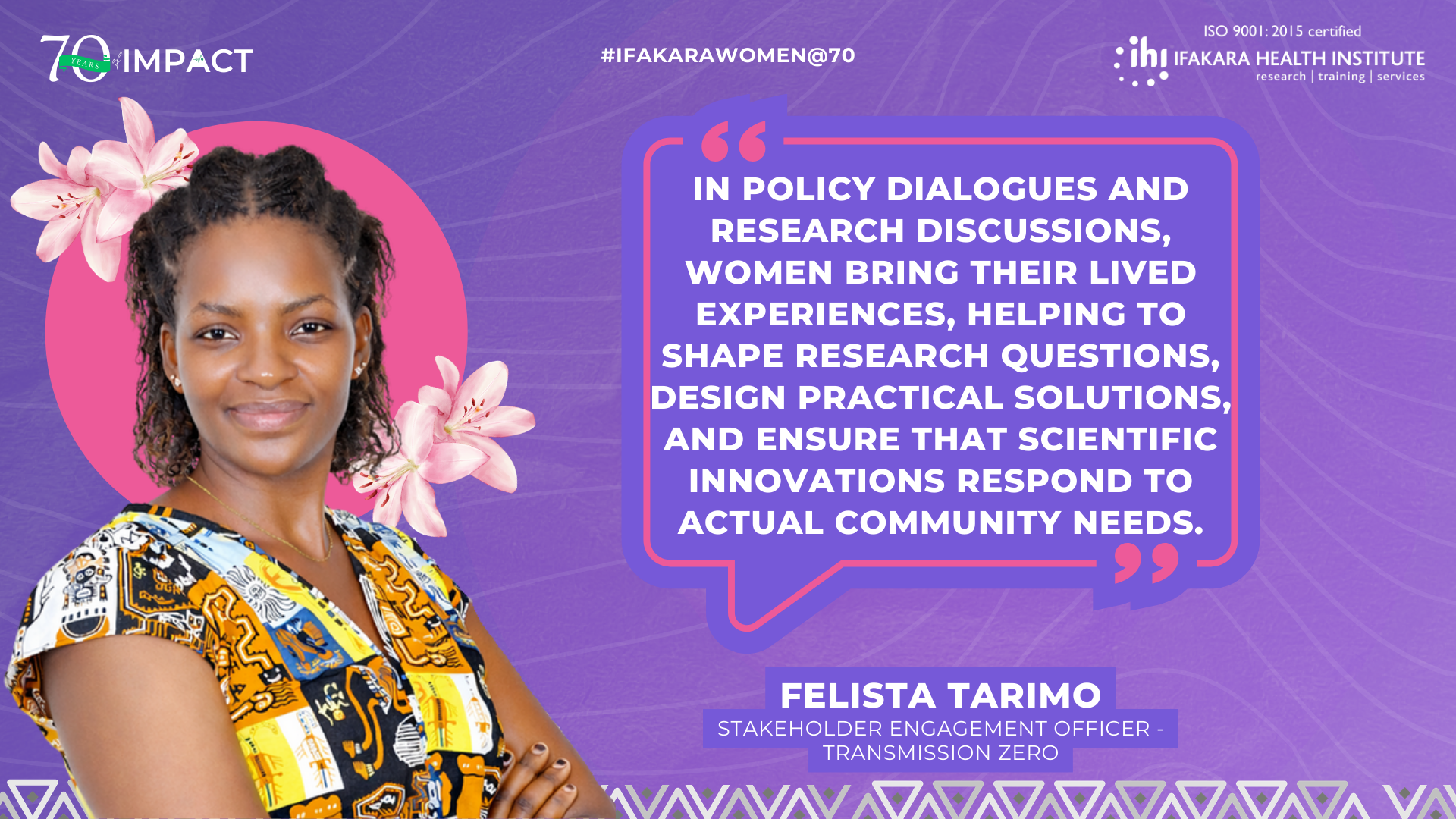
“In policy dialogues and research discussions, women bring their lived experiences,” she explains. “Those experiences help shape research questions, design practical solutions, and ensure innovations respond to real community needs.”
Empowering women with knowledge, she argues, does more than protect families—it strengthens entire communities.
Inspiring the next generation of scientists
Why girls belong in the laboratory—and beyond
Felista is passionate about ensuring that the future of science is more inclusive than its past.
Her message to young girls is simple but powerful:
“Science needs your voice.”
“Women and girls bring perspectives that shape better questions, better research, and better outcomes for our communities,” she says.
For her, science is not an abstract discipline—it is a tool for solving real-life challenges.
“We want young girls to see science as something accessible and meaningful,” she explains. “It is a way to solve everyday problems and improve lives, starting at the community level.”
A future built on listening
Felista Tarimo’s work reminds us that the fight against malaria is not only about laboratories, data, or mosquitoes.
It is about people.
It is about trust.
It is about communities whose voices guide the direction of discovery.
“When women lead, communities benefit,” Felista says. “When girls are inspired, nations progress.”
And perhaps most importantly, when science listens—it becomes a shared journey, one where the people most affected by malaria are no longer just beneficiaries of innovation.
They become its leaders.
And in the next chapter of Ifakara’s story—one that stretches beyond 70 years—more girls will see themselves not just as beneficiaries of science, but as its authors, architects, and leaders.
__________
Bilal Mpembamoto heads the Communications Office at the Ifakara Health Institute. He’s an experienced science writer and media editor, having worked for reputable and top-notch media outlets in Tanzania, including The Guardian and Mwananchi Communications.