

NEWBORN CARE: Data gaps threaten health outcomes across Central and East Africa
Reliable data on newborns and stillbirths is essential for saving lives, yet many health systems in low- and middle-income countries continue to struggle to collect, manage, and use such information effectively.
New findings from four studies reveal significant weaknesses in how health systems in Tanzania, Uganda, Ethiopia and the Central African Republic record and use newborn and stillbirth data, gaps that experts warn could undermine efforts to improve maternal and newborn care.
Conducted as part of the IMProving qUaLity and uSE of newborn measures (IMPULSE) project, researchers assessed routine health information systems in health facilities across four countries. Through surveys and in-depth evaluations, they examined staff skills, data quality and availability, system features, and management practices. The findings were published in the Journal of Global Health recently.
Ifakara scientists among contributors to the studies
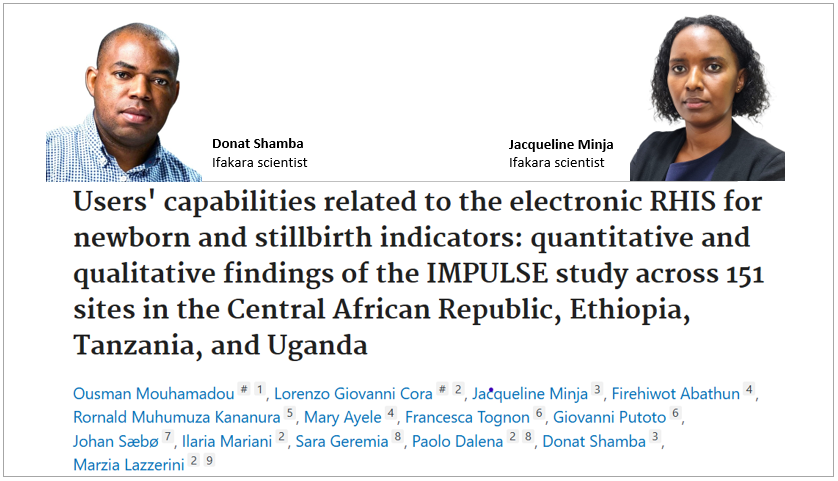
Scientists from the Ifakara Health Institute, including Donat Shamba and Jacqueline Minja, contributed to the research, with Shamba serving as co-senior author on two of the papers. Additional collaborators came from CUAMM Doctors with Africa (Central African Republic and Ethiopia), the Institute for Maternal and Child Health IRCCS (Italy), Makerere University (Uganda), the University of Oslo (Norway), the University of Trieste (Italy), and the London School of Hygiene & Tropical Medicine (UK).
Why these findings matter
Newborn and stillbirth data are more than just numbers—they reflect a health system’s ability to deliver quality care and prevent avoidable deaths. Accurate, timely, and usable data helps policymakers, health managers, and frontline workers identify gaps, track progress, and design effective interventions.
The IMPULSE studies provide a roadmap for strengthening health information systems, showing that investments in people, technology, and management must go hand in hand to ensure every newborn is counted and protected.
Here’s what the researchers found:
Study 1: Health workers need more support
Across all four countries, most health staff were able to enter and report data, but many lacked the skills needed to analyze, interpret, and use data for decision-making. The problem was most pronounced in rural and lower-level health facilities, where staff shortages and limited training increased the risk of errors and incomplete reporting. Researchers found that training and supportive supervision were inconsistent, limiting the potential of electronic systems to improve care.
Takeaway: Setting-specific interventions are needed to strengthen skills in both data analysis and data reporting. Particular attention should be placed on how data is used to improve quality of care.
Study 2: Data gaps persist
The studies also found that newborn and stillbirth data in routine health information systems (RHIS) were often incomplete, inconsistent, or inaccurate. While these systems (RHIS) allow for real-time monitoring, data quality concerns raise questions about their reliability for planning and decision-making.
Takeaway: For data to be useful, it must be complete, accurate, and consistent—supported by better processes, routine supervision, and accountability.
Study 3: Technology can help, but isn’t enough
All four countries used electronic routine health information systems (eRHIS), but system functionality varied widely across and within country with the Central African Republic lagging behind. While most facilities could generate basic annual reports, many struggled to use the systems for advanced tasks such as data integration, and disaggregation.
Takeaway: Optimizing eRHIS functionality is essential to improve data quality, enhance data use, and ultimately strengthen newborn care services and reduce neonatal deaths and stillbirths.
Study 4: Governance and management are critical
The studies highlighted major differences in leadership, supervision, and management across facilities and countries. Common challenges included limited funding, insufficient training, and weak feedback mechanisms. Strengthening organizational structures was consistently highlighted as essential to improving data quality and use.
Without strong governance structures, researchers warn, even good data systems are unlikely to deliver meaningful improvements.
Takeaway: Tailored interventions are needed to strengthen management and governance at all levels of the health system, to ensure better quality and use of newborn and stillbirth data
A call for integrated solutions
Taken together, the four studies point to a clear conclusion: improving newborn data requires integrated solutions. People, data, technology, and management are deeply interconnected, and weaknesses in one area affect the entire system.
The research also shows that context matters. Tanzania, Ethiopia, and Uganda generally performed better than Central African Republic, highlighting the need for country-specific strategies. Rural and peripheral facilities, in particular, require additional support through training, supervision, and functional systems.
“Without trustworthy and accurate data, improvements in maternal and newborn health are heavily hindered,” the researchers note, adding that targeted investments could unlock meaningful gains in newborn survival and quality of care across diverse settings.
The IMPULSE findings offer a practical roadmap for strengthening health information systems—one that could help ensure every newborn is counted, and every life has a better chance to survive.
Read the full publications: Users’ Capabilities, here | Data Availability and Quality, here | System Functionalities, here | Organizational and Management Factors, here.