

MOSQUITOES: Study shows how populations are connected across Tanzania
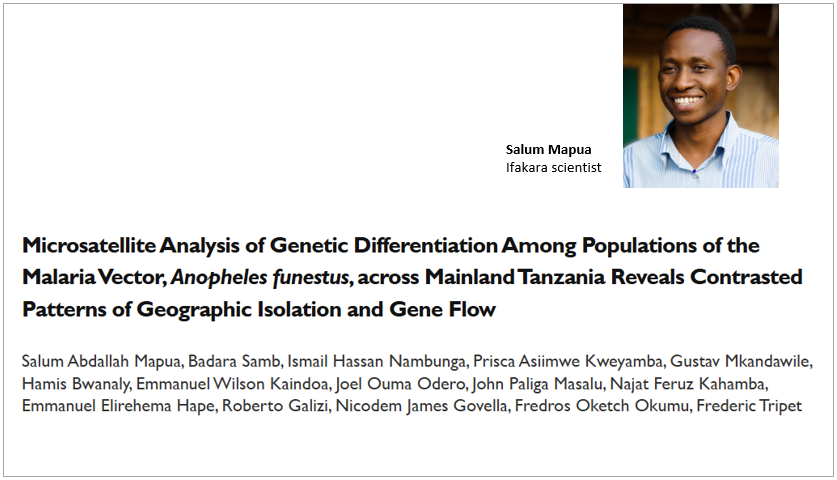
A new study led by scientists from the Ifakara Health Institute and partners in Europe and Africa has found that populations of one of Africa’s major malaria-carrying mosquitoes are genetically connected across mainland Tanzania, an insight that could help improve malaria control efforts.
The research focuses on Anopheles funestus, a key malaria mosquito in eastern and southern Africa. By analyzing DNA from mosquitoes collected across Tanzania, scientists were able to track how populations move, mix, or remain isolated.
The study was led by Ifakara scientist Salum Abdallah Mapua and Badara Samb from Cheikh Anta Diop University of Dakar in Senegal, under the supervision of Fredros Oketch Okumu of Ifakara Health Institute and Frédéric Tripet of the Swiss Tropical and Public Health Institute (Swiss TPH).
Analyzing mosquitoes from 10 regions
Published in the journal Parasites & Vectors, the study analyzed 654 An. funestus mosquitoes from ten regions of Tanzania, along with 28 An. parensis mosquitoes for comparison.
Using DNA markers called microsatellites, researchers studied how populations are related, how genes flow between regions, and whether geographic barriers affect genetic differences.
Why this matter for malaria control?
Malaria remains a major public health challenge in Tanzania, with Anopheles funestus playing a central role in transmission. Understanding how mosquito populations are genetically connected is critical for designing effective control strategies.
Well-connected populations can rapidly spread traits like insecticide resistance, reducing the effectiveness of key malaria control tools such as bed nets and indoor spraying. In contrast, isolated populations may respond differently to malaria control measures, meaning strategies that work in one region may not work the same way elsewhere.
The study highlights the importance of considering local mosquito population dynamics when planning malaria control programs, rather than relying on uniform approaches across all regions.
Southeastern mosquito populations stand out
The results showed that most An. funestus populations did not differ much genetically, even across large distances and natural barriers like the Rift Valley. However, mosquitoes from southeastern Tanzania—particularly Mtwara—were highly distinct from inland populations, nearly as different as a separate species.
What may be driving these patterns
These findings suggest that mosquitoes—or at least their genes—can move between regions more freely than previously thought. Human activities and environmental factors, may also contribute to this genetic mixing.
Researchers recommend further studies using whole-genome sequencing to better understand the unique Mtwara population and to explore how local adaptation and human-driven movement shape mosquito populations.
Ifakara team behind the study
The study was co-led by Salum Abdallah Mapua and included contributions from Ismail Hassan Nambunga, Gustav Mkandawile, Hamis Bwanaly, Emmanuel Wilson Kaindoa, Joel Ouma Odero, John Paliga Masalu, Najat Feruz Kahamba, Emmanuel Elirehema Hape, Nicodem James Govella, and Fredros Oketch Okumu, all from the Ifakara Health Institute.
Read the publication, here.