

MALARIA: Climate change could trigger millions more cases in Africa, scientists warn
Climate change could reverse hard-won gains against malaria in Africa, leading to hundreds of millions of additional cases and hundreds of thousands of more deaths over the next 25 years, according to a major new scientific study.
Published in Nature last month, the research combines 25 years of climate, malaria and socioeconomic data with future climate projections to assess how climate change may affect malaria burden across the continent.
Researchers say that while rising temperatures and changes in rainfall are important, the greatest threat comes from extreme weather events—such as floods and cyclones—which disrupt health systems and malaria control efforts.
Ifakara scientists contribute to the research
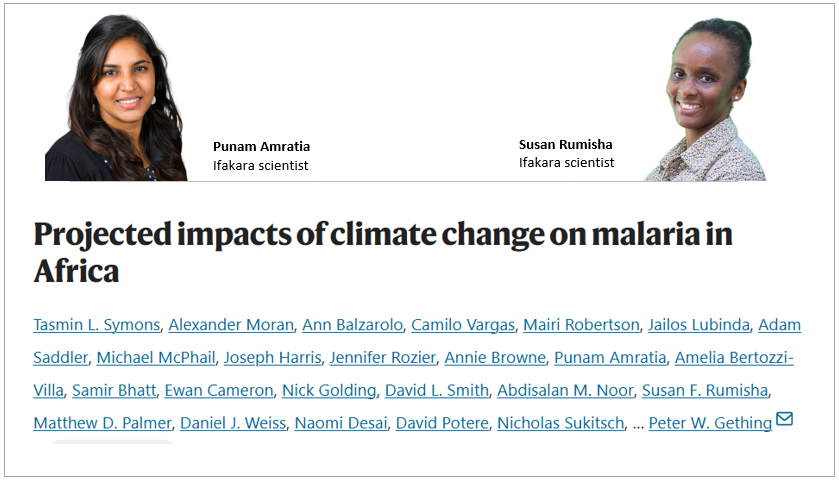
The study includes contributions from Punam Amratia and Susan Rumisha of Ifakara Health Institute, working within the Malaria Atlas Project (MAP). MAP, together with global partners, develops and maintains advanced data and modelling platforms to support malaria innovation, policy planning, monitoring and evaluation.
Other key contributors come from Curtin University and The Kids Research Institute Australia, The Boston Consulting Group, the Institute for Disease Modeling, Imperial College London, the University of Washington, and Harvard T.H. Chan School of Public Health.
The findings suggest that if current malaria control efforts remain unchanged, climate change could result in about 123 million additional clinical malaria cases in Africa between 2024 and 2050, along with an estimated 532,000 extra deaths over the same period.
Extreme weather emerges as the main driver
Contrary to many earlier studies, the researchers found that most of the projected increase in malaria burden is not driven by gradual changes in mosquito habitat or temperature alone. Instead, extreme weather events play a dominant role, accounting for about 79% of additional cases and 93% of additional deaths.
Floods and cyclones can destroy homes and health facilities, interrupt access to care, delay distribution of bed nets and medicines, and increase exposure to mosquitoes. Such effects have been widely documented in parts of Africa and Asia, where spikes in malaria have followed major weather events, noted the researchers.
Calls for climate-resilient malaria control
The authors warn that maintaining current strategies will not be enough. They urge governments and global health agencies to invest in climate-resilient malaria control strategies at both national and local levels including multi-sectoral policy responses.
Proposed strategies include stronger and more resilient health and supply-chain infrastructure, enhanced early-warning and emergency response systems, decentralized health services to strengthen local capacity, and the tailored use of new malaria tools that are less vulnerable to climate disruption.
“Eradicating malaria in the first half of this century would be one of the greatest accomplishments in human history,” the authors write. The underline that achieving this goal will require ongoing vigilance, proactive planning, engaged communities and sustained financing, supported by robust health systems and climate-resilient societies.
Read the publication, here.