

GENE DRIVES: Civil society voices on Tanzania’s path toward responsible use in fighting malaria
Tanzania’s commitment to investing in innovative malaria control strategies is opening a new chapter in the country’s public-health response, particularly the exploration of advanced genetic tools such as gene-drive technology.
A new study by scientists from Ifakara Health Institute examines what will be required to ensure that such cutting-edge approaches, if adopted, are introduced safely, ethically, and with strong public confidence.
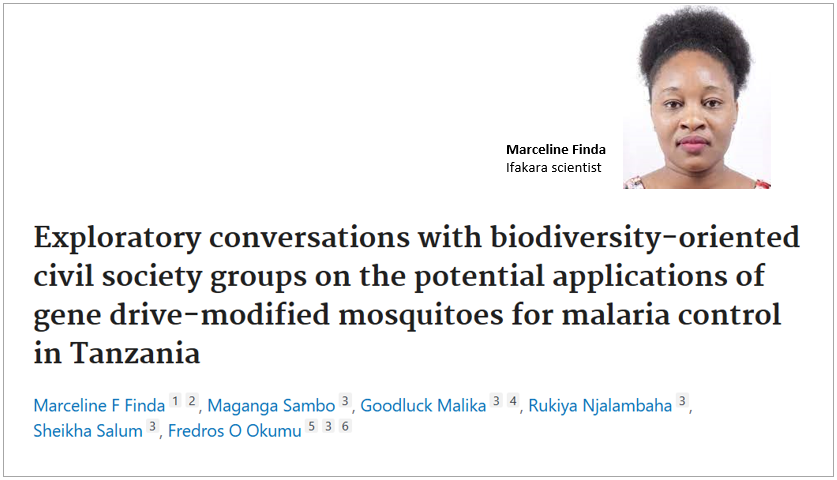
Published in Transgenic Research, the research explores how Tanzanian civil society organizations (CSOs) view the possible use of genetically modified mosquitoes to help control malaria, and what foundations must be in place before any real-world application is considered.
The study was led by Dr. Marceline Finda, with contributions from Dr. Maganga Sambo, Goodluck Malika, Rukiya Njalambaha, Sheikha Salum, and Dr. Fredros Okumu.
Why this study matters
Malaria remains a major public-health challenge across sub-Saharan Africa. Progress has slowed in recent years due to insecticide resistance, changing mosquito behaviour, and environmental pressures—factors that have increased the search for new tools.
This study underlines that technological innovation alone will not determine success. Social acceptance, ethical safeguards, and strong institutions are just as important as scientific breakthroughs.
The researchers conclude that discussions on gene-drive mosquitoes should continue, alongside efforts to strengthen governance, build local expertise and ensure affected communities have a meaningful voice in shaping the future of malaria control.
Understanding gene-drive technology
Gene-drive technology is an emerging genetic approach being studied as a possible tool to reduce malaria transmission. It is designed to spread a selected genetic trait rapidly through mosquito populations over generations, potentially reducing mosquito numbers or preventing them from spreading malaria.
Unlike conventional interventions, such as insecticide-treated bed nets or indoor spraying, gene-drive changes could sustain themselves in nature. This raises the possibility of a long-lasting complement to existing malaria control strategies.
Innovation backed by government, examined by society
The study comes at a time when the Tanzanian government has emphasized the importance of science, research, and home-grown innovation in accelerating the fight against malaria.
To better understand public-interest perspectives, researchers conducted interviews, focus-group discussions and stakeholder engagements with Tanzanian CSOs working in biodiversity and environmental protection.
The findings show that stakeholders are not opposed to innovation. Instead, they support continued research into gene-drive approaches and recognize their potential contribution to malaria control—provided appropriate safeguards are in place.
Priority areas to safely advance gene-drive technology
Rather than viewing gene-drive technology as an immediate solution, stakeholders identified key areas that require strengthening as the country advances toward possible adoption.
CSO groups underlined the need for strong national oversight before any deployment is considered, pointing to gaps in ethical and regulatory frameworks, limited independent expertise and the absence of clear liability systems.
They also called for investment in knowledge, governance and local scientific capacity to progress alongside research, so that Tanzania can guide and regulate the technology through clear policies on safety, ethics and responsibility.
Researchers say addressing these areas early would allow the country to adopt such innovations from a position of readiness and national ownership.
Read the publication, here.