

#IFAKARAWOMEN@70: Stepping into the rooms where decisions are made
Science may begin in labs and field stations. But its direction—what gets studied, funded, and translated into policy—is often decided in boardrooms.
At the Ifakara Health Institute, those rooms are slowly changing. Today, women hold 31% of positions in key governance and leadership organs—specifically the Board and senior management.
It is a figure that signals both progress and possibility inside one of Africa’s leading health research institutions.
Behind that number lies a network of boards and committees where strategies are shaped, resources allocated, and the future of health research imagined.
Where decisions about science are made
The governance system of Ifakara is built on a structured framework designed to guide strategy, accountability, and institutional growth.
At the top sits the Board of Governors, responsible for overall strategic direction and the appointment of the Board of Trustees. The Board of Trustees ensures financial accountability, approves budgets and annual plans, and safeguards the institute’s long-term sustainability.
Supporting this leadership structure are specialized committees—including the Scientific Advisory Committee and the Finance, Audit and Risk Committee—which provide expert guidance on research priorities and institutional accountability.
Meanwhile, the Management Committee, led by the institute’s Chief Executive Director, oversees day-to-day operations and the implementation of scientific and institutional strategies.
Together, these governance structures steer the work of an organization that has spent nearly seven decades shaping health research and policy in Tanzania and across Africa.
Women at the strategic table
Within these governance spaces—traditionally dominated by men in many scientific institutions—women at Ifakara are increasingly visible. Across the Board and senior management levels, women now account for 31% of leadership positions. Several women are playing key roles across these structures.
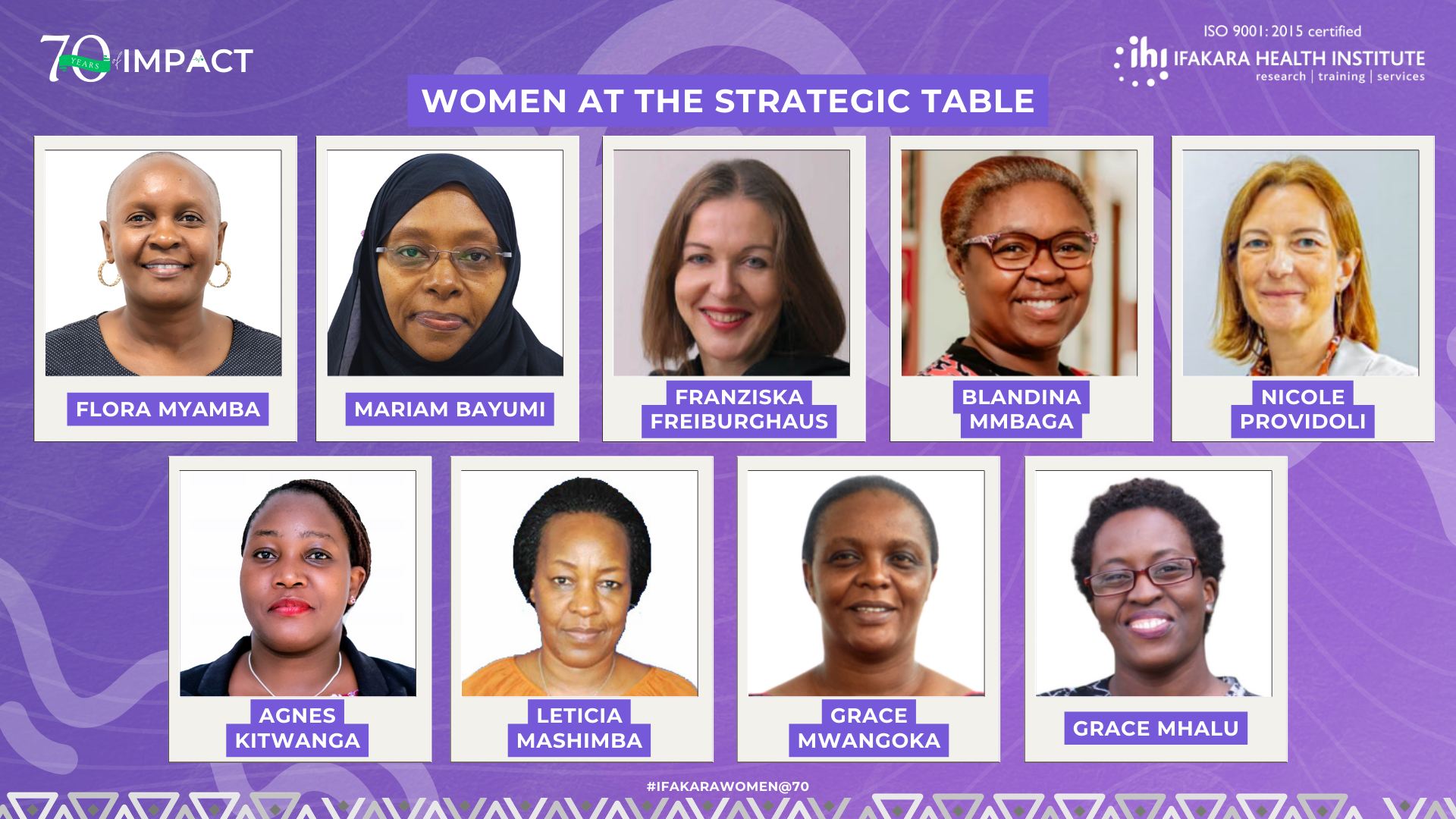
Within governance bodies, female members include Flora Myamba, Mariam Bayumi, Franziska Freiburghaus, Blandina Mmbaga, Nicole Providoli, Agnes Kitwanga, and Leticia Mashimba.
Also, within the institute’s senior management, women also lead important scientific portfolios, including Grace Mwangoka (Biomedical Research and Clinical Trials) and Grace Mhalu (Health Systems, Interventions, Impact Evaluation and Policy).
Their presence spans governance boards, advisory committees, and executive leadership roles that help steer the institute’s scientific agenda and institutional strategy.
The committees shaping research and accountability
Two advisory committees provide specialized oversight within the institute’s governance structure.
The Scientific Advisory Committee, chaired by Blandina Mmbaga, provides guidance on scientific priorities, research quality, and emerging opportunities for innovation.
Meanwhile, the Finance, Audit and Risk Committee oversees financial accountability, institutional risk management, and transparency. Women such as Agnes Kitwanga and Leticia Mashimba contribute to strengthening governance safeguards within this committee.
These committees ensure that scientific ambition moves forward with both rigor and accountability.
Leadership that connects science to society
Leadership at Ifakara extends far beyond internal management.
Its governance bodies bring together expertise from Tanzania’s health sector, academic institutions, and international research partners—ensuring that scientific work remains closely linked to national and global health priorities.
In these spaces, decisions about research investments, partnerships, and policy engagement are made.
When women sit at these tables, their influence reaches far beyond the institute—helping shape research that ultimately affects millions of lives.
The quiet transformation of leadership
Numbers alone cannot tell the full story.
But they can reveal momentum.
At a research institution that has spent decades generating evidence to improve health systems and save lives, the increasing presence of women in governance signals something deeper: a shift in how leadership itself is evolving.
The laboratories may still produce the data.
The field sites may capture the evidence.
But in the boardrooms where strategies are drawn and futures imagined, more women are now helping decide what comes next.
And that may be one of the most powerful changes of all.