

#IFAKARAWOMEN@70: Trailblazers in action - Writing Ifakara's research legacy
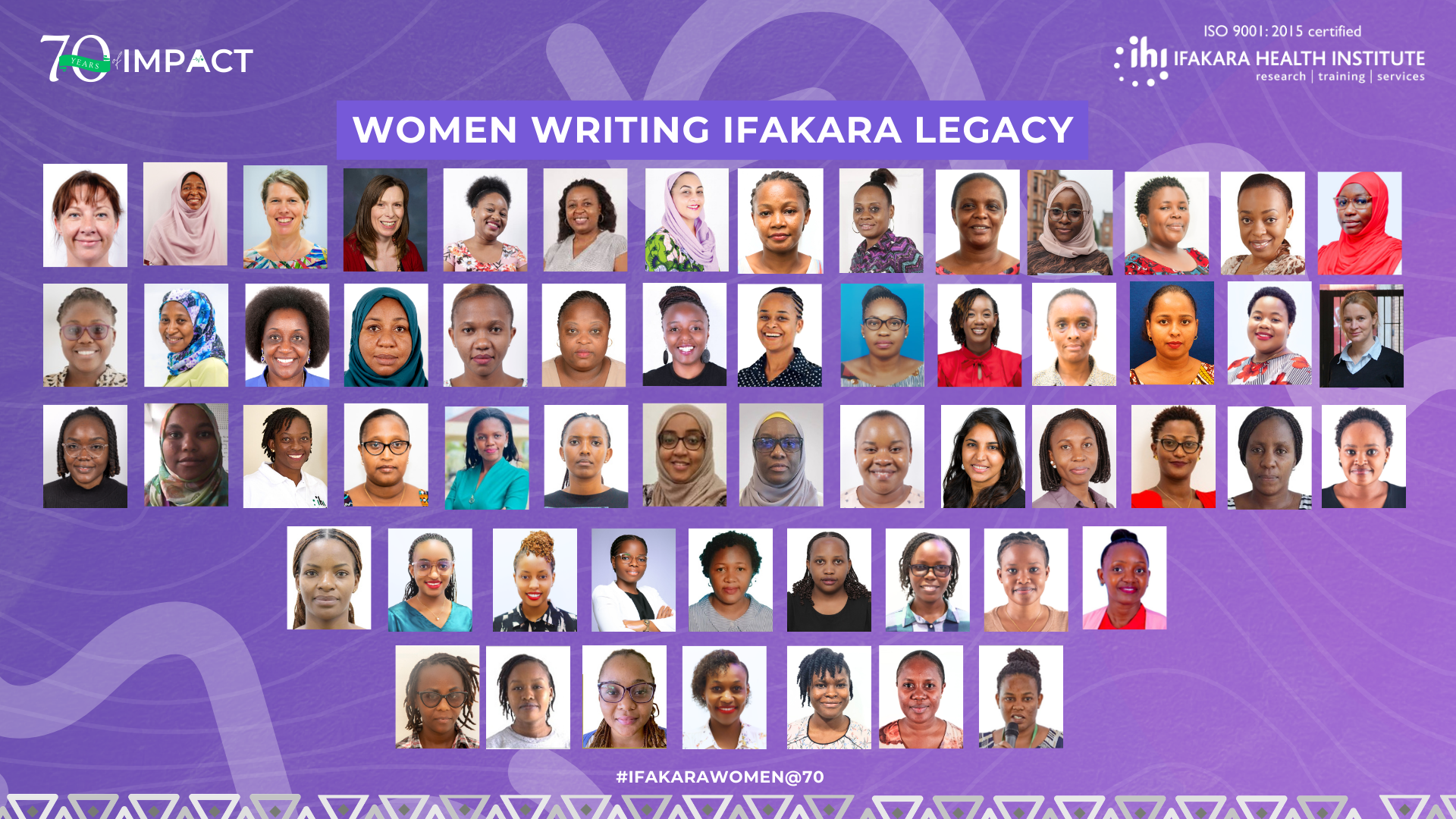
In science, numbers tell stories. Publication numbers are more than academic milestones—they are footprints. They show where knowledge has travelled, what questions have been answered, and who is shaping the conversation.
Here at the Ifakara Health Institute, these numbers reveal something powerful: a generation of women who are not just participating in research—but defining it. From 1965 to date, female scientists at IHI have contributed to 982 scientific publications.
Interestingly, more than half of the publications can be traced to just ten extraordinary women whose productivity, leadership, and persistence continue to shape Tanzania’s scientific voice on the global stage.
Top 10 women driving the numbers
Behind this growing body of knowledge stands a group of high-performing scientists whose productivity tells a powerful story.
- Sarah Moore – 130 publications
- Fatuma Manzi – 80 publications
- Maja Weisser – 64 publications
- Heather Ferguson – 51 publications
- Marceline Finda – 41 publications
- Sally Mtenga – 40 publications
- Nahya Salim – 33 publications
- Dorcas Mnzava – 27 publications
- Josephine Shabani and Grace Mwangoka – 26 publications
- Najat Kahamba – 25 publications
A story of leadership and scale
With 130 publications, Sarah Moore stands in a league of her own—contributing nearly 13% of the total female publication output at IHI over the last 70 years. That level of productivity reflects not just consistency, but sustained scientific leadership over time.
A strong core of scientific drivers
The next five ranked scientists – Fatuma Manzi (80 publications), Maja Weisser (64), Heather Ferguson (51), Marceline Finda (41), and Sally Mtenga (40) – collectively contributed more than 200 publications. This is the engine room of IHI’s female-led research.
Their work spans infectious diseases like TB and HIV, complex malaria epidemiology, behavioural interventions, maternal health innovations, and strengthening health systems that serve millions. They represent a bridge generation—scientists experienced enough to lead major projects, yet active enough to remain deeply engaged in day-to-day research.
Depth and emerging momentum
Ranks seven to ten tell another important story: sustainability. The presence of multiple scientists clustered around 25–33 publications suggests that leadership is not confined to a single tier – mostly of legends. It is gradually expanding.
When two scientists share the ninth position, it reflects healthy competition and growing research capacity. It signals that the next wave of senior leadership may already be in motion.
Beyond Malaria: A broad scientific portfolio
It would be easy to assume that IHI’s research strength lies mainly in malaria—and historically, it has been a global leader there. But these publications go far beyond mosquito nets and vector control. They include: TB treatment optimisation studies, HIV prevention and service delivery research, cancer screening and NCD investigations, non-communicable diseases (NCDs), maternal, newborn and child health, and health systems efficiency and financing analyses.
This diversity matters. It means Tanzanian women scientists are contributing evidence across the full spectrum of national health priorities—not just one disease area. In short, they are not studying one disease. They are mapping the health future of a nation.
The bigger picture: What 543 publications tell us
Together, the top 10 women account for 543 publications—more than half of the total number of female-authored publications: 982. That level of concentration reveals two key dynamics:
- High-output scientists play a critical role in sustaining institutional visibility and funding competitiveness.
- There is an opportunity to intentionally broaden authorship leadership to ensure even more women rise into top productivity tiers.
In science, visibility leads to funding. Funding leads to larger projects. Larger projects create mentorship pipelines. And mentorship builds the next generation.
Why this matters for Tanzania
For young women, these numbers are not abstract statistics. They are signals. They show that Tanzanian women are: Leading clinical trials, designing national-level health studies, publishing in international journals and influencing global health policy debates.
These scientists are not simply contributing to research—they are shaping how diseases are prevented, diagnosed, and treated across Africa and beyond. Behind every publication is fieldwork in rural communities, data analysis sessions, policy dialogues, manuscript revisions, and the courage to ask difficult scientific questions.
And together, these women are doing something profound: They are ensuring that Tanzania is not just a site of research. It is a source of knowledge.