BREAKTHROUGH: New drug offers hope in the fight against river blindness
Two new studies suggest that oxfendazole, a medicine long used in animals, could have the potential to treat river blindness, a parasitic disease affecting millions of people, mainly in sub-Saharan Africa.
River blindness, also known as onchocerciasis, is caused by worms spread by blackflies. While current medicines help control the disease, they mainly target the young worms. Adult worms can survive and continue the cycle of infection.
Scientists have long been searching for a treatment that can kill these adult worms and speed up elimination efforts.
Contributing to this important research are scientists from Ifakara Health Institute, working in collaboration with partners including Swiss Tropical and Public Health Institute (Swiss TPH), Drugs for Neglected Diseases initiative (DNDi), Mahidol University, and the University of Oxford.
Why these studies matter
River blindness remains a major health challenge across parts of Africa. Current treatment programs rely on medicines that reduce transmission but may need to be taken repeatedly over many years.
If successful, oxfendazole could:
- Reduce the number of treatment doses needed
- Target adult worms that current medicines cannot
- Strengthen efforts to eliminate the disease in affected communities
Experts say early-stage studies like these are critical in turning promising compounds into real-world solutions.
Testing safety in volunteers
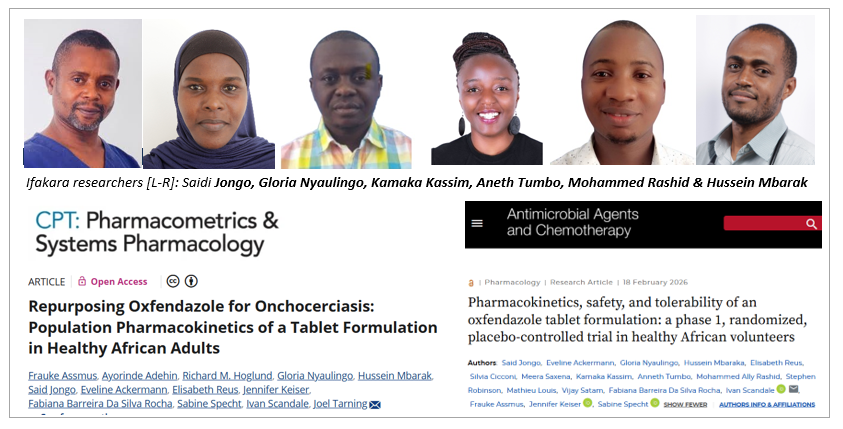
The studies, published in Antimicrobial Agents and Chemotherapy and CPT: Pharmacometrics & Systems Pharmacology, examined how oxfendazole behaves in the human body and whether it is safe.
The first study was a Phase 1 clinical trial carried out in healthy African adults. Led by Ifakara’s seasoned research scientist Said Jongo, the study tested a tablet form of oxfendazole to answer key questions about safety, tolerability, and how the body absorbs and processes it.
Volunteers received different doses, including single doses and repeated daily doses over several days.
The results were encouraging:
- The drug was well tolerated, with no serious side effects
- It reached peak levels in the blood within 2 to 3 hours
- It remained in the body for roughly half a day
- Higher doses did not always lead to higher drug levels
“This is a vital first step as the oxfendazole tablet formulation was well tolerated at all tested doses—100 mg, 400 mg (single dose), and 400 mg once daily for 5 days,” noted the researchers.
They further noted that the findings support continued clinical development of the drug and provide a strong foundation for future trials in patients to evaluate its efficacy in the treatment of human helminth infections.
Using data to find the right dose
The second study used data from the same trial but went a step further by applying advanced modelling techniques. Instead of only describing what happened, researchers built a model to better understand how the drug behaves in the body.
The model helped researchers understand why drug responses vary between individuals and predict which dosing strategies might work best in future studies.
A step towards better treatment
Researchers stress that these early findings do not yet prove that oxfendazole can treat river blindness.
However, they provide something essential: evidence that the drug is safe in humans and clear guidance on what doses should be tested next.
With further trials expected, researchers say oxfendazole could become an important new tool in the global effort to eliminate river blindness.
Ifakara scientists behind the study
Scientists from Ifakara contributing to the studies include Said Jongo, Gloria Nyaulingo, Hussein Mbarak, Kamaka Kassim, Anneth Tumbo, and Mohammed Ally Rashid.