

MALARIA CONTROL: Targeting mosquitoes early at the source
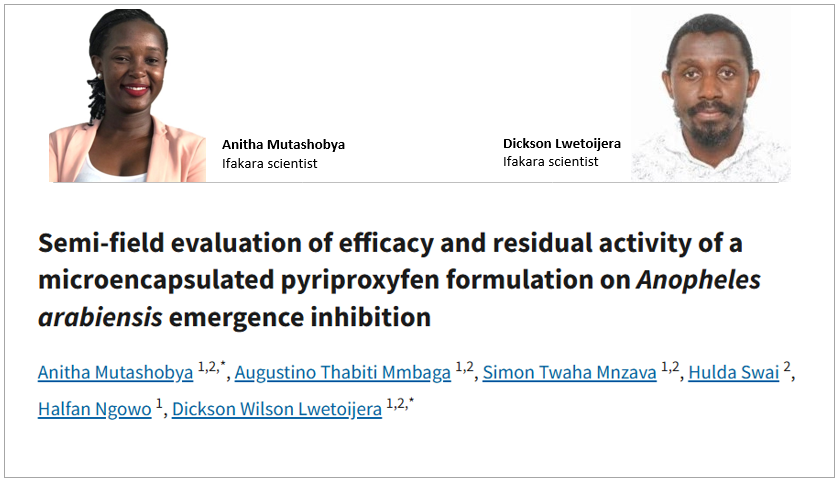
Larval source management—a strategy that targets mosquitoes at their breeding and larval stages—is gaining attention as an alternative approach to malaria control. In this context, scientists at the Ifakara Health Institute conducted a study to assess the effectiveness of the mosquito control chemical pyriproxyfen that disrupts the development of mosquito larvae, preventing them from reaching adulthood.
The study focused on Anopheles arabiensis, a key malaria vector in Tanzania and across sub-Saharan Africa. Scientists evaluated the product’s ability to prevent mosquito larvae from becoming adults, as well as its residual activity—how long its protective effect lasts—under semi-field conditions.
Published on Malaria World Journal, the study was led by Anitha Mutashobya, with senior authorship from Dickson Lwetoijera. Contributors included Augustino Mmbaga, Simon Mnzava, and Halfan Ngowo – also from Ifakara, and Hulda Swai from the Nelson Mandela African Institution of Science and Technology.
Promising results under real-world conditions
Tested under semi-field conditions, the formulation effectively stopped larvae from maturing into adults, leading to a sharp drop in the number of adult mosquitoes emerging.
But the researchers say the impact goes beyond simply reducing mosquito numbers. The formulations also reduced mosquito fertility and body size—both important factors that influence how mosquitoes transmit malaria.
The treatment remained effective for over three months, indicating strong potential for long-lasting larval control.
Why this finding matter
Current malaria tools mainly target adult mosquitoes, using tools such as insecticide-treated bed nets and indoor spraying. While these tools remain essential, challenges such as insecticide resistance and changing mosquito behavior continue to threaten progress.
This study supports larval control as a complementary strategy that can strengthen existing interventions.
Its long-lasting effect could make it a cost-effective option for larviciding programmes.
What happens next?
The findings add to growing evidence supporting larval source management, particularly using long-lasting formulations that reduce the need for frequent reapplication.
While the findings are promising, the researchers recommend further testing across different field conditions and mosquito species. If successful at scale, the approach could strengthen malaria control and elimination efforts.
Read the publication, here.