

INSECTICIDE: Malaria mosquitoes weakened by common control chemical
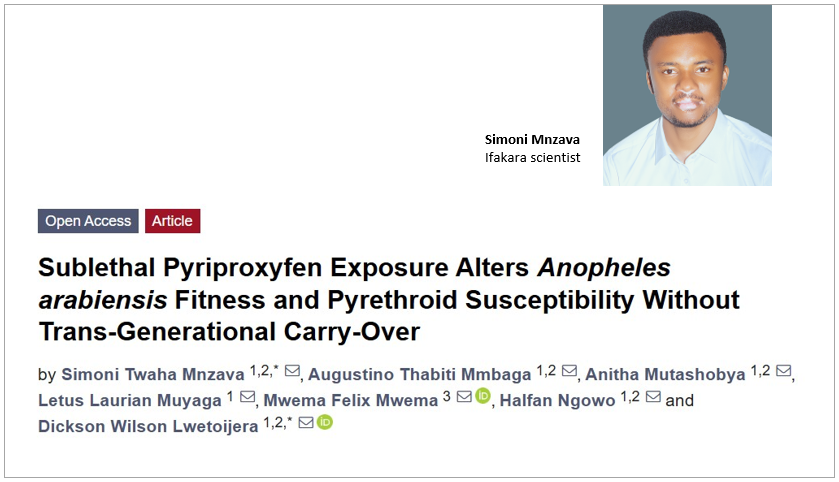
Researchers from the Ifakara Health Institute have found that a commonly used mosquito control chemical, pyriproxyfen, can weaken malaria-carrying mosquitoes without causing long-term resistance to other insecticides.
Mosquitoes become weaker when exposed to low doses
The scientists discovered that when mosquitoes are exposed to small, non-lethal amounts of pyriproxyfen, they become weaker. The insects develop into smaller adults, lay fewer eggs, and fewer of those eggs are able to hatch. This means the chemical can reduce mosquito populations over time by affecting their ability to reproduce.
The study, published in Insects, was carried out by a team of researchers from Ifakara Health Institute. The team included Simoni Mnzava (lead author), alongside Dickson Wilson Lwetoijera, Augustino Thabiti Mmbaga, Anitha Mutashobya, Letus Laurian Muyaga, Mwema Felix Mwema, and Halfan Ngowo.
How the study was done
The researchers exposed larvae of Anopheles arabiensis — one of Africa’s main malaria vectors — to very low (sublethal) doses of pyriproxyfen, a chemical that disrupts mosquito growth and development. They then followed the mosquitoes over three generations, assessing their survival, reproduction, and response to commonly used insecticides.
Mosquitoes become weaker and less fertile
The study found that mosquitoes exposed to pyriproxyfen were smaller, laid fewer eggs, and produced eggs with lower hatch rates. These effects were most noticeable in the first generation after exposure, showing a clear reduction in mosquito reproductive capacity.
Slight short-term change in insecticide response
The team also tested how the mosquitoes responded to widely used insecticides such as permethrin and deltamethrin, which are commonly used in bed nets and indoor spraying.
They found a slight, temporary increase in tolerance to these insecticides. However, this effect did not persist in later generations, suggesting it does not lead to permanent resistance.
What this means or malaria control
Researchers say the findings are important for malaria control programmes because they suggest pyriproxyfen can be effectively used as part of combined mosquito control strategies.
“These findings support the strategic use of Pyriproxyfen (PPF) in integrated vector management, suggesting that it can be rotated with pyrethroids to help manage resistance while maintaining the effectiveness of existing control interventions,” the researchers noted.
They concluded that the chemical could help reduce mosquito populations and strengthen existing control tools without driving long-term resistance that might otherwise undermine their effectiveness.
Read the publication, here