

MORTALITY DATA: Why most deaths miss in official records—and how Tanzania is fixing it
A new study has revealed a critical gap in Tanzania’s health data, saying that the majority of deaths occur outside health facilities—and most go unrecorded or recorded without a known cause.
Researchers found that nearly 70% of deaths in Tanzania happen in community settings, meaning hospitals capture only a small fraction of the country’s true mortality data. As a result, national health planning has long relied on incomplete data representing just 10–15% of the population.
Filling a critical data gap
To address this challenge, scientists and government partners introduced a system known as verbal autopsy (VA)—a method that involves interviewing family members about symptoms experienced before death to determine the likely cause.
The study, published in the BMJ Global Health and led by researchers from Ifakara Health Institute and partners, tracked the implementation of verbal autopsy across multiple regions in Tanzania between 2017 and 2020.
Using digital tools and questionnaires, they collected information from households and analyzed it using both doctors and computer algorithms. This approach allowed researchers to reconstruct causes of death even where no medical records existed.
Why this matter
Experts emphasize that improving death registration and cause-of-death data is essential for guiding healthcare investments and policy decisions. Beyond identifying diseases, verbal autopsy also captures critical social factors—such as delays in seeking care, access to insurance, and lifestyle risks—that influence health outcomes.
By making previously “invisible” deaths visible, this approach has the potential to transform how Tanzania plans and delivers healthcare. While challenges remain—including strengthening reporting systems and reaching remote communities—the study shows that better, more inclusive health data is within reach.
Revealing the true causes of death
The study findings reveal a clearer picture of mortality patterns across the country. The leading causes of death identified were: HIV/AIDS, heart (cardiac) diseases, malaria, tuberculosis, and diabetes. Together, these conditions account for more than half of all deaths.
When grouped more broadly, communicable diseases such as malaria and TB accounted for the largest share (45.6%), followed closely by non-communicable diseases (40.2%) like heart disease and diabetes. Injuries—including road traffic accidents—made up about 10.5% of deaths
Rural–urban divide in health
The study also highlights a clear rural–urban divide.
In rural communities, deaths are more likely to be caused by infectious diseases such as malaria, while urban areas are increasingly affected by non-communicable diseases like heart conditions and diabetes.
Researchers describe this as a “dual burden” of disease, underscoring the need for tailored health interventions—especially in underserved and hard-to-reach areas.
A scalable solution for better health decisions
Importantly, the study shows that verbal autopsy can be successfully integrated into Tanzania’s civil registration and vital statistics (CRVS) system—providing a scalable solution for countries where many deaths occur outside hospitals.
The use of computer-based analysis alongside physician review also proved effective, offering a faster and more cost-efficient way to generate reliable mortality data.
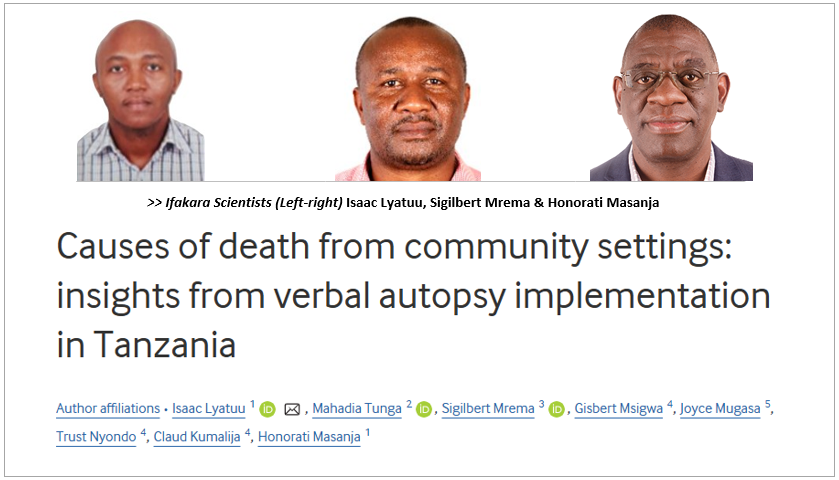
Ifakara scientists lead the study
The study was led by scientists from the Ifakara Health Institute, with Isaac Lyatuu as the lead author and Honorati Masanja as the senior (last) author.
Additional contributors include Siglibert Mrema, alongside collaborators from the Ministry of Health, the University of Dar es Salaam’s College of Engineering and Technology, and Muhimbili National Hospital.
Read the publication, here.