
MALARIA: Lessons from China could reshape elimination efforts in Africa
China’s success in eliminating malaria could provide valuable lessons for Africa, as experts point to a growing partnership between the two regions as a promising model in the fight against the disease.
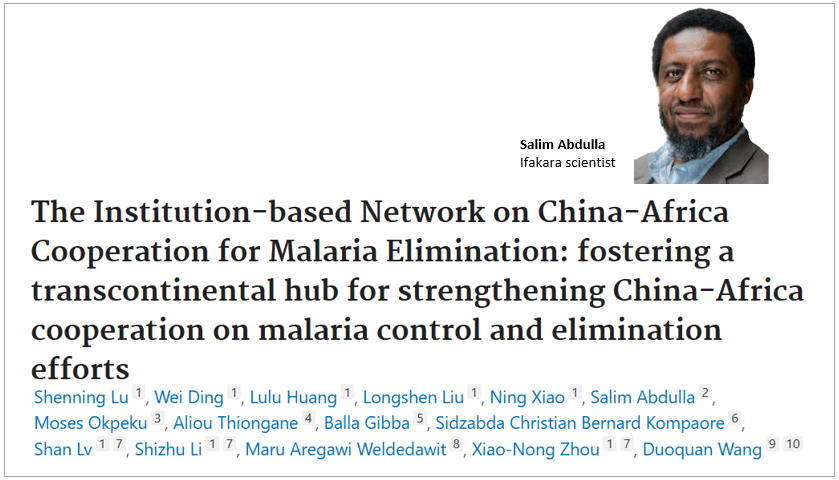
In a recent scientific paper published in Infectious Diseases of Poverty, the researchers highlight how strengthened collaboration between China and African countries could accelerate progress towards malaria elimination.
Study led by global team of researchers
The study brings together researchers from leading institutions across China, Africa, and the World Health Organization (WHO), including the Chinese Center for Disease Control and Prevention (China CDC) and its National Institute of Parasitic Diseases (NIPD).
African partners include national malaria control programmes and research institutions such as the Ifakara Health Institute, alongside collaborators from Senegal, The Gambia, Burkina Faso, and South Africa. Among the contributors is Ifakara’s Dr. Salim Abdulla.
Why this matters
Africa continues to bear the highest global burden of malaria, despite major gains in prevention and treatment over the past two decades.
The authors argue that combining China’s elimination experience with African implementation expertise could help close critical gaps in:
- surveillance systems
- capacity building
- research translation
- cross-country coordination
Learning from China’s elimination success
The opportunity for collaboration builds on a major milestone: in 2021, the WHO officially certified China as malaria-free, marking the end of decades of sustained control efforts.
This achievement has positioned China as a valuable source of expertise, tools, and strategies that could be adapted to African settings.
One example is the country’s “1–3–7” surveillance approach, which ensures rapid detection, reporting, and response to malaria cases. Researchers say this model could be tailored to fit the realities of African health systems.
INCAM provides a growing cooperation platform
At the centre of this effort is the Institution-based Network on China–Africa Cooperation for Malaria Elimination (INCAM), launched in 2018 to strengthen ties between researchers, policymakers, and institutions.
Since 2019, INCAM has convened six forums, creating a platform for knowledge exchange and practical problem-solving. Discussions have focused on adapting China’s elimination strategies to Africa’s diverse transmission patterns and health system contexts.
“INCAM exemplifies the potential of China–Africa collaboration to accelerate malaria control and elimination in Africa through solutions tailored to local contexts,” researchers write.
From knowledge-sharing to practical solutions
The partnership has also promoted what researchers describe as “demand-driven” approaches—developing tools and strategies based on the needs of affected communities.
This includes advancing affordable anti-malarial products and strengthening the use of evidence in shaping public health policy.
According to the authors, INCAM is also envisioned as a research and training hub, supporting joint studies, exchange programmes, and innovation in diagnostics, treatment, and vector control.
Structural gaps threaten long-term progress
Despite its promise, the initiative faces significant structural challenges.
The authors warn that “INCAM’s long-term sustainability faces critical constraints, including funding instability that jeopardises continuity.” They also highlight human resource gaps and limited government ownership of Public–Private–Academic partnerships.
“To realize its full potential, INCAM requires a stronger Public–Private–Academic Partnership model and institutionalized financing mechanisms,” the study notes, adding that expanded cross-border capacity-building programmes will be essential
A step toward coordinated malaria elimination
While still evolving, the China–Africa partnership reflects growing global interest in south–south cooperation in health research and disease control.
Sustained impact, however, will depend on stronger institutional support, sustainable financing, and deeper cross-sector partnerships.
If successful, the collaboration could help bring malaria elimination within closer reach—not just for individual countries, but across the African continent.
Read the publication, here.