

MALARIA: Natural bacteria in mosquitoes may help curb the disease
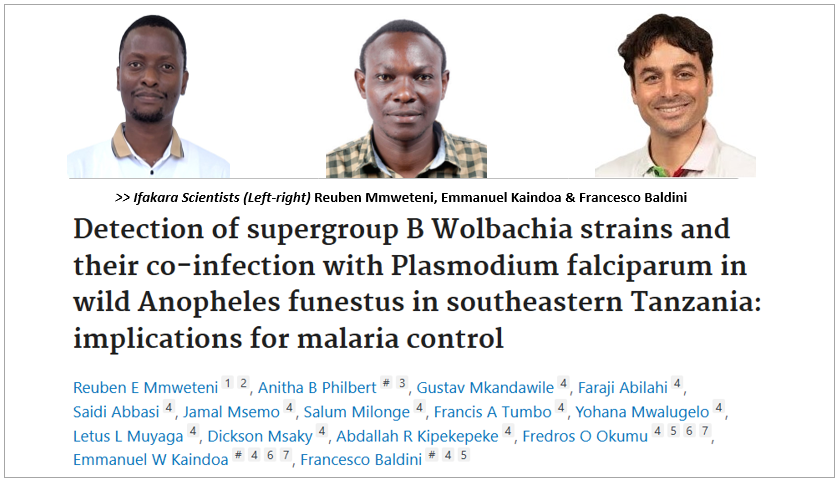
Scientists from Ifakara Health Institute studying wild mosquitoes in southeastern Tanzania have discovered that wild anopheles funestus mosquitoes naturally carry wolbachia — a bacterium increasingly being explored as a tool against mosquito-borne diseases like malaria.
Wolbachia has attracted scientific interest because in some mosquito species, it can reduce the insect’s ability to carry or transmit malaria parasites to humans.
Published in the Parasites & Vectors journal, the study provides the first strong evidence that funestus in southeastern Tanzania carry wolbachia at high levels. This finding is particularly important, as funestus is one of the primary mosquito species responsible for spreading malaria in the country.
Researchers say the discovery could help inform future malaria-control strategies using Wolbachia-based approaches.
Why the findings matter
For communities that continue to face the burden of malaria, the discovery could open doors to future mosquito-control strategies that are safer, sustainable, and biologically driven.
Previous studies in Tanzania had only found natural Wolbachia infection in one malaria mosquito species — Anopheles arabiensis. This study is the first to report widespread Wolbachia infection and Wolbachia-malaria co-infection status in An. funestus mosquitoes in the country.
Searching for answers in rural villages
The study was conducted across five villages in Kilombero Valley, Morogoro region, between March and June 2024. Researchers collected mosquitoes from households and tested them for both Wolbachia bacteria and the malaria parasite, Plasmodium falciparum.
Wolbachia was found in nearly half of all mosquitoes tested using standard laboratory methods, and in more than 70% when more sensitive testing was used.
Few mosquitoes carried malaria parasites
Researchers also examined whether the mosquitoes were carrying malaria parasites.
Only three out of 400 mosquitoes tested positive for malaria parasites, and just one mosquito was found to carry both the parasite and Wolbachia at the same time.
Although the numbers are still too small to draw firm conclusions, scientists say the findings raise important questions about whether Wolbachia could help reduce malaria transmission naturally.
Looking ahead
Researchers say larger studies are still needed to understand whether naturally occurring Wolbachia can directly influence malaria transmission in the wild.
If confirmed, the findings could help shape new approaches for malaria control in Tanzania and beyond — turning naturally occurring bacteria inside mosquitoes into a powerful tool against one of the world’s deadliest diseases.
Ifakara scientists behind the study
The study was led by scientists from Ifakara Health Institute, with Reuben Mmweteni serving as lead author and Emmanuel Kaindoa and Francesco Baldini as joint senior authors.
Other contributors included Gustav Mkandawile, Faraji Abilahi, Saidi Abbasi, Jamal Msemo, Salum Milonge, Francis Tumbo, Yohana Mwalugelo, Letus Muyaga, Dickson Msaky, Abdallah Kipekepeke, and Fredros Okumu.
Read the publication, here.
We're a Registered Charity Organization in Tanzania
Ifakara Health Institute (IHI) is officially recognized as a charitable organization under the Income Tax Act. Certification issued on 20 March 2025 and valid until 31 December 2030.
Ifakara Health Institute (IHI) is officially recognized as a charitable organization under the Income Tax Act. Certification issued on 20 March 2025 and valid until 31 December 2030.