
HEALTH FINANCING: Tanzania study shows combined health financing improves patient care
Adding performance-based financing to existing health funding systems can further improve the quality and coverage of healthcare services, helping to strengthen health systems and improve patient care, a new study suggests.
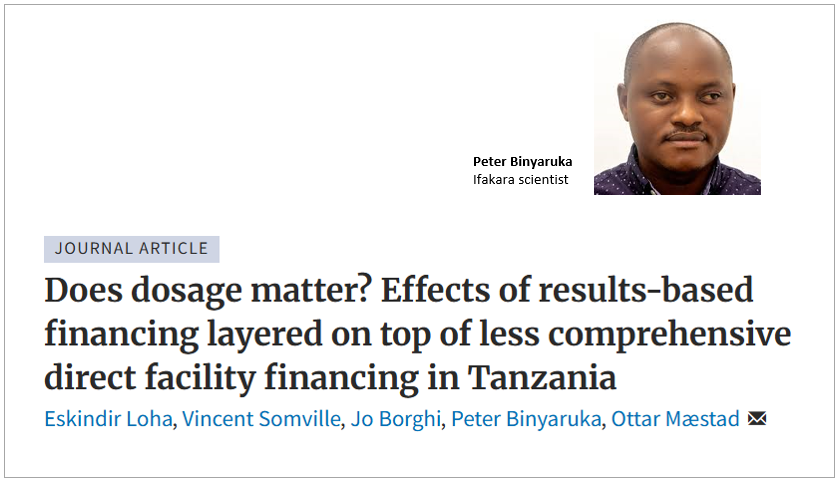
The study, published recently in Health Policy and Planning, examined how performance-based financing schemes (result-based financing, RBF) work alongside Direct Health Facility Financing (DHFF) in Tanzania’s health system. Researchers wanted to understand whether adding RBF on top of direct financing improves health system performance or creates inefficiencies.
RBF is a system in which health facilities receive financial rewards for meeting specific performance targets. DHFF, meanwhile, gives health facilities direct and flexible funding to support day-to-day operations and improve service delivery.
The study was led by researchers from Norway, the United Kingdom and Tanzania, with contributions from Peter Binyaruka of the Ifakara Health Institute.
Study tracked facilities and households over four years
The researchers tracked 150 health facilities and more than 3,000 households between 2016 and 2020. They compared eight districts in Mwanza Region, where both RBF and DHFF were implemented, with six districts in Mara Region, where only DHFF was in place.
Improvements seen across several health services
Both sets of districts showed improvements over time. However, facilities that received both RBF and DHFF performed better across a broader range of indicators.
The study found that performance-based financing improved 36 out of 71 measured outcomes. These included earlier attendance for antenatal care, higher measles and BCG vaccination coverage, and better quality maternal healthcare services.
Researchers also found improvements in health workers’ satisfaction with their working conditions, which may have contributed to better service quality and wider coverage of care.
Why the findings matter
The researchers conclude that health financing reforms do not work in isolation and that “dosage matters” in health system strengthening.
They say adding that comprehensive direct financing schemes—with more resources and incentives—can significantly improve service delivery beyond what is achieved by less comprehensive ones,
For countries such as Tanzania, the findings suggest that combining financing approaches could help strengthen maternal healthcare, improve immunization coverage, and enhance the overall quality of care in resource-limited settings.
We're a Registered Charity Organization in Tanzania
Ifakara Health Institute (IHI) is officially recognized as a charitable organization under the Income Tax Act. Certification issued on 20 March 2025 and valid until 31 December 2030.
Ifakara Health Institute (IHI) is officially recognized as a charitable organization under the Income Tax Act. Certification issued on 20 March 2025 and valid until 31 December 2030.