

INNOVATION: Simple lab cage tweaks boost mating success of key malaria mosquito
Scientists have found that changing what malaria mosquitoes see inside laboratory cages can significantly improve their ability to mate — a discovery that could help strengthen malaria research efforts.
The study, published in Parasites & Vectors, focused on Anopheles funestus, one of Africa’s most important malaria-transmitting mosquitoes. The species is also known to be particularly difficult to keep and breed in laboratory conditions because it often fails to mate in captivity.
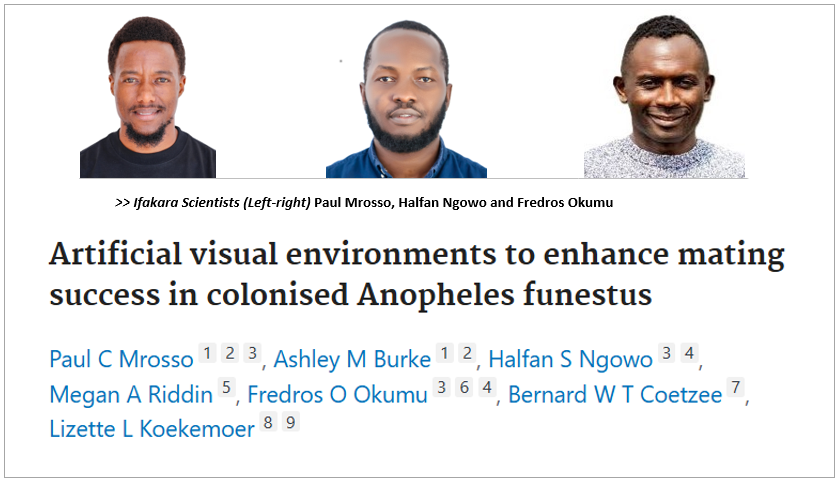
Led by African researchers, the study involved scientists from the Ifakara Health Institute — Paul Mrosso, Halfan Ngowo, and Fredros Okumu — in collaboration with colleagues from the University of the Witwatersrand and the University of Pretoria in South Africa.
A long-standing challenge in malaria research
Researchers have struggled for years to maintain stable laboratory colonies of Anopheles funestus. One key challenge is that the mosquitoes often fail to mate when kept in captivity, limiting the supply needed for experiments.
Without reliable colonies, it becomes harder to study the species, test new insecticides, or better understand how it spreads malaria.
Testing a simple idea: changing what mosquitoes see
In the study, scientists experimented with the visual environment inside mosquito cages. They added black cloth coverings and placed visual markers in different positions to alter what the insects could see.
Overall, these changes increased mating success. However, the effect was not uniform.
Results varied depending on mosquito strain: some populations showed a strong increase in mating success, while others responded weakly or even negatively depending on the cage setup. This suggests that different mosquito populations react differently to the same visual cues.
Why this matters for malaria control
The findings could offer a simple, low-cost way to improve the breeding of this difficult species in the laboratory, helping researchers maintain stable colonies for studies on malaria transmission and control tools.
However, the study also highlights an important limitation: there is no single setup that works for all populations. Laboratory conditions may need to be tailored depending on the origin of the mosquito strain.
A small change with big potential
While not yet a universal solution, the study shows that a simple adjustment — changing lighting and visual cues inside cages — can have a meaningful impact on mosquito behaviour.
Researchers say further work is needed to refine these methods, but the findings represent a promising step toward solving one of the most persistent challenges in mosquito research.
Read the publication, here.