

INNOVATION: AI-powered drones help map hidden mosquito breeding sites in Dar es Salaam
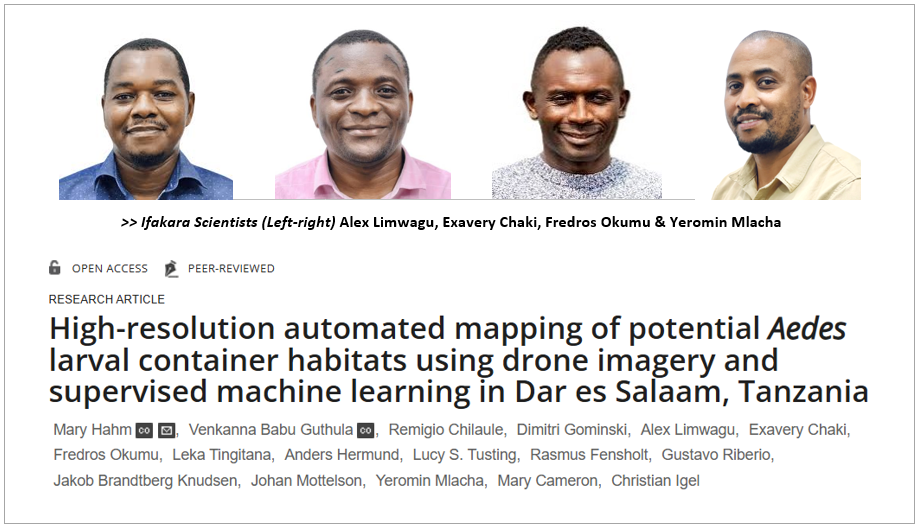
Researchers in Tanzania and Europe have used drones and artificial intelligence to identify thousands of potential mosquito breeding sites across Dar es Salaam, in a development they say could strengthen the fight against dengue and other mosquito-borne diseases.
The study, published in PLOS Neglected Tropical Diseases, combined high-resolution drone imagery with machine learning to detect water-holding containers where Aedes mosquitoes breed. These mosquitoes transmit diseases including dengue, Zika, chikungunya and yellow fever.
Scientists from the UK and Denmark worked with researchers from the Ifakara Health Institute, including Alex Limwagu, Exavery Chaki, Fredros Okumu and Yeromin Mlacha.
Why these findings matter
The study highlights a shift in how urban mosquito control could be done in the future. Instead of relying mainly on slow, ground-based inspections, public health teams could use AI-driven maps to guide rapid and targeted action.
This is especially important in cities like Dar es Salaam, where informal settlements are hard to access and mosquito breeding sites are widely dispersed and often hidden.
If scaled, the approach could help countries respond faster to outbreaks, reduce transmission risk, and make better use of limited public health resources.
Filling a gap in mosquito surveillance
Controlling mosquito larvae by identifying and destroying breeding sites is a key public health strategy. But in practice, experts say it is difficult and time-consuming, especially in large cities with dense informal settlements.
Dar es Salaam, Tanzania’s commercial capital, has experienced repeated dengue outbreaks in recent years. Evidence also suggests ongoing transmission of chikungunya and yellow fever, though the true scale is thought to be underreported due to limited analysis.
This study covered 20 sub-wards representing different urban and housing settings across the city.
Training AI to spot breeding sites
The team captured ultra-high-resolution drone images across 20 neighborhoods in September 2023, covering more than 27 square kilometres.
They then trained an artificial intelligence model to identify common containers used by Aedes mosquitoes to breed. These included buckets and jerry cans, discarded tires and water storage tanks.
More than 135,000 potential sites identified
The AI model detected more than 135,000 potential breeding habitats across the study area. It correctly identified approximately 75% of water tanks, 72% of tires and 54% of buckets and jerry cans.
The images also revealed some unexpected findings, including discarded tires stored on rooftops — potential breeding sites that are difficult to reach during routine ground inspections.
A tool for targeted control
The researchers say AI and drone mapping could make mosquito control faster, more targeted and cost-effective, particularly in fast-growing cities.
According to researchers, the new approach could help close a major surveillance gap, urban environments characterized by informal settlements with limited accessibility, strengthening efforts to control dengue and other Aedes-borne diseases.
Read the publication here.
We're a Registered Charity Organization in Tanzania
Ifakara Health Institute (IHI) is officially recognized as a charitable organization under the Income Tax Act. Certification issued on 20 March 2025 and valid until 31 December 2030.
Ifakara Health Institute (IHI) is officially recognized as a charitable organization under the Income Tax Act. Certification issued on 20 March 2025 and valid until 31 December 2030.