

MALARIA CONTROL: Targeting the right mosquito could make prevention cheaper and more effective
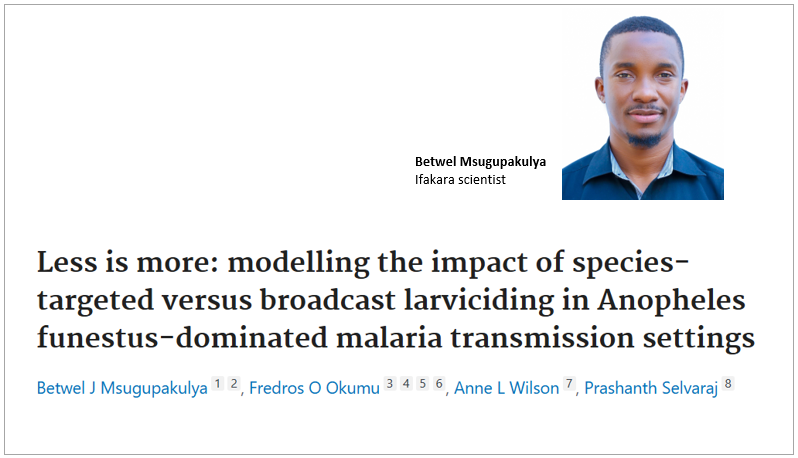
Focusing malaria control efforts on the mosquito species responsible for most transmission could reduce malaria cases while cutting the cost of control programmes, a new modelling study from Tanzania suggests.
Malaria is spread by different mosquito species, but their contribution to disease transmission is not equal. In southeastern Tanzania, Anopheles funestus is the dominant malaria vector, responsible for most transmission, while Anopheles arabiensis plays a much smaller role.
Researchers from Tanzania, the United States and the United Kingdom found that targeting the breeding habitats of Anopheles funestus alone could achieve much of the impact of broader larviciding campaigns, while reducing operational costs by an estimated 30–50%.
Why this matter
Despite major progress in malaria control over the past two decades, the disease remains a major public health challenge in Tanzania. Increasing insecticide resistance among mosquitoes is making it highly important to find more efficient ways to protect communities.
The study shows that malaria programmes could improve the efficiency of larviciding by focusing on the mosquito species driving most transmission in a specific area. This targeted approach could help maximize impact while complementing existing interventions such as insecticide-treated bed nets.
Moving from blanket control to targeted action
Larviciding involves applying biological agents to mosquito breeding sites to prevent mosquito larvae from developing into adults. Traditionally, many programmes use broadcast larviciding, where all identified breeding habitats are treated regardless of the mosquito species using them.
However, treating every breeding site across large areas can be costly and labour-intensive.
Modelling a more efficient malaria control approach
To explore whether a more targeted approach could work, researchers used an advanced computer model to simulate malaria transmission in southeastern Tanzania. They compared three strategies: targeting Anopheles funestus breeding sites, targeting Anopheles arabiensis breeding sites, and treating habitats used by both species.
The findings, published in the Malaria Journal recently, showed that targeting Anopheles funestus alone substantially reduced malaria transmission and childhood malaria cases. In contrast, targeting Anopheles arabiensis had limited impact, reflecting its smaller contribution to malaria transmission in the study area.
“When several mosquito species contribute to malaria transmission, focusing larviciding efforts on the species responsible for most transmission can achieve greater impact at a lower cost than treating all mosquito populations equally,” the authors noted.
A smarter way to use limited resources
The researchers also found that species-targeted larviciding remained beneficial even in communities with high coverage of insecticide-treated bed nets. Adding targeted larviciding against Anopheles funestus provided further reductions in malaria transmission.
The findings highlight the importance of understanding local mosquito populations before designing malaria control strategies. Since mosquito species vary between regions, identifying which species contributes most to transmission could allow programmes to direct resources where they will have the greatest impact.
The researchers conclude that in settings such as southeastern Tanzania, where Anopheles funestus is the main malaria vector, species-targeted larviciding could provide a practical, scalable and cost-effective addition to existing malaria interventions.
Ifakara, partners led the study
The study was co-led by Ifakara Health Institute scientist Betwel Msugupakulya and Prashanth Selvaraj from the Gates Foundation, with contributions from Fredros Okumu of Ifakara Health Institute and Anne Wilson from the Liverpool School of Tropical Medicine.
Read the publication here.
We're a Registered Charity Organization in Tanzania
Ifakara Health Institute (IHI) is officially recognized as a charitable organization under the Income Tax Act. Certification issued on 20 March 2025 and valid until 31 December 2030.
Ifakara Health Institute (IHI) is officially recognized as a charitable organization under the Income Tax Act. Certification issued on 20 March 2025 and valid until 31 December 2030.