

REFUGEE HEALTH: Evidence reveals barriers delaying surgical care for refugees in Tanzania
Access to safe and timely surgical care remains a major challenge for people living in refugee camps. A new study has identified the main barriers that prevent refugees from receiving the surgical care they need, providing important evidence to help improve healthcare in humanitarian settings.
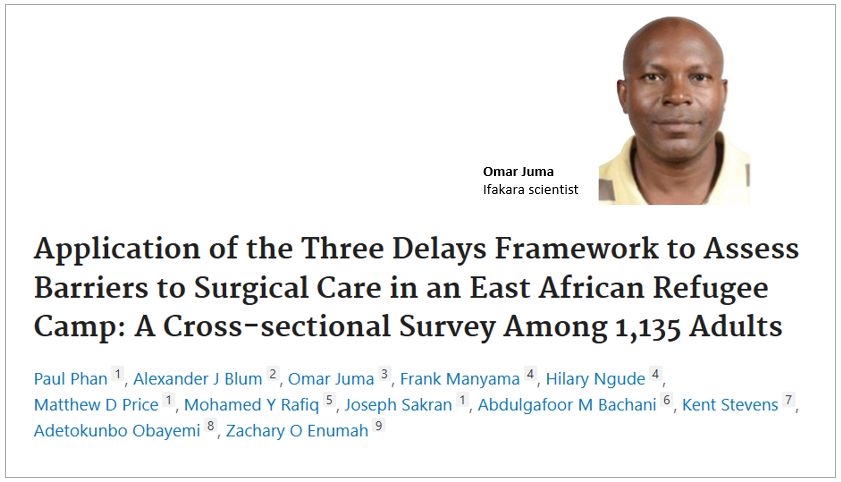
Published in the Journal of Surgical Research, the study – conducted by researchers from the USA, Tanzania, and China – assessed 1,135 refugees living in Tanzania’s Nyarugusu Refugee Camp and identified 2,463 conditions that could potentially be corrected through surgery. Among the participants, 689 (60.1%) experienced delays in accessing surgical care for at least one condition, with delays in seeking care being the most common barrier (42.2%).
The research applied the Three Delays Framework—a widely used model for understanding barriers to healthcare—to identify where delays occur along the journey to receiving surgical treatment. The framework examines three key points where delays may happen: delays in seeking care (Delay 1), delays in reaching a healthcare facility (Delay 2), and delays in receiving appropriate care after arriving at a facility (Delay 3).
Identifying where delays happen
The researchers found that obstacles to surgical care occur at multiple stages. Many refugees delayed seeking medical attention because they did not recognize the seriousness of their condition, feared treatment, or faced financial challenges.
Others struggled to reach healthcare facilities due to transportation and logistical barriers. Even after arriving at a health facility, some experienced further delays before receiving appropriate surgical care because of limited healthcare resources and surgical capacity.
Why the findings matter
Globally, access to surgical care is increasingly recognized as an essential component of universal health coverage. However, displaced populations remain among the most underserved when it comes to receiving timely and safe surgical treatment.
This study demonstrates that improving surgical care in refugee settings requires a comprehensive approach that addresses barriers throughout the entire patient journey rather than focusing only on hospitals.
The evidence generated by this research can inform policies and programmes aimed at ensuring refugees receive timely and high-quality surgical care, ultimately reducing preventable illness and saving lives.
A need to strengthen humanitarian healthcare
People living in refugee camps often face difficult living conditions and limited access to specialist healthcare services. By identifying the challenges refugees face at each stage of accessing care, the study provides valuable evidence that can help humanitarian agencies, governments and healthcare providers design more effective interventions.
The researchers recommend interventions that address delays across the entire care pathway to improve surgical outcomes for refugees. Effective solutions include strengthening patient awareness of surgically treatable conditions and increasing health services accessibility in humanitarian settings. Together, these measures could significantly reduce delays and ensure refugees receive the treatment they need.
Ifakara's Omar Lweno contributes to the study
The study included contributions from Omar Juma of Ifakara Health Institute, working alongside collaborators from Johns Hopkins School of Medicine, the Tanzania Red Cross Society and other international partners.
Read the publication here.
We're a Registered Charity Organization in Tanzania
Ifakara Health Institute (IHI) is officially recognized as a charitable organization under the Income Tax Act. Certification issued on 20 March 2025 and valid until 31 December 2030.
Ifakara Health Institute (IHI) is officially recognized as a charitable organization under the Income Tax Act. Certification issued on 20 March 2025 and valid until 31 December 2030.