
CHILD EDUCATION: Study finds many children in Zanzibar start school unprepared
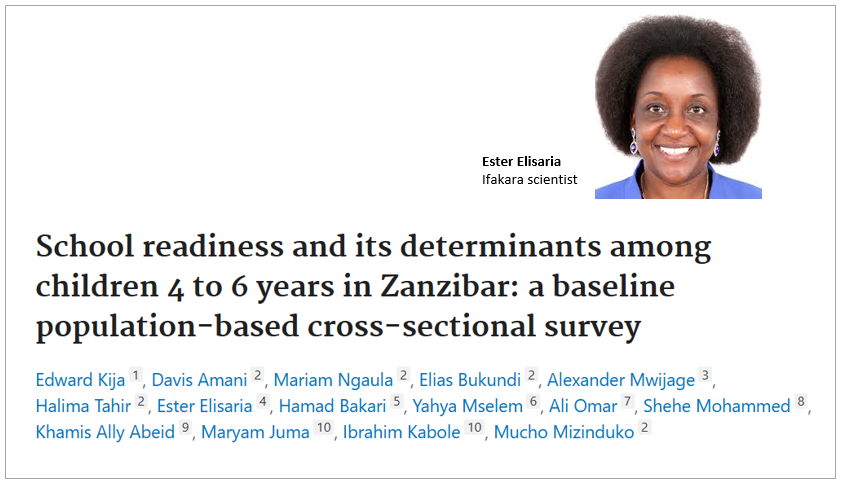
Nearly one in four children aged four to six in Zanzibar are not adequately prepared to begin primary school, according to a new study involving Tanzanian researchers. The findings highlight important gaps in early childhood development (ECD) and underscore the need for targeted interventions to give every child the best possible start in life.
Published this month in Frontiers in Public Health, the study assessed school readiness among preschool-aged children in Zanzibar and examined factors affecting their transition into formal education. Led by scientists from Muhimbili University of Health and Allied Sciences (MUHAS), the research included contributions from Ifakara Health Institute seasoned researcher, Dr. Ester Elisaria.
Why school readiness matters
School readiness refers to a child's ability to successfully engage in learning when they begin primary school. It includes essential skills such as early literacy and numeracy, motor development, communication, social-emotional skills and the ability to interact with others.
Children who begin school with these foundational skills are more likely to perform well academically, remain in school, and experience better health and economic outcomes later in life.
The study highlights the need to invest in quality ECD programmes so that every child has an equal opportunity to learn, thrive and reach their full potential.
First assessment of school readiness in Zanzibar
Between September and October 2024, researchers surveyed 362 children aged four to six years and their caregivers across Unguja and Pemba islands.
Children's school readiness was assessed using the International Development and Early Learning Assessment (IDELA), an internationally recognized tool that measures four developmental domains: emergent literacy, emergent numeracy, motor development and social-emotional development.
The study provides Zanzibar's first population-based baseline on school readiness, offering important insights to inform policies and programmes aimed at strengthening ECD.
Literacy and social-emotional skills lag behind
Overall, the study found that 23% of children lacked the level of school readiness expected for their age, increasing the likelihood that they will begin primary school without the foundational skills needed for successful learning.
The greatest challenges were observed in emergent literacy, where nearly 40% of children struggled, and social-emotional development, where about 37% faced difficulties. These skills are essential for learning to read, communicating effectively, building relationships with peers, and adapting to the classroom environment.
While children performed better in some areas, including motor development and early numeracy skills, the findings indicate that many children still require additional support before beginning formal schooling.
Rural children and vulnerable households most affected
The study found that children’s school readiness was strongly influenced by their living environment and household circumstances.
Children living in rural communities were less likely to be ready for school than those in urban areas. Likewise, children from socioeconomically vulnerable households faced greater challenges in developing the skills needed for school entry.
According to the researchers, these findings show that inequalities begin well before children enter the classroom, placing some at a disadvantage from the very start of their education.
A call for stronger early childhood programmes
The researchers conclude that the findings provide strong, context-specific evidence for strengthening ECD strategies in Zanzibar.
They note that a considerable proportion of preschool children enter formal schooling without adequate readiness, particularly in literacy and social-emotional development, with disparities linked to age, place of residence, and household vulnerability.
To address these gaps, they recommend prioritizing younger children, those living in rural communities, and children from vulnerable households through integrated, community-based early learning and nurturing care interventions. They also call for these services to be embedded within existing health, education, and social protection systems to ensure children receive comprehensive support before entering primary school.
Such investments, the researchers say, will be critical for helping Zanzibar achieve universal access to quality early childhood development and pre-primary education by 2030.
Read the publication here.
We're a Registered Charity Organization in Tanzania
Ifakara Health Institute (IHI) is officially recognized as a charitable organization under the Income Tax Act. Certification issued on 20 March 2025 and valid until 31 December 2030.
Ifakara Health Institute (IHI) is officially recognized as a charitable organization under the Income Tax Act. Certification issued on 20 March 2025 and valid until 31 December 2030.