

MALARIA CONTROL: Insecticide-treated window screens show promise in keeping mosquitoes out
Many homes in malaria-endemic areas have structural gaps, particularly around windows and roof eaves, that allow mosquitoes to enter, increasing the risk of indoor bites.
A new study by Tanzanian and international researchers suggests that simple house modifications using insecticide-treated screens (ITS) could help block mosquito entry, kill malaria vectors and potentially reduce malaria transmission.
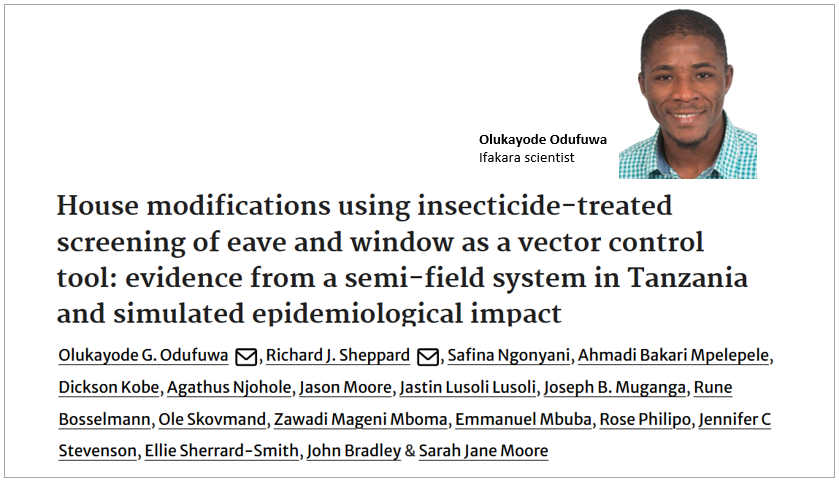
Published in BMC Public Health recently, the study evaluated insecticide-treated screens fitted to windows and roof eaves—the openings between walls and roofs that mosquitoes commonly use to enter houses. The researchers assessed whether the screens could act as both a physical barrier and a mosquito-killing tool, and compared their performance with insecticide-treated bed nets.
The study was co-led by Olukayode Odufuwa of the Ifakara Health Institute and Richard Sheppard fromImperial College, London, in collaboration with researchers from Ifakara, the Swiss Tropical and Public Health Institute, the London School of Hygiene & Tropical Medicine, Durham University, Moon Netting Ltd and other partner institutions.
Blocking mosquitoes before they enter homes
Malaria mosquitoes typically enter houses at night when people are resting or sleeping. While treated bed nets provide protection during sleep, they do not cover the hours before bedtime or when people are exposed outside the net.
Using a semi-field system in Bagamoyo, Tanzania, the researchers evaluated experimental houses fitted with screens treated with deltamethrin and piperonyl butoxide (PBO), a combination designed to improve mosquito control, particularly against insecticide-resistant mosquitoes.
They measured how many mosquitoes entered the houses, how many died after contacting the treated screens, and how many fed on human volunteers. The results were then compared with houses protected by permethrin-PBO treated bed nets.
Treated screens outperformed aged bed nets
The study found that insecticide-treated screens significantly reduced mosquito entry compared with unscreened houses.
The screens also:
- Killed more mosquitoes after contact with the treated surfaces.
- Reduced the number of mosquitoes that fed on people.
- Provided protection throughout the evening and night, including hours before people went to bed.
In both laboratory and semi-field experiments, newly installed treated screens also outperformed aged PBO-treated bed nets, highlighting their potential as an additional malaria control tool.
Models predict reduced malaria transmission
Beyond measuring mosquito behaviour, the researchers used mathematical models to estimate the public health impact of widespread use of insecticide-treated screens.
The modelling suggested that, with high household coverage and proper maintenance, the intervention could substantially reduce malaria transmission by preventing mosquitoes from entering homes and increasing mosquito mortality.
Why these findings matter
These findings are particularly important as malaria programmes face increasing challenges from insecticide resistance and changes in mosquito behaviour, both of which threaten the effectiveness of existing interventions.
The researchers say insecticide-treated screening could complement current malaria control tools by providing continuous household protection, including during periods when people are not under bed nets.
Because the intervention protects the house rather than individual users, it also has the potential to benefit all household members, including those who do not consistently sleep under a net.
A promising addition to malaria control
While the results are encouraging, the researchers say further studies are needed to assess the long-term durability, affordability and community acceptance of insecticide-treated screens under real-world conditions.
The study concludes that insecticide-treated screening is a simple but effective vector control intervention that can kill substantial numbers of malaria and dengue mosquitoes while reducing nuisance biting. The researchers recommend considering it as an additional—or, in poorly screened homes, even a stand-alone—tool for protecting households against mosquito-borne diseases.
Read the publication here.
We're a Registered Charity Organization in Tanzania
Ifakara Health Institute (IHI) is officially recognized as a charitable organization under the Income Tax Act. Certification issued on 20 March 2025 and valid until 31 December 2030.
Ifakara Health Institute (IHI) is officially recognized as a charitable organization under the Income Tax Act. Certification issued on 20 March 2025 and valid until 31 December 2030.