

MALARIA: Stronger, long-lasting mosquito nets show new promise
Fresh evidence from a large durability study in India is prompting health programs to rethink how long-lasting mosquito nets are selected and deployed—showing that certain insecticide-treated nets (ITNs) maintain protection far longer than expected, even in areas with growing insecticide resistance.
The study, conducted in Andhra Pradesh, followed more than 7,500 ITNs for three years and found that Veeralin®, a dual active-ingredient net containing pyrethroid and piperonyl butoxide (PBO), far outperformed other commonly used nets in durability and insecticidal effectiveness.
Published in Parasites & Vectors earlier this year, the findings come at a critical time, as malaria-endemic countries continue to grapple with rising resistance to pyrethroid-only nets.
Why it matters
Across malaria-endemic regions, ITNs remain one of the most effective tools for preventing mosquito bites and reducing infection. But their impact depends heavily on how long nets remain physically intact and insecticidally potent—especially in areas with resistant mosquito populations.
Many countries, including Tanzania, still rely on ITNs as the frontline defense. With donor funding tightening and malaria burden shifting, selecting nets that stay effective for longer can save both lives and resources.
This study’s findings offer governments and malaria partners new evidence to guide procurement choices—particularly in communities where resistance threatens the efficacy of traditional nets.
Years of protection, not just months
The study assessed three net types—Veeralin® (pyrethroid + PBO), Olyset® Plus (pyrethroid + PBO), and MAGNet® (pyrethroid-only)—tracking their physical condition, attrition, community acceptance, and bioefficacy over 36 months.
Using WHO durability protocols, researchers found:
- Veeralin® median functional survival: 8 years
- MAGNet® median functional survival: 5.7 years
- Olyset® Plus median functional survival: 2.5 years
This means Veeralin® nets stayed serviceable and effective far beyond the WHO’s 3-year benchmark for long-lasting insecticidal nets (LLINs).
Importantly, Veeralin® also maintained over 80% mosquito mortality—an indicator of optimal insecticidal performance—for up to 30 months, even against resistant mosquito strains.
Stronger protection against resistant mosquitoes
Mosquito resistance to pyrethroids is a growing threat across Africa and Asia. The addition of PBO helps counter this by disabling resistance mechanisms.
Researchers found:
- Veeralin® remained highly effective against both susceptible and resistant mosquito strains across the study period.
- Olyset® Plus showed declining efficacy after the first year.
- MAGNet® (pyrethroid-only) showed a steep decline in mosquito-killing ability within 18 months.
This suggests that not all PBO nets perform equally—and selecting the right product is crucial for sustained malaria protection.
Gaps and opportunities
While Veeralin® displayed the strongest durability, researchers noted contextual factors—such as climate, household behaviors, and socio-economic conditions—also influence how long nets last.
The study reinforces the need for:
- Continued monitoring of net durability in real-world settings
- Data-driven procurement of ITNs based on local resistance patterns
- Investment in products that reduce long-term replacement costs
With rising concerns about resistance and limited donor resources, choosing more durable nets offers both cost savings and improved community protection.
A boost for malaria elimination efforts
As global malaria programs refine their strategies, these findings provide timely support for countries working toward elimination targets. Long-lasting, high-efficacy nets can significantly bolster efforts—especially in regions facing resistance.
According to the researchers, durability data like this help policymakers make smarter decisions about resource allocation, net distribution cycles, and long-term malaria control strategies.
Ifakara contributes to the study
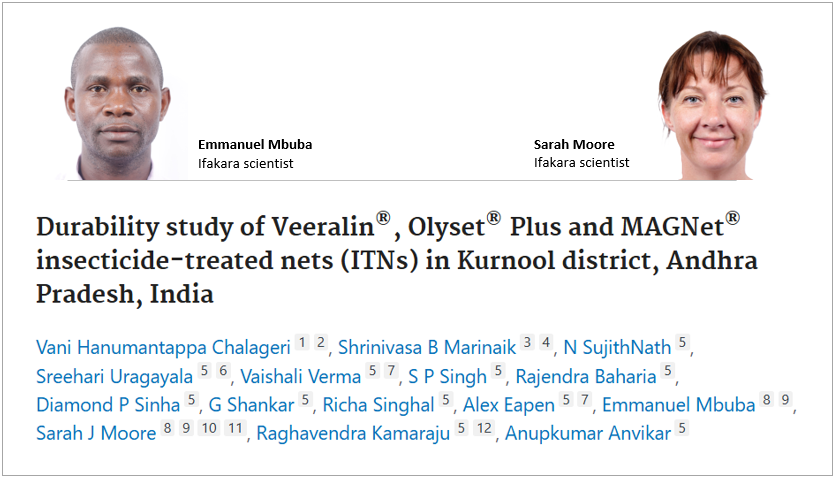
The Ifakara Health Institute played a key role in the study. Researchers, Emmanuel Mbuba and Sarah Moore from Ifakara’s Vector Control Product Testing Unit in Bagamoyo—contributed expertise in net testing and study design.
The study was led by Vani Hanumantappa Chalageri and colleagues from the Indian Council of Medical Research–National Institute of Malaria Research (ICMR-NIMR), with additional collaborators from Columbia University, Johns Hopkins University, and other international partners.
Read the publication, here.