

MALARIA: How Tanga communities are stopping mosquito breeding
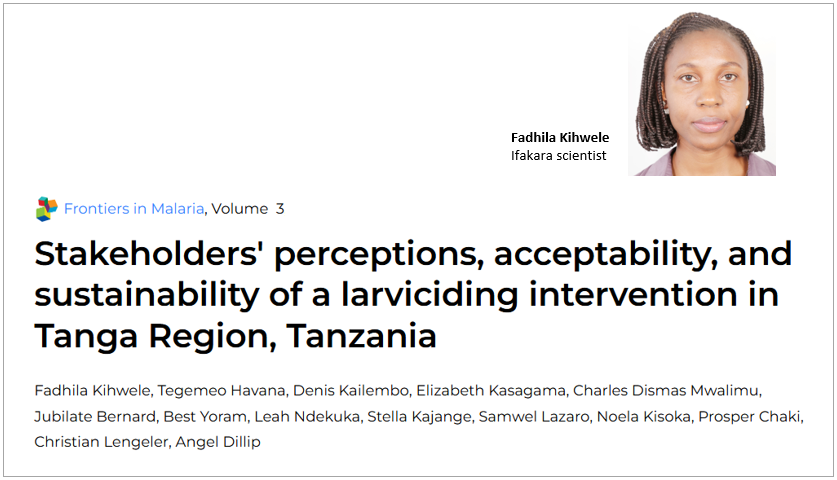
Communities across Tanzania’s Tanga Region have welcomed larviciding, a mosquito control method that targets mosquitoes at their earliest stage of life (breeding sites), as a promising approach to malaria prevention. Moving beyond traditional bed nets and indoor spraying, this strategy is gaining traction among both residents and local authorities.
Targeting mosquitoes at their source
A new study published on Frontiers in Malaria recently highlights this approach through the voices of community members, local leaders, and health officials involved in a large-scale larviciding intervention implemented between 2022 and 2024.
The intervention was widely accepted and seen as a promising malaria control approach by both communities and authorities in Tanga, covering than one million people in urban and peri-urban areas.
Why this study matters
Larviciding is recommended by the World Health Organization as a supplementary malaria control tool, particularly in settings where breeding sites are few and identifiable. This study adds to growing evidence that, when well implemented, larviciding can gain strong community and institutional support.
Ifakara young scientist led the study
Leading the research is Fadhila Kihwele, a young scientist from the Ifakara Health Institute, whose work highlights the importance of community’s experiences in shaping effective malaria control strategies. She worked alongside fellow Ifakara researchers Tegemeo Gavana and Prosper Chaki, in close collaboration with partners from the Swiss Tropical and Public Health Institute (Swiss TPH), the National Malaria Control Programme (NMCP), the President’s Office – Regional Administration and Local Government (PO-RALG), and the Apotheker Health Access Initiative (AHI).
Listening to those on the ground
Rather than focusing only on disease outcomes, Fadhila and her team explored how communities, implementers, and decision-makers perceived the intervention. They conducted in-depth interviews with government officials and held focus group discussions with community members, including community resource persons who were directly involved in implementing the intervention.
The study assessed whether larviciding was:
- Acceptable to communities
- Feasible to implement
- Likely to be sustained over time
Strong support from communities and leaders
Overall, the findings revealed strong support. Many participants described the larviciding program as safe, effective, and beneficial, reporting fewer mosquitoes, improved comfort in their homes, and confidence that the larviciding products were safe. Community members also appreciated that the approach tackled mosquito breeding sites directly, complementing existing tools such as bed nets, especially in areas where mosquitoes bite outdoors.
Local leaders and health officials also echoed these views, describing larviciding as a valuable addition to existing malaria control strategies.
Challenges to long-term sustainability
Despite broad support, the study identified challenges that could affect long-term success of larviciding in Tanzania. These included:
- Unpleasant odor from the larvicide product
- High turnover of community workers, requiring repeated training
- Logistical and supply chain constraints
- Interruptions in implementation, which affected consistency
The researchers emphasize that addressing these challenges will be essential for sustaining and scaling up larviciding programs.
“Understanding what works—and what doesn’t—from the perspective of those involved is crucial if we want these interventions to last,” the authors note. “Successful implementation in sub-Saharan Africa must consider these challenges, and those reported in other studies in the region.”
The authors conclude that continued investment in community engagement, reliable supply chains, and strong local leadership will be key to ensuring larviciding remains effective and sustainable.
Read the publication, here.